•
•
•
•
•
•
•
•
•
•
•
•
•
•
•
•
•
•
•
•
•
•
•
•
•
•
•
•
•
•
•
•
•


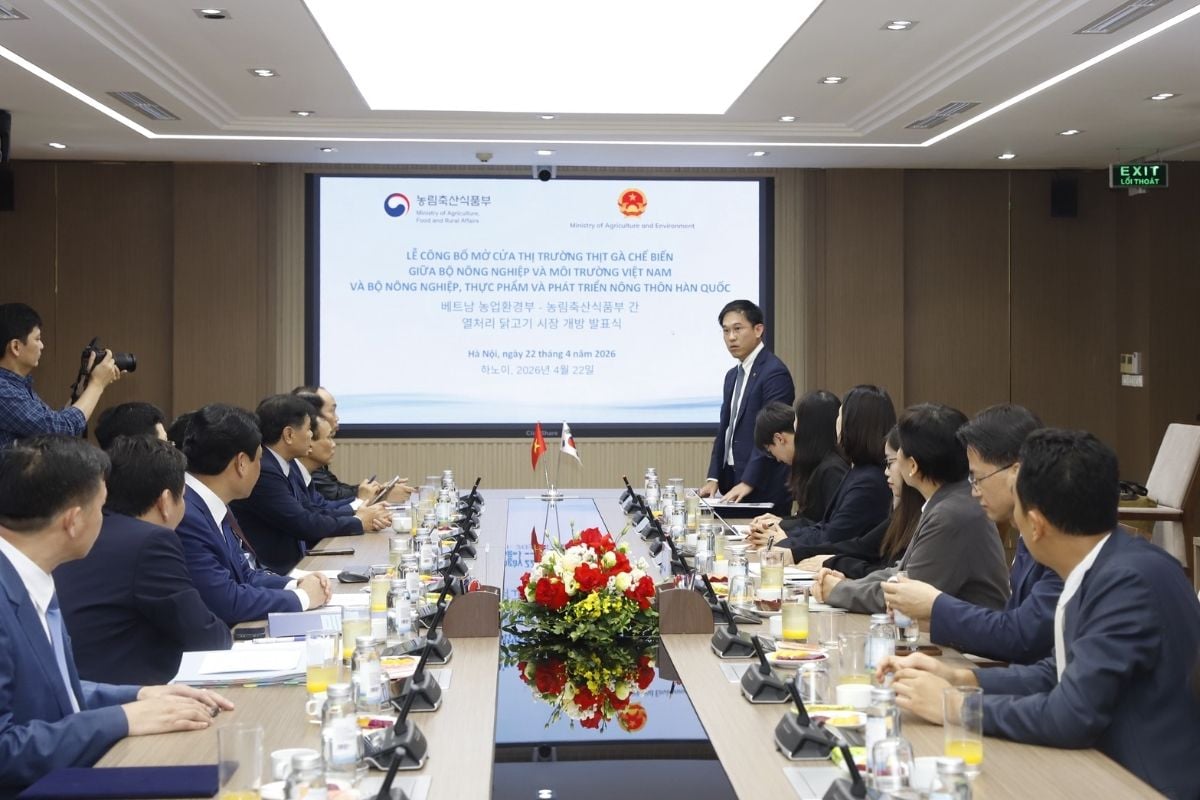
Vietnam and South Korea have concluded negotiations to open the market for processed chicken, setting the stage for Vietnamese exporters to access a destination with stringent veterinary controls, food-safety standards, and origin-traceability requirements.
Under the initial phase of the agreement, each country will allow two companies to export processed chicken to the other market.
On April 21, during a visit to Vietnam by Korean President Lee Jae Myung, his wife Kim Hae Kyung and a high-level delegation, the two countries signed a Memorandum of Understanding on cooperation in veterinary and animal-quarantine matters at the headquarters of Vietnam’s Ministry of Agriculture and Environment in Hanoi.
On April 22, Vietnam’s Ministry of Agriculture and Environment coordinated with South Korea’s Ministry of Agriculture, Food and Rural Development to hold a ceremony announcing the opening of the processed chicken market between the two countries in Hanoi.
Vietnam’s ministry said the completion of negotiations is both commercially significant and demonstrates the ability of the two regulators to meet technical requirements for animal-origin products.
South Korea is described as a market with high requirements for animal-quarantine, food safety, and origin-traceability. The outcome is expected to create additional opportunities for Vietnam’s poultry and processing industry, particularly for firms that have invested in deep processing and supply-chain control.
At the event, Minister of Agriculture and Environment Trinh Viet Hung said that in the initial phase each country will have two companies allowed to export processed chicken, with the arrangement intended as a starting point to scale up as more enterprises meet technical requirements.
From South Korea, Minister of Agriculture, Food and Rural Affairs Song Miryung said the result reflects ongoing professional cooperation and lengthy negotiations between the authorities. The two sides will continue technical exchanges in animal-quarantine, with the aim of opening the market for other products.
From a business perspective, CP Vietnam CEO Pawalit Ua-Amornwanit said that securing access to export processed chicken to Korea is a milestone for Vietnam’s poultry and processing industry. He noted that it reflects the industry’s international integration and highlights the production, processing, and standard-compliance capabilities of Vietnamese enterprises that have improved.
CP Vietnam representatives said the company received support from Vietnam’s Ministry of Agriculture and Environment, the Department of Livestock and Veterinary, and other professional agencies in finalizing dossiers and meeting quarantine, food-safety, and technical requirements.
CPV Vietnam said it strengthens capacity through an integrated production chain. The company operates the CPV Food Bình Phước complex, with total investment of about USD 250 million, developed under the Feed–Farm–Food integration model. The complex includes a feed mill, hatchery, farm network, slaughterhouse, and processing plant.
The integrated model is intended to help the company control the process from input to output, improve traceability and disease control, and ensure food-safety standards—supporting processed chicken access to import markets with stringent requirements.
CPV Bình Phước currently supplies processed chicken to markets including Japan, Hong Kong, Singapore, Russia, and Mongolia. The company said its exporting experience helps it improve production and processing and adapt to increasingly strict import requirements.
CPV Vietnam said the completion of negotiations to export processed chicken to Korea will widen its markets and provide momentum for the poultry sector to shift toward deep processing, stronger quality control, and higher export value.
In the long term, access to additional high-demand markets such as Korea is presented as a foundation for Vietnamese poultry products to participate more deeply in the global food-supply chain.

Premium gym chains are entering a “golden era” that is ending or already in decline, as rising operating costs collide with shifting consumer preferences toward more flexible, community-based ways to exercise. Long-term memberships are shrinking, margins are pressured by higher rents and facility expenses, and competition from smaller, more personalized…



