•
•
•
•
•
•
•
•
•
•
•
•
•
•
•
•
•
•
•
•
•
•
•
•
•
•
•
•
•
•
•
•
•


Architecture increasingly focuses on safety and comfort, but urban life has also distanced people from green environments. In response, designers are tasked with creating living spaces that support health and mental well-being.
Open spaces with good natural ventilation and design that aligns with local climate can contribute to the healing process. Approaches such as minimalist décor, natural materials and textures, and reducing visual clutter are paired with long windows that bring in natural light, helping create a sense of spaciousness and a more positive mood.
In Vietnam, current design trends are testing concepts that respect cultural values and local identities. Alongside the use of local materials and flexible adaptation to climate change, greenery around buildings and “paths” that bring nature into daily life are presented as decisive elements in building a “healing” home.
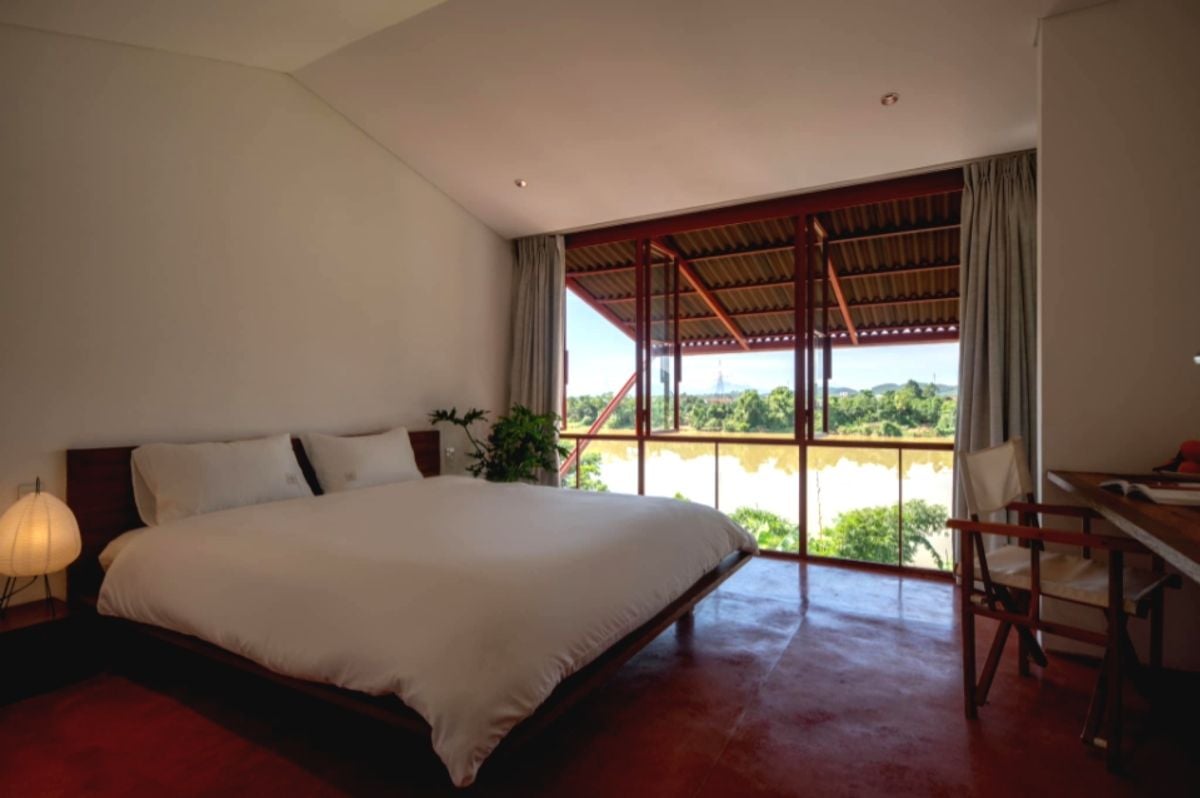
Set against a calm green backdrop on the outskirts of Hue undergoing urbanization, Scarlet Pavilion stands out with a red metal roof and steel structures. The design turns away from noisy urban traffic and opens toward the Huong River.
Designed as a second home for a young couple, the site supports weekend retreats with small-scale lodging. The plot measures 7m × 35m and is used to shape a design approach that is closed toward the city while fully open to nature. Rather than creating hard boundaries, the pavilion is organized as a sequence of transitional spaces that guide users from busier conditions into quieter intervals.
Passive climate strategy forms the foundation of the project, using deep eaves, flexible openings, cross ventilation, and shaded buffer zones to help the building respond to Hue’s hot summers and frequent long rains. Layers of greenery and climbing plants soften the building’s massing, increase privacy, and maintain an ongoing dialogue between architecture and nature.
Red is used as an intentional identity marker. Key materials include corrugated metal roofing, polished concrete floors, steel frames designed for natural oxidation, and wooden shading. The materials are selected not for perfection, but for natural aging over time, which the project notes as reducing maintenance costs while enhancing sustainable aesthetic value.
The pavilion includes five guest rooms, designed to offer varied experiences of light, openness, and integration with the landscape. Along the river axis, movement is guided from private spaces through wooden verandas to the pool and then to the water’s edge. This spatial sequence is described as creating a microclimate influenced by sun, wind, shade, and a plant ecological layer.
Kitchen, dining, and the living room are located on the ground floor and open fully to the river using floor-to-ceiling glass sliding doors. A wooden veranda runs the full width of the building, connecting inside and outside in a continuous flow toward the pool and water surface. Despite a compact footprint, the restrained design and open-plan layout are intended to create openness and calm.
The project concludes that Scarlet Pavilion is not meant to be “shown” through form alone, but experienced through light, air, and the flow of time—creating a quiet space for deeper connection with nature and with oneself amid urbanization.
In Da Nang’s busy environment, Boi Bong House is presented as a muted counterpoint where the boundary between work and life is softened to make room for tranquility. With an area of 80m2, TRAN TRUNG Architects describe the project as a symbiotic ecosystem for everyday living.
The house is located at the end of a narrow alley, deliberately set apart from the city’s pace. Inside, living spaces unfold gently, engaging multiple senses—sound, light, cool breeze, delicate aromas, and tactile experiences—while harmonizing with the surrounding landscape.
Two blocks of the house are connected by a central garden, turning daily life into a “quiet symphony” shaped by the rhythm of life intertwined with work. At the center, the roof directs rainwater via steel cables into a collection system used to irrigate and maintain the fishpond below.
The water surface is described as a natural central cooling device. Under intense sun, evaporation is said to create convection that draws cooler air from the East and Northeast into the house, reducing interior temperatures during hot central Vietnam summers.
A distinctive feature is the wooden shell treated with the traditional Shou Sugi Ban technique. The project notes that this helps the building withstand time while also imparting a warm aroma.
Nature is described as more than a backdrop—present through the sound of flowing water, sunlight filtering through leaves, children playing, and the elderly finding peace in a small veggie garden.
The project is framed as a statement supporting sustainable architecture and balancing people, nature, and energy—aiming to bring healing while fostering environmental awareness for future generations.
Premium gym chains are entering a “golden era” that is ending or already in decline, as rising operating costs collide with shifting consumer preferences toward more flexible, community-based ways to exercise. Long-term memberships are shrinking, margins are pressured by higher rents and facility expenses, and competition from smaller, more personalized…