•
•
•
•
•
•
•
•
•
•
•
•
•
•
•
•
•
•
•
•
•
•
•
•
•
•
•
•
•
•
•
•
•


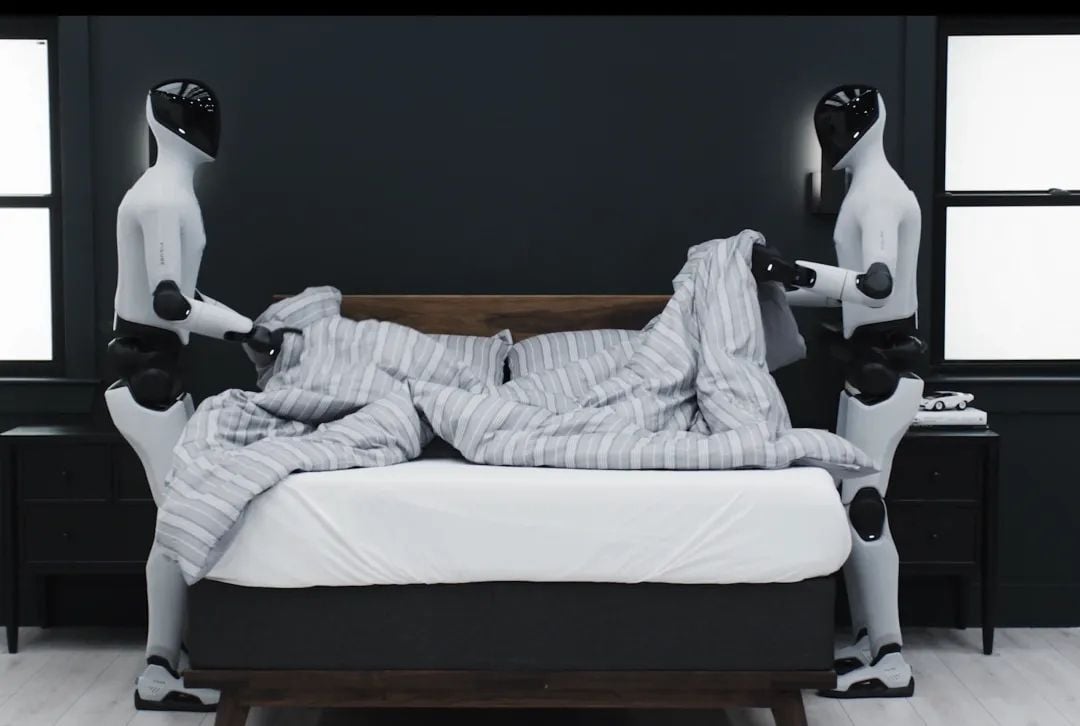
Figure AI unveiled a new demo on the evening of May 8, featuring two humanoid robots, Helix-02, collaborating to tidy a bedroom. The sequence included opening a door and hanging clothes, picking up trash, and—most complex—laying out sheets in coordinated motion in under two minutes.
Figure AI said the event marked the first time multiple robots operated in smooth, collaborative movement powered by a single neural network. Each robot runs its own model and continuously observes the partner’s motion to anticipate the next step. The company also highlighted the challenge of handling soft objects such as sheets, noting that shapes can change during manipulation; it said Helix-02 achieved the task using real-time visual perception and self-adjusting behavior.
Despite the performance, the demo prompted skepticism from some experts. One concern is that the system may depend on carefully staged initial conditions. Critics argue that, rather than understanding intent in open environments, the robots could be responding to pre-scripted scenarios learned through brief training sequences. This, they say, raises questions about how well the approach would adapt to more chaotic home settings.
Other commentary echoed similar doubts, suggesting the robots may be executing pre-programmed scripts instead of truly interpreting a partner’s movements in an open environment.
Alongside the robotics demo, Figure AI emphasized progress toward scaling manufacturing. The company said that at its BotQ plant in California, production speed rose 24-fold within 120 days, reaching a rate of one Figure 03 per hour.
Figure AI linked the manufacturing scale-up to two goals: addressing supply-demand and generating a large dataset from real-world operation. The company said this dataset would help optimize perception and durability for its Helix AI system.
In strategic terms, CEO Brett Adcock described the next generation—Figure 04—as the “iPhone moment,” citing expected breakthroughs in design, manufacturability, and cost optimization.
Figure AI also outlined a leasing plan for household robots, with monthly costs ranging from 400 to 600 USD. The company said the machines are compact, self-charging, and include user-friendly maintenance features. It also noted hot-swap capability and a “Vulcan anti-fall protocol” intended to support continuous operation or autonomous navigation to maintenance areas if hardware fails.
Figure AI said it has more than 500 top engineers and operates a closed-loop manufacturing setup, positioning the company to demonstrate that multi-robot collaboration is central to its future roadmap rather than a detour.
Premium gym chains are entering a “golden era” that is ending or already in decline, as rising operating costs collide with shifting consumer preferences toward more flexible, community-based ways to exercise. Long-term memberships are shrinking, margins are pressured by higher rents and facility expenses, and competition from smaller, more personalized…