•
•
•
•
•
•
•
•
•
•
•
•
•
•
•
•
•
•
•
•
•
•
•
•
•
•
•
•
•
•
•
•
•


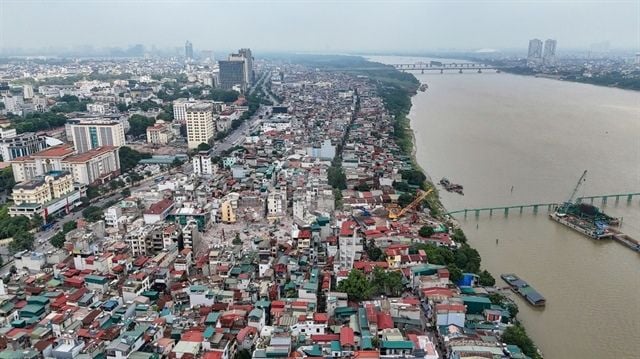
Hanoi’s People’s Council has approved the investment policy for the Red River scenic boulevard axis project, while reducing the project’s funding scale compared with the plan announced at the groundbreaking in December 2025. At the second meeting, 100% of attending delegates voted in favor of the investment policy for a set of major city projects, including the Red River boulevard axis.
According to the Hanoi People’s Committee’s report, the project will use over 11,400 hectares of land across 16 wards and communes along the Red River, including Hong Ha, O Diên, Thuong Cat, Dong Ngac, Phu Thuong, Linh Nam, Thanh Tri, Nam Phu, Hong Van, Me Linh, Thien Loc, Vinh Thanh, Dong Anh, Bo De, Long Bien, and Bat Trang.
The preliminary total investment is nearly VND 737 trillion, down by VND 118 trillion from the VND 855 trillion figure announced at the project groundbreaking in December 2025.
The project is structured into five groups comprising 18 component projects. These include two boulevards along the right bank (about 45.35 km) and left bank (about 35 km) of the Red River, and 11 parks covering more than 3,513 hectares. The package also includes quay works and riverbank stabilization on both banks in areas such as Xuan Quan – Phung Cong and Nhat Tan – Tu Lien.
Hanoi’s Vice Chairman Truong Viet Dung said Resolution 498/NQ-HDND, issued on December 14, 2025, sets out the preliminary approach as a basis for subsequent steps. He added that during the study process, the city updated orientations under Resolution 02-NQ/TW and the Hanoi Capital Plan with a 100-year horizon.
He further noted that the absence of an underground metro line reflects ongoing study to ensure alignment with the urban rail system development and feasibility for implementation along both sides of the river.
The project will be implemented in phases through 2038. Hanoi plans to carry out two phases from 2026 to 2038:
Compared with the late-2025 plan, the current total investment has been reduced by about VND 118 trillion. The scope has also been narrowed to exclude three wards (Vinh Tu, Vinh Hung, and Hoang Mai), and the underground metro portion of about 45 km has been omitted.
On the investor side, three investors remain in the joint venture: Dai Quang Minh Real Estate, THACO, and Hoa Phat Group. Previously, three investors—MIK Group, Van Phu, and TT Group—had withdrawn.
Premium gym chains are entering a “golden era” that is ending or already in decline, as rising operating costs collide with shifting consumer preferences toward more flexible, community-based ways to exercise. Long-term memberships are shrinking, margins are pressured by higher rents and facility expenses, and competition from smaller, more personalized…