•
•
•
•
•
•
•
•
•
•
•
•
•
•
•
•
•
•
•
•
•
•
•
•
•
•
•
•
•
•
•
•
•


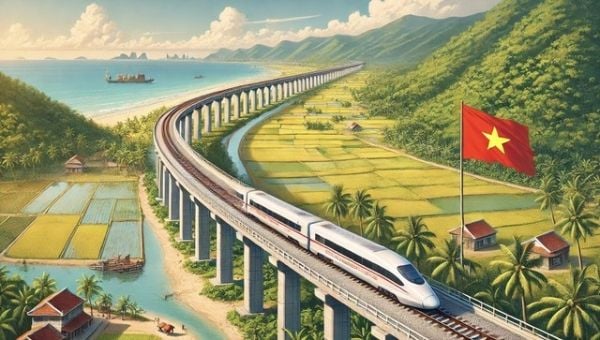
At the regular Lunar New Year Binh Ngo 2026 press briefing on the afternoon of January 30, Deputy Minister of Construction Nguyen Danh Huy said that requests from several enterprises to withdraw their investment registration for the North-South high-speed rail project should be considered under the principle of balancing responsibility between the State and the private sector to ensure the project remains feasible.
Deputy Minister Huy said the State’s policy is to mobilize the maximum social resources for infrastructure investment. However, he noted that at the pre-feasibility stage, the project does not yet have enough data to assess financial viability, so it cannot transfer all risk to enterprises.
“Experience in PPP project implementation shows that if the financial model is not viable, you cannot force enterprises to participate. Public service content that enterprises cannot perform must be shouldered by the State,” Deputy Minister Huy said.
On the financial and risk-management model for the North-South high-speed rail project, Deputy Minister Huy said regulations and practical implementation indicate that key parameters—such as total investment, economic efficiency, and the investment method—can only be determined once a feasibility study report is available.
He added that at the pre-feasibility step, financial, technical, and technological data are not yet sufficient for a comprehensive assessment.
The Ministry of Construction is currently selecting leading global consultants in the high-speed rail field to study technical solutions, route alignment, and complex technological issues.
Deputy Minister Huy said issues such as signal interference risk in the control system and signaling information require careful assessment before technical solutions and costs are defined. From that basis, investment efficiency can be calculated and the appropriate investment form chosen.
Deputy Minister Huy also said that in 2026 the Ministry will continue promoting research, transfer, and application of advanced technology in infrastructure development.
In the rail sector, the goal is for Vietnamese enterprises to gradually master construction technology for high-speed rail and urban rail—reducing dependence on foreign contractors—starting with operations and maintenance and moving toward production participation.
Earlier, the Ministry sent a letter inviting 13 enterprises to participate in the North-South high-speed rail project, focusing on investment methods and implementation procedures. The list includes:
The Thang Long Project Management Board is currently the unit preparing the feasibility study report for the North-South high-speed rail project, responsible for overall quality, schedule, and cost.
The Ministry of Construction’s response to enterprises interested in the North-South high-speed rail project noted a commitment to engaging with businesses on investment methods and implementation processes.
Officials have also emphasized accelerating the implementation of national rail projects. In early 2026, the government reiterated the need for careful evaluation of investment proposals for the North-South high-speed rail project.

Premium gym chains are entering a “golden era” that is ending or already in decline, as rising operating costs collide with shifting consumer preferences toward more flexible, community-based ways to exercise. Long-term memberships are shrinking, margins are pressured by higher rents and facility expenses, and competition from smaller, more personalized…