•
•
•
•
•
•
•
•
•
•
•
•
•
•
•
•
•
•
•
•
•
•
•
•
•
•
•
•
•
•
•
•
•


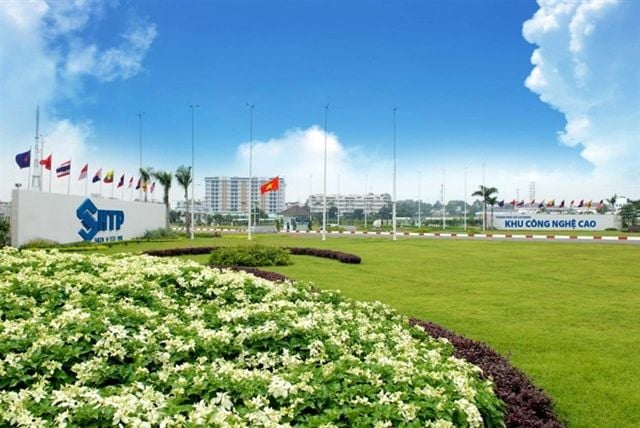
Ho Chi Minh City will design and implement a “green lane” for high-tech investment projects with international linkages to help investors understand what to do, who to contact, and how long each step will take, reducing the need to search for information as before.
Under Plan No. 127/KH-UBND to implement the 2026 digital economy development program, the Ho Chi Minh City People’s Committee sets out core tasks and solutions to drive investment and economic development. Among them, the city will prioritize building and implementing a controlled experimentation mechanism (sandbox) for digital services and new business models.
The city will also design the “green lane” for high-tech investment projects with international linkages to streamline procedures and shorten processing time. Relevant departments are tasked with completing policy frameworks, building a coherent legal environment, removing barriers to science and technology activities, and supporting innovation and digital transformation.
In addition, the city plans to pilot a mechanism to commercialize scientific research results and intellectual property created from state budgets, with the aim of bringing research outcomes into production and business more quickly.
Mr. Lữ Vincent Thế Hùng, founder and CEO of eduX Global Institute, said the proposed “green lane” design would signal clear priority and government support for investors, particularly in new technology sectors such as artificial intelligence (AI) and blockchain. He added that his company plans to establish a base in Ho Chi Minh City focused on AI and related technologies, and that implementing the “green lane” would help it access investment procedures, licensing, and project deployment faster.
“The green lane not only shortens the administrative process but must play a clear guiding role for investors. Participating enterprises will know what to do, whom to contact, and how long it will take to complete each step, instead of having to search for information as before. However, these are only suppositions, because the ‘green lane’ has not yet come to life,” Mr. Hùng said.
A representative of a technology startup in Ho Chi Minh City said that while they have heard about the relaxed mechanism, procedural bottlenecks remain in practice, with processing times lasting months and opportunities for collaboration and product development being missed. The startup said it hopes the “green lane” will be designed properly to be truly “green,” providing more favorable conditions for startups to develop high-tech investment projects.
In an interview with Nguoi Lao Dong, Dr. Nguyen Van Nen, a lecturer at the University of Economics - Law, said the “green lane” is not intended to cut or loosen laws, noting that the current legal framework is relatively open. He said the key is to standardize and restructure the implementation process to eliminate overlaps and allow parallel processing of steps to accelerate investment for investors.
Dr. Nen said the city should integrate and standardize input dossiers for investment projects and build a shared data set for all appraisal stages, including construction, environmental, and fire safety reviews. This, he said, would help eliminate repeated declarations by enterprises and provide a basis for parallel processing by agencies.
He also emphasized the need to standardize inter-agency coordination and define clear lead responsibilities, ensuring a single coordinating body rather than dossiers rotating between units. “The ‘green lane’ is not simply about reducing procedures but about restructuring the process toward standardization and transparency. This will shorten project timelines while ensuring quality of appraisal and risk control within the current legal framework. A one-stop is currently mainly a receiving point, while internal steps still proceed sequentially, sometimes overlapping. Therefore, the process should be reorganized toward parallel processing to speed up investment,” Dr. Nen said.
ThS Le Nhat Quang, Director of the Center for Startup Innovation at Vietnam National University Ho Chi Minh City, said the core of the “green lane” is not only policy but execution. He suggested the city build a specialized governance system, potentially as a “one-stop” model with a dedicated unit responsible for centralizing and handling related procedures.
He added that timeframes should be clearly defined, responsibilities among departments should be assigned, and coordination with central agencies should be ensured when needed.
Dr. Tran Quy said that if implemented correctly, the “green lane” could become a genuine runway to attract large technology groups and contribute to Ho Chi Minh City’s target of attracting US$11 billion in FDI this year.
The proposal includes applying a digital platform to manage the “green lane” with explicit criteria. Companies meeting the criteria would receive a “priority” label, enabling streamlined processing and reducing reliance on subjective assessment while ensuring transparency. The mechanism should also include post-audit to verify commitments related to technology, the environment, and project impact.
From the investor’s perspective, the system should set clear eligible project lists and processing times, potentially referencing fast-track clearance practices to shorten time.
CT Innovation Hub 4.0 by CT Group in Ho Chi Minh City was cited as a model that addresses practical problems from startups and links directly with research and entrepreneurship, aiming for commercialization from the outset and reduced risk.
Tran Kim Chung, Chairman of CT Group, said the model could help reduce startup failure rates by aligning ideas with real market needs. He also cited Finland and Israel as examples of successful government-industry-academic cooperation that shorten commercialization timelines and enhance innovation.
“Adopting similar models, adapted to domestic conditions, is expected to help complete the innovation ecosystem and foster a generation of technology companies with international competitiveness,” Chung emphasized.





Premium gym chains are entering a “golden era” that is ending or already in decline, as rising operating costs collide with shifting consumer preferences toward more flexible, community-based ways to exercise. Long-term memberships are shrinking, margins are pressured by higher rents and facility expenses, and competition from smaller, more personalized…