•
•
•
•
•
•
•
•
•
•
•
•
•
•
•
•
•
•
•
•
•
•
•
•
•
•
•
•
•
•
•
•
•


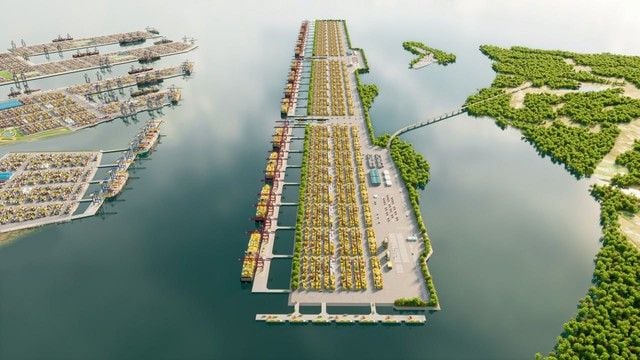
The Can Gio International Transshipment Port project not only marks a milestone for Vietnam on the world maritime map but also demonstrates VIMC's leadership in concretizing the strategic resolutions for developing the state’s economy. More than a port, this project signifies a national strategic scale. On the occasion of the 51st anniversary of the South Liberation and national reunification and marking the 31-year establishment of Vietnam Maritime Corporation - VIMC, Ho Chi Minh City authorities on April 29, 2026, organized a ceremony to hand over the decision approving the investor for the Can Gio International Transshipment Port project. The project will be undertaken by a consortium of investors led by VIMC, Saigon Port, and MSC, with VIMC holding a 36% stake (equivalent to nearly 13.918 billion dong). The total investment is estimated at up to 128.873 billion dong. This event is described as a milestone not only as a legal document but as a strategic mission and the trust bestowed by the Party, the State, and Ho Chi Minh City to maritime professionals to realize the nation’s ambition to expand access to the sea. The Can Gio project is planned on GO Con Chau island (Can Gio district) covering about 571 hectares (land and water areas), capable of accommodating container ships up to 250,000 DWT (about 24,000 TEU) with a design capacity of about 17 million TEU per year. The project’s total investment is estimated between 128,000 and 128,873 billion dong. Unlike the phased strategy of turning ports into gateway ports and then international gateway ports for Cai Mep - Thi Vai (Ho Chi Minh City) and Lach Huyen (Hai Phong), Can Gio aims to be a clearly defined international large-scale transshipment hub, competitive with regional leaders such as Singapore and Malaysia—the two largest transshipment centers in Southeast Asia—attracting a share of goods that Vietnam could absorb domestically. Investor participation in Can Gio includes a 36% stake (nearly 13.918 billion dong). The venture underscores VIMC’s pioneering role and strengthens its leadership in realizing major national economic development directions for maritime growth. The project embodies the spirit of the 14th Party Congress and the Government’s policy on state-owned enterprise development. VIMC emphasizes that state-owned enterprises must play a leading role in constructing strategic national infrastructure. Investing in Can Gio is seen as fulfilling the state’s mandate to propel Vietnam outward to the world’s oceans through internal capacity and international cooperation, with a scale and significance that extend beyond a single port. Sustainable growth is a key objective. The Can Gio Port is planned outside the core and buffer zones of the Can Gio Biosphere Reserve, ensuring strict environmental protections and pursuing a model of a green and smart port that leverages modern technologies to reduce greenhouse gas emissions, optimize operations, and enhance governance. This aligns with global shipping industry sustainability trends and balances growth with ecological preservation. Can Gio is expected to contribute 34,000–40,000 billion dong annually to the state budget, and create tens of thousands of jobs in construction, port operations, and related services. The project will help reduce logistics costs, improve competitiveness for exporters and importers, attract high-quality foreign investment, and serve as a cornerstone for building a regional logistics- industrial-financial services ecosystem in the south, supporting Ho Chi Minh City’s goal of becoming a regional financial and commercial hub. Le Anh Son, General Director of VIMC, notes that Can Gio is intended to become an international transshipment hub that competes with international ports rather than directly competing with Cai Mep - Thi Vai. Can Gio and Cai Mep - Thi Vai are two inseparable links in a complete logistics ecosystem, with Can Gio attracting the world’s largest container ships for transshipment, while Cai Mep - Thi Vai continues to develop as a gateway port and logistics support. This synergy yields unprecedented scale and service breadth, allowing shipping lines to access a single, large hub offering international transshipment as well as domestic trade, optimizing cost and time. Sustainability will be central to the development, with the project sited in a zone that minimizes ecological impact, and technology-driven efficiency to ensure low emissions and optimized operations. The overall approach is designed to align with sustainable development trends in the global maritime sector, balancing growth with ecological protection.




Premium gym chains are entering a “golden era” that is ending or already in decline, as rising operating costs collide with shifting consumer preferences toward more flexible, community-based ways to exercise. Long-term memberships are shrinking, margins are pressured by higher rents and facility expenses, and competition from smaller, more personalized…