•
•
•
•
•
•
•
•
•
•
•
•
•
•
•
•
•
•
•
•
•
•
•
•
•
•
•
•
•
•
•
•
•


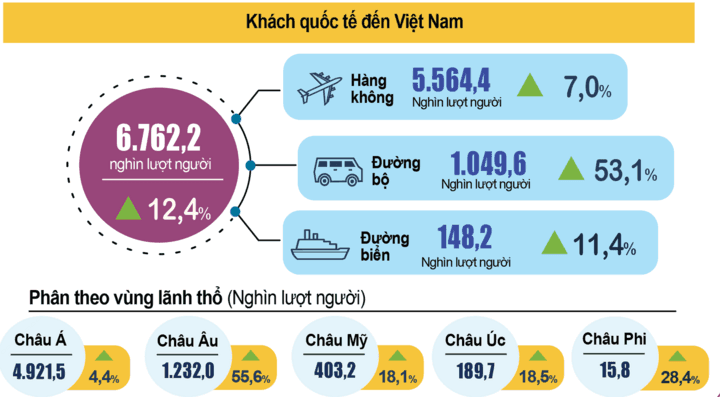
Vietnam’s tourism sector is aiming to build momentum in 2026 with a target of welcoming 25 million international visitors and serving 150 million domestic travelers. Total tourism revenue is expected to reach about 1.125 quadrillion dong. While some experts previously viewed the goals as challenging, the record pace of international arrivals in the first quarter has shifted sentiment toward greater confidence.
Vietnam welcomed more than 21 million international visitors in 2025 and served about 135 million domestic travelers. In the first three months of 2026, international arrivals reached 6.76 million, up 12.4% year-on-year, marking the highest Q1 on record. Arrivals also exceeded 2 million in each of the three months of the quarter.
In this context, Nghia said the annual targets are feasible and could be achieved earlier than planned, adding that the current momentum supports the goal of 25 million international visitors and 150 million domestic travelers with revenue around 1.125 quadrillion dong.
Tran The Dung, CEO of Vietluxtour, said bookings for the remainder of 2026 have already been placed, despite higher airfares linked to fuel costs amid tensions in the Middle East. He noted that while new bookings may slow in the short term, overall demand remains positive.
Dung also highlighted changes in the traveler profile. He said European–American visitors are increasingly stable, with longer stays, higher expenditures, and a preference for multi-destination itineraries across Vietnam. This trend, he said, helps spread visitors beyond major hubs such as Ho Chi Minh City, Hanoi, Da Nang, Nha Trang, and Phu Quoc, potentially boosting arrivals to other provinces.
In Q1, the Russian market was the standout, with more than 367,000 arrivals to Vietnam, up 194.5% year-on-year. Russia ranked third among Vietnam’s source markets during the period. Nghia attributed the rise to factors including a 45-day visa-free policy, the rapid recovery of direct flight services, and Vietnam’s positioning as a safe destination amid global uncertainties.
Nghia and Dung also pointed to strong recovery in Russian and Eastern European markets, characterized by long-stay, high-spending travelers. European markets such as Poland posted growth of more than 50% over the same period, signaling positive signs for expanding into more distant markets.
China remains a strategic market. The launch of the “Vietnam–China Tourism Cooperation Year 2026–2027” is expected to provide a boost to Vietnam’s largest source market.
Beyond government measures, the travel industry is also improving. Nghia cited better tourism promotion, improved airport capacity, expanded transportation infrastructure, upgraded accommodation, and higher service quality at destinations—especially outside central hubs. He also noted improvements in human resources and safety.
“These positive changes give Vietnam’s tourism more confidence to welcome large volumes of visitors as expected,” Nghia emphasized.
Analysts said that with demand growing, Vietnam’s key strategy will be to focus on high-spending markets such as Russia and Europe while continuing to maintain major markets including China, Korea, and ASEAN. Bình concluded that the 2026 targets—25 million international visitors and 150 million domestic travelers—are achievable.






Premium gym chains are entering a “golden era” that is ending or already in decline, as rising operating costs collide with shifting consumer preferences toward more flexible, community-based ways to exercise. Long-term memberships are shrinking, margins are pressured by higher rents and facility expenses, and competition from smaller, more personalized…



