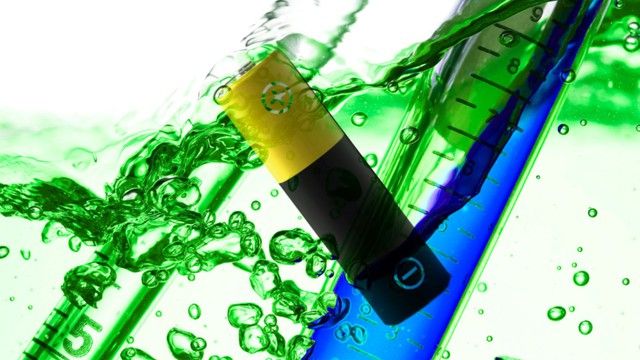
With the surge in energy demand for data centers today, water-based batteries could become an ideal replacement for traditional lithium-ion batteries.
In the race to develop next-generation batteries, lithium-ion remains the dominant technology. However, despite advantages in energy density, this type of battery also comes with drawbacks such as fire hazards, high material costs, and environmental challenges. Therefore, for years researchers worldwide have been seeking safer and cheaper alternatives.
Zinc, the common electrode material in water batteries, tends to deposit unevenly during charging and form irregular structures that damage the battery from within. Moreover, zinc reacts with water in the electrolyte, causing corrosion and rapid loss of capacity.
As a result, water-based batteries typically have shorter lifespans than lithium-ion while their capacity lags behind—a pair of issues that researchers have rarely solved simultaneously.
Professor Hoseok Park and his team at Sungkyunkwan University pursued a different approach. Instead of changing the battery design or using a new electrode material, they added a small amount of an additive to the existing electrolyte.
This additive is named C10, belonging to the zwitterionic group, meaning molecules that carry both positive and negative charges in a single structure. That property allows C10 to interact with surrounding ions in ways ordinary molecules cannot.
When dissolved in the electrolyte, C10 molecules self-assemble into nano-structures with a diameter of about 3.77 nanometers. These nano-structures perform two tasks simultaneously.
The effectiveness of this solution far exceeds what previous studies have achieved. The battery improved with C10 maintained stable operation continuously for more than 2,800 hours under test conditions, and achieved an areal capacity of 8.10 mAh cm−2. Researchers say this is the highest recorded in water-based battery systems to date.
Notably, these two metrics are often traded off in prior battery designs; improving lifespan typically comes with reduced capacity and vice versa. The C10 approach achieves both simultaneously without changing battery architecture or production lines, and the method can be applied to current water battery systems without large switching costs.
The research team identifies two main application areas. First, large-scale energy storage for renewable grids, where safety, low cost, and durability are more important than energy density. Second, and more notable in the current context, is the AI infrastructure and data centers experiencing explosive growth.
Data centers require stable, safe, scalable energy storage, and the water battery with the new performance can meet these needs better than lithium-ion in fixed applications. The study was published in a peer-reviewed science journal and is being evaluated for commercialization potential.