•
•
•
•
•
•
•
•
•
•
•
•
•
•
•
•
•
•
•
•
•
•
•
•
•
•
•
•
•
•
•
•
•


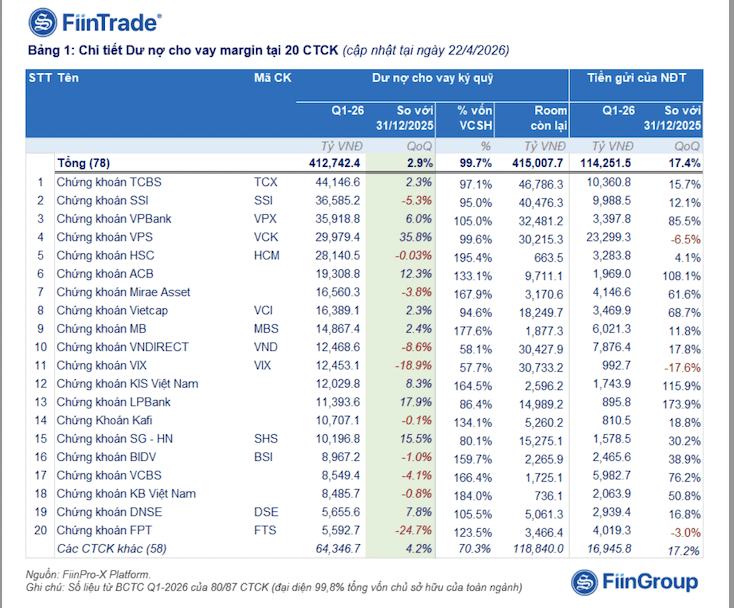
Margin debt-to-equity across Vietnam’s brokerage sector averaged 99.7%, but in practice many firms were operating close to the 200% maximum. Several brokerages reported ratios near or above 160%, including HCM (195.4%), MBS (177.6%), Mirae Asset (167.9%), and KBSV (184%). Total market-wide margin debt exceeded 412.7 trillion VND as of end-March 2026, continuing an uptrend, though growth slowed as the market entered a correction. The VN-Index fell 6.16% in Q1, ending a four-quarter rally that had gained 29%, according to FiInGroup data.
Total industry margin debt rose 2.9% quarter-on-quarter, but the pace varied significantly by firm. Some brokerages continued to expand margin lending, including VPS (+35.8%), LPBS (+17.9%), SHS (+15.5%), and ACBS (+12.3%). In contrast, several major players reduced margin balances, such as SSI (-5.3%), VND (-8.6%), and VIX (-18.9%).
The gearing ratio—margin debt relative to market capitalization adjusted for free float—stayed very high at about 14.1% at end-March 2026, up from 12.8% at end-2025. The increase points to continued reliance on leverage. Liquidity remained roughly 23% below the Q3/2025 peak, although it improved by 22% from the previous quarter.
A notable feature in Q1 was that some brokerages increased margin debt while their market share declined. VPBankS reported margin lending of over 36,000 billion VND as of March 31, ranking third in the sector, but its HoSE Q1 trading share was 2.94% (ninth). VPS led the brokerage market with a 15.32% share, yet its loan balance was smaller—around 30,000 billion VND by end-Q1.
TCBS also illustrates the divergence: it had the largest margin lending in the sector at nearly 45,000 billion VND, but its market share ranked third at 8.85%.
This pattern suggests that a portion of margin funds may be used for purposes beyond direct retail trading, including uses by institutions, major shareholders, or management. The trend appears more pronounced at brokerages backed by banks, reflecting the expansion of a “shadow banking” model within the industry.
If margin funds are not closely tied to stock trading and are instead directed toward other objectives, debt servicing capacity becomes more dependent on the company’s broader financial health. In the event of a shock, forced liquidations could spread and potentially have wider effects than traditional margin loans extended to individual investors.
Cash held at brokerages increased slightly again in Q1 2026. Investors’ deposits rose 15.3% quarter-on-quarter to nearly 114.3 trillion VND, indicating capital inflows returning after the heavy outflow in Q4 2025. However, waiting cash remained about 17.6% below the historical peak of approximately 138.8 trillion VND, suggesting latent demand had not fully recovered.
Overall, the data points to somewhat improved sentiment, but still cautious positioning, which may limit the development of broad-based rallies.






Premium gym chains are entering a “golden era” that is ending or already in decline, as rising operating costs collide with shifting consumer preferences toward more flexible, community-based ways to exercise. Long-term memberships are shrinking, margins are pressured by higher rents and facility expenses, and competition from smaller, more personalized…