•
•
•
•
•
•
•
•
•
•
•
•
•
•
•
•
•
•
•
•
•
•
•
•
•
•
•
•
•
•
•
•
•


Metallus (NYSE: MTUS) reported higher first-quarter 2026 sales and profitability, citing improving demand, stronger shipment volumes and operational gains that offset higher utility and labor costs, executives said on the company’s earnings call.
Chief Executive Officer Mike Williams said demand continued to improve across the company’s end markets, with the order book growing year over year. He pointed to industrial and defense demand, lower distribution inventory levels and onshoring as factors supporting the outlook.
Williams also said Section 232 tariffs continue to support Metallus’ competitive position. He noted that recent April 2026 tariff updates applied to downstream steel-containing derivative products and did not affect the company’s primary steel products.
Executive Vice President and Chief Financial Officer John Zaranec said first-quarter net sales totaled $308.3 million, up $27.8 million, or 10%, from the prior-year period. The increase was primarily driven by higher shipments across most end markets.
Net income was $5.4 million, or $0.13 per diluted share. Adjusted net income was $7.7 million, or $0.18 per diluted share. Adjusted EBITDA was $24.6 million, up $6.9 million, or 39%, from the first quarter of 2025.
Zaranec said the improvement reflected higher shipments, better price mix, a higher raw material spread and better fixed-cost leverage from higher production volume. These benefits were partly offset by higher utility costs and a partial-quarter cost increase tied to a ratified union contract.
Williams said shipments increased 11% sequentially, while lead times for both bars and seamless mechanical tubing extended into the late third quarter. He said the longer lead times indicate stronger domestic steel demand and momentum expected to continue through 2026.
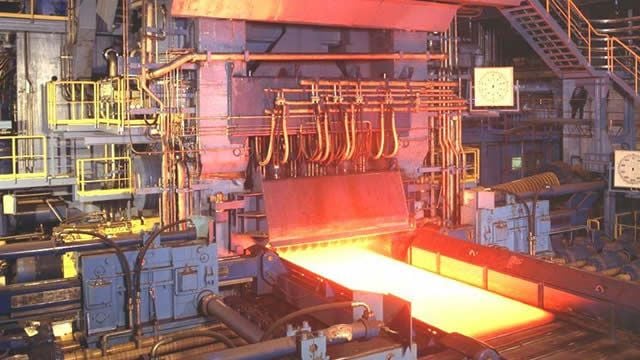
Williams highlighted progress on Metallus’ new bloom reheat furnace and roller furnace. He said the company safely reheated and rolled the first blooms from the new bloom reheat furnace during the quarter.
Williams said the bloom reheat furnace has demonstrated a run rate of about 150 tons per hour, compared with about 100 tons per hour using legacy assets, along with improved temperature uniformity. The company expects the bloom reheat furnace to be fully operational in early to mid-third quarter and the roller furnace to be fully operational in late third quarter.
Zaranec said capital expenditures totaled $24.7 million in the first quarter, including about $18.3 million of spending partially funded by the U.S. government. Full-year 2026 capital expenditures are expected to be about $70 million, including about $35 million primarily funded by the government.
Metallus received $5.9 million of government cash funding in the first quarter and an additional $9.5 million in April after completing key milestones. Zaranec said about $2 million of additional government funding is expected in 2026, contingent on achieving the final milestone. The funding is part of a previously announced nearly $100 million agreement supporting the U.S. Army’s mission to increase munitions production.
Williams said industrial customers are reassessing supply chains in response to trade policy shifts and macroeconomic uncertainty, creating more opportunities for domestic suppliers. He said low inventories in distribution channels and selected products returning from offshore sourcing are helping Metallus strengthen relationships and gain share as industrial markets stabilize.
Automotive demand remained steady, with volumes up slightly from a year earlier. Williams said the company’s automotive order book and customer relationships remain strong, supported by exposure to light truck and SUV transmission programs. During the quarter, Metallus won two additional programs with existing customers.
In energy, Williams said customers remain cautious as producers seek more confidence in long-term oil prices before materially increasing investment. He added that trade-related tailwinds, lower imports and a gradual increase in domestic oil and gas activity are creating incremental opportunities.
Aerospace and defense remained a key area of strength. Williams said Metallus was awarded a contract with a new entrant in the defense supply chain to produce tubing for new rocket motors related to advanced weapon systems. He said demand across defense programs continues to support the company’s near-term $250 million run-rate revenue expectation and longer-term expansion in the market.
During the question-and-answer session, Williams said delayed production timing at a U.S. Army munitions partner’s facility could affect the ramp toward 100,000 shells per month. He said Metallus is seeing increased demand from other facilities and non-U.S. customers, mostly in North America. Zaranec clarified that the $250 million target is a run-rate expectation the company expects to achieve during the year.
Metallus ended the first quarter with $104 million in cash and cash equivalents and total liquidity of $375 million. Zaranec said the company had no outstanding borrowings as of March 31.
The company repurchased approximately 277,000 shares of common stock during the quarter at a cost of $4.3 million. At the end of March, $85.4 million remained under the company’s existing share repurchase authorization. Zaranec said share repurchases and convertible note repurchase activity have reduced diluted shares outstanding by 26%, or 13.8 million shares, since early 2022.
Zaranec also said Metallus made $19.8 million of required pension contributions in the first quarter and another approximately $5 million contribution in April. The company expects about $5 million of additional required pension contributions for the rest of 2026, with total required pension contributions expected to decline by nearly 60% from 2025.
For the second quarter, Zaranec said shipments are expected to rise modestly on a sequential basis in the low single digits, supported by the order book and normal seasonality. The company expects second-quarter adjusted EBITDA to be modestly higher both sequentially and year over year.
Metallus has announced targeted price actions across its bar and tube portfolios through the first four months of 2026. Bar pricing actions totaled $120 per ton, while tube pricing actions averaged about $100 per ton across the product mix. Zaranec said these actions apply only to business not sold under annual price agreements and to new business, historically representing about 30% of annual volume.
Second-quarter price and mix are expected to be similar to the first quarter, with improvement anticipated in the second half of the year. Manufacturing costs are expected to improve by about $2 million sequentially in the second quarter due to higher melt utilization and better cost absorption, net of the full-quarter impact of the ratified union contract.
Williams said the company remains focused on execution, safety, operational discipline and prudent capital allocation as it works to meet rising customer demand and deliver long-term shareholder value.
Metallus, Inc. (NYSE: MTUS) is an industrial metals recycling and distribution company that acquires, processes and markets a wide array of ferrous and non-ferrous materials. Its product portfolio includes stainless steel, nickel alloys, aluminum and other specialty metals sourced from manufacturing scrap, obsolete products and post-consumer waste streams.
Metallus provides services such as shredding, sorting, melting and baling, enabling customers to optimize metal recovery and streamline supply chains. Headquartered in Philadelphia, Pennsylvania, the company operates processing facilities and distribution centers across the United States.
Premium gym chains are entering a “golden era” that is ending or already in decline, as rising operating costs collide with shifting consumer preferences toward more flexible, community-based ways to exercise. Long-term memberships are shrinking, margins are pressured by higher rents and facility expenses, and competition from smaller, more personalized…