•
•
•
•
•
•
•
•
•
•
•
•
•
•
•
•
•
•
•
•
•
•
•
•
•
•
•
•
•
•
•
•
•


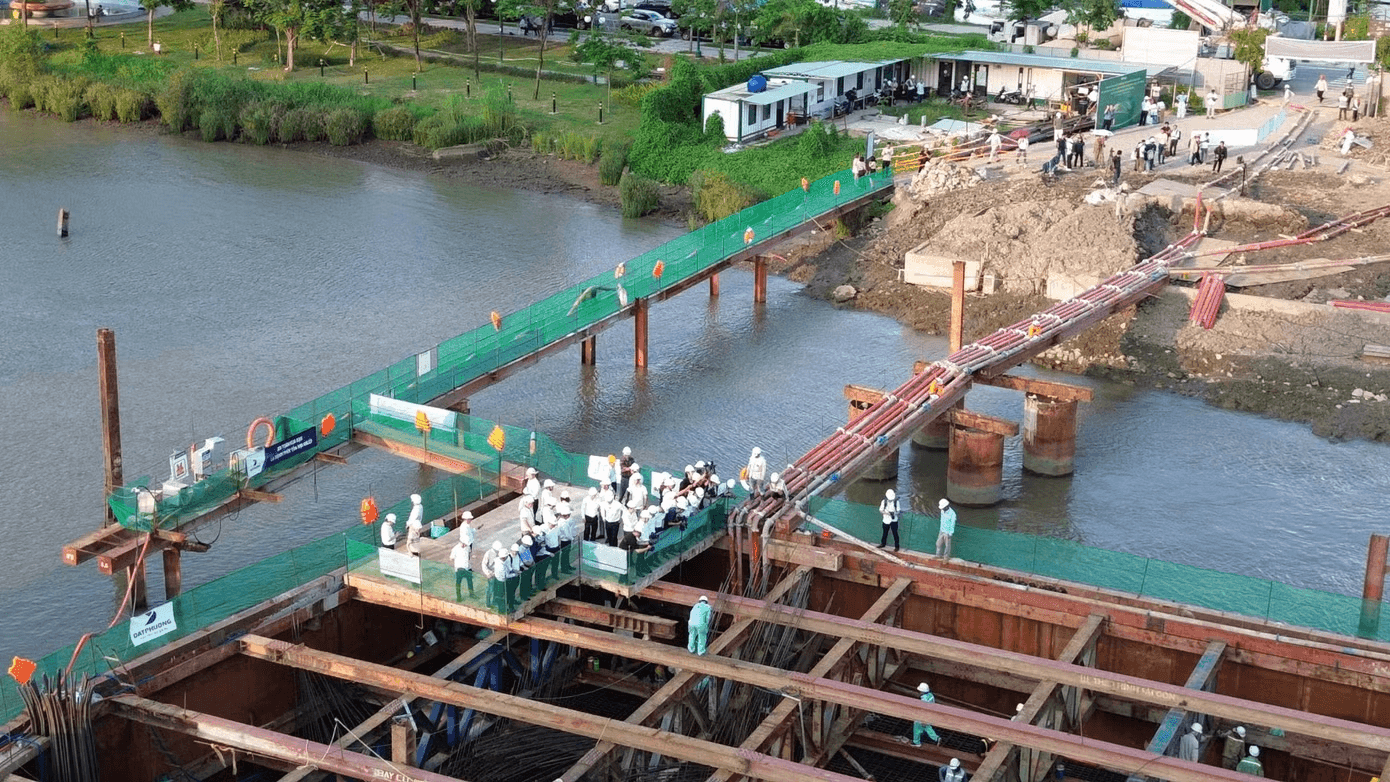
On May 11, 2026, Ho Chi Minh City leaders visited the Saigon River pedestrian bridge construction site and witnessed the first concrete pour for the main pillar TC2, marking a milestone as the project enters its major structural construction phase.
The project is managed by the Mỹ Thuận Project Management Board (Ministry of Construction). It is designed to support the quality of the structure, safety during construction, and overall progress for the pedestrian bridge over the Saigon River.
The total length of the project, including the main bridge and approach viaduct, is about 720 meters, with a main span of 187 meters. To date, the approach viaduct work is about 90% complete. For the main bridge, the steel structure package is around 60% complete.
At the site, the Dat Phuong contractor has completed all bored piles for the two main piers, TC1 and TC2. The TC2 pier footing measures 48.5 meters long, 39 meters wide, and 3 meters high. More than 5,600 cubic meters of concrete have been poured in continuous work.
After the concrete pour, the two main piers TC1 and TC2 are expected to be completed in June 2026. In early August, steel deck sections will be towed from Vung Tau to Ho Chi Minh City for installation.
The Mỹ Thuận Project Management Board will coordinate with the Ho Chi Minh City Department of Construction and related agencies to implement the towing and erection of the steel structure. The target is to complete the entire project by September 2, 2026, National Day.
The project is financed under a socialization model, with NutiFood sponsoring nearly 1,000 billion VND. The bridge’s space steel arch, designed to resemble a coconut leaf, is highlighted as a distinctive architectural feature.
With an overall length of about 720 meters and a deck width ranging from 6 to 11 meters, the suspended arch and deck arrangement are designed to provide a river traffic clearance of 80 meters wide and 10 meters high to accommodate waterway traffic.
The project is expected to become a new architectural-cultural landmark and provide a modern public space for walking and enjoying views of the river.
Premium gym chains are entering a “golden era” that is ending or already in decline, as rising operating costs collide with shifting consumer preferences toward more flexible, community-based ways to exercise. Long-term memberships are shrinking, margins are pressured by higher rents and facility expenses, and competition from smaller, more personalized…