•
•
•
•
•
•
•
•
•
•
•
•
•
•
•
•
•
•
•
•
•
•
•
•
•
•
•
•
•
•
•
•
•


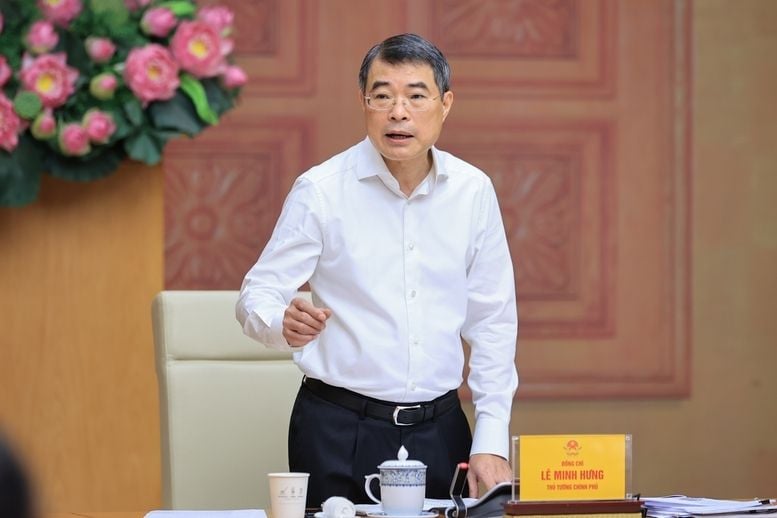
Morning of 22 April 2026, Prime Minister Le Minh Hung chaired a working meeting with the Ministry of Industry and Trade on the status of implementing tasks for 2026, the difficulties and obstacles that have arisen, and the key directions and tasks for the near future.
Attending the meeting were Deputy Prime Minister Pham Gia Tuc; Deputy Prime Minister Nguyen Van Thang; Minister of Industry and Trade Le Manh Hung; Minister, Chief of the Government Office Dang Xuan Phong; together with leaders of several ministries, agencies and state-owned economic groups.
The meeting took place as the industry and trade sector entered the first year of the 2026–2030 period, continuing the results of the 2021–2025 term and implementing the Government Action Program to realize the XIV Party Congress’s resolution. From early 2026, the Ministry and the sector set out high determination to complete the targets and lay the foundation for the next development stage.
According to the report and discussions, the Ministry of Industry and Trade has implemented and complied with Party directives, National Assembly resolutions, and Government and Prime Minister directives. The focus has been on perfecting the institutional framework, developing industrial production, ensuring energy security, developing domestic and international trade, and enhancing the effectiveness of state management and the sector’s competitiveness.
Prime Minister Le Minh Hung acknowledged and appreciated the Ministry and sector’s efforts in implementing tasks, overcoming difficulties, and achieving important results—particularly in presenting policies related to gasoline and oil amid fluctuations, contributing to macroeconomic stabilization and ensuring essential supply.
Noting the sector’s pressures, the Government is directing urgent measures to remove obstacles across multiple areas, including the energy field. The Prime Minister said the purpose of the meeting is to unify approaches to address the issues raised, and to effectively implement the Government’s Action Program and Conclusion No. 18-KL/TW, toward the target of two-digit growth.
The Prime Minister requested the Ministry of Industry and Trade to promptly concretize and implement the Government’s Action Plan, assigning clear targets, tasks, and timelines to each leader, affiliated units, state economic groups, and localities, while ensuring progress and clear accountability.
He also asked the Ministry to build a clean and strong Party organization, develop a cadre team capable of meeting mission requirements, and promptly review and replace individuals who fail to fulfill duties or meet requirements.
For upcoming tasks, the Prime Minister emphasized the need to build and finalize institutions. The Ministry must complete the drafting and issuance of guiding documents without delay and advance the drafting of laws to submit to the National Assembly at the second session of the XVI National Assembly, including the Oil Law (amendment), the Electricity Law (amendment), the Derivatives Trading Law, and other laws related to trade.
He further directed the Ministry to complete the draft of the key Industrial Law under Government Resolution 82/NQ-CP, and to coordinate with other ministries and agencies to review and refine functions and duties to avoid overlap—ensuring the principle “one matter – one leading agency, and one responsible party.”
In administrative reform, the Prime Minister asked the Ministry to continue implementing decentralization, simplifying administrative procedures and business conditions, promoting genuine decentralization to localities, and streamlining the organizational apparatus in line with Government guidance.
On energy security, the Prime Minister stressed that power shortages and gasoline shortages must not occur under any scenario. The Ministry of Industry and Trade was tasked with coordinating to review and update Power Plan VIII, add base-load power projects using new technologies, accelerate key power projects, and coordinate with the Ministry of Agriculture and the Environment for effective operation of hydro reservoirs.
For gasoline and oil, the Prime Minister directed the Ministry to quickly restructure the distribution system to reduce intermediaries and cut costs, accelerate construction of the national gasoline reserve, and promote the use of E10.
The Prime Minister also directed the Ministry and the sector to push forward restructuring of industrial and supply chains, promote in-depth manufacturing, implement large-scale industrial projects, and strengthen linkages between domestic enterprises and foreign-invested enterprises to increase self-reliance and the ability to participate in global supply chains.
In trade and imports-exports, the Prime Minister asked the Ministry to improve the effectiveness of exploiting FTAs already signed, carefully prepare reciprocal tariff negotiation plans with the United States, and diversify export markets. He also urged renewing the operation of Vietnam’s trade offices abroad to improve effectiveness and deliver tangible contributions.
He further emphasized promoting digitization and modernization of domestic distribution systems, completing industry databases and linking them with the national database, and strengthening market management by strictly handling violations to support a healthy and sustainable domestic market.
The Prime Minister highlighted that two-digit growth is the inevitable path toward completing the 100-year development targets.





Premium gym chains are entering a “golden era” that is ending or already in decline, as rising operating costs collide with shifting consumer preferences toward more flexible, community-based ways to exercise. Long-term memberships are shrinking, margins are pressured by higher rents and facility expenses, and competition from smaller, more personalized…