•
•
•
•
•
•
•
•
•
•
•
•
•
•
•
•
•
•
•
•
•
•
•
•
•
•
•
•
•
•
•
•
•


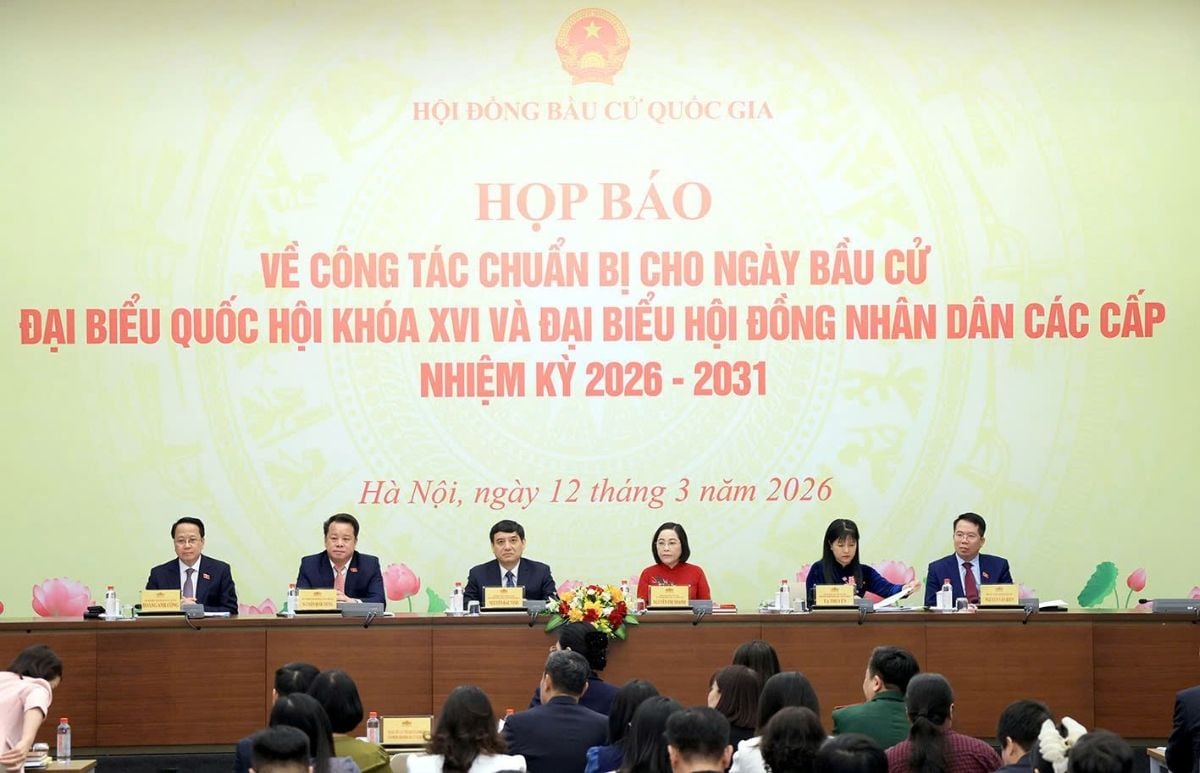
The National Election Council has completed preparations for the election of deputies to the 16th National Assembly and deputies to People’s Councils at all levels for the 2026–2031 term. More than 78 million voters nationwide participated in the March 15 election. On the morning of March 12, the council held a press conference on election preparation and opened the Election Press Center.
Vice Chairwoman of the Committee for Deputies’ Work and Deputy Chief of the Standing Office of the National Election Council, Ms. Ta Thi Yen, said that only a little over two days remain until Election Day. She noted that preparations have been implemented nationwide by the National Election Council and central and local agencies in a synchronized, tight, and on-schedule manner as required by law.
Ms. Yen said many key contents of the election process were completed earlier than statutory deadlines. At the central level, the National Election Council organized two nationwide online conferences to implement election work, two online training sessions on using election software, and four meetings to direct and govern the election process. The agencies also issued all 27 documents guiding election work according to the division of tasks of the National Election Council.
She added that the National Election Council and its subcommittees issued 31 resolutions, eight plans, and 46 guiding documents related to early voting, helping promptly address difficulties arising during implementation.
The country has established 34 provincial election committees, 3,320 commune-level election committees, 182 election committees for the National Assembly, 724 election committees for provincial-level People’s Councils, 22,401 commune-level People’s Council election committees, and 72,191 polling locations. Ms. Yen said the full establishment of election-organizing bodies is a key basis to ensure the election is conducted legally, coherently, and effectively nationwide.
She also stated that personnel work has been prepared tightly to ensure the structure complies with regulations.
At the press conference, Ms. Ha Thi Nga, Vice President and General Secretary of the Vietnam Fatherland Front, said there are five self-nominated candidates for the 16th National Assembly across localities: two in Ho Chi Minh City and one in Vinh Long, Can Tho, and An Giang each. She said all five self-nominated candidates have support from voters in their localities.
For the 16th National Assembly, the total number of elected deputies is 500 from 864 nominees, a ratio of 1.73 nominees per elected deputy, including five self-nominated.
The candidate structure includes: women at 45.37%, under 40 years old at 21.64%, ethnic minorities at 21.76%, non-party members at 7.41%, and incumbent candidates at 27.31%.
For provincial-level People’s Councils, total elected deputies are 2,552 from 4,217 nominees, a ratio of 1.65. For commune-level People’s Councils, total elected deputies are 72,611 from 120,873 nominees, a ratio of 1.66.
Ms. Ha Thi Nga said these figures show that official candidate lists meet legal margins and that attention has been paid to a reasonable mix of female, young, and minority representatives.
As of March 10, the country has 78,928,647 voters who will vote at 72,195 polling locations. Voter lists have been posted publicly early so citizens can check and verify in accordance with the law. The voter data will continue to be updated by localities up to 24 hours before polling begins.
The National Election Council has allowed 217 polling areas in 11 provinces and cities to conduct early voting. As of March 12, there are 34 early voting areas in An Giang, Khanh Hoa, Ho Chi Minh City and some special localities to ensure compliance with early voting regulations.
Ms. Yen said it can be affirmed that preparations for the March 15, 2026 election are basically complete, on schedule, and in full compliance with the law.
According to preliminary counts from nine provinces/cities, there were 10,649 voter contact events organized in various forms, including direct and online. She added that many localities have organized training conferences to strengthen campaigning skills for first-time candidates, contributing to higher quality electoral campaigning.
Premium gym chains are entering a “golden era” that is ending or already in decline, as rising operating costs collide with shifting consumer preferences toward more flexible, community-based ways to exercise. Long-term memberships are shrinking, margins are pressured by higher rents and facility expenses, and competition from smaller, more personalized…