•
•
•
•
•
•
•
•
•
•
•
•
•
•
•
•
•
•
•
•
•
•
•
•
•
•
•
•
•
•
•
•
•


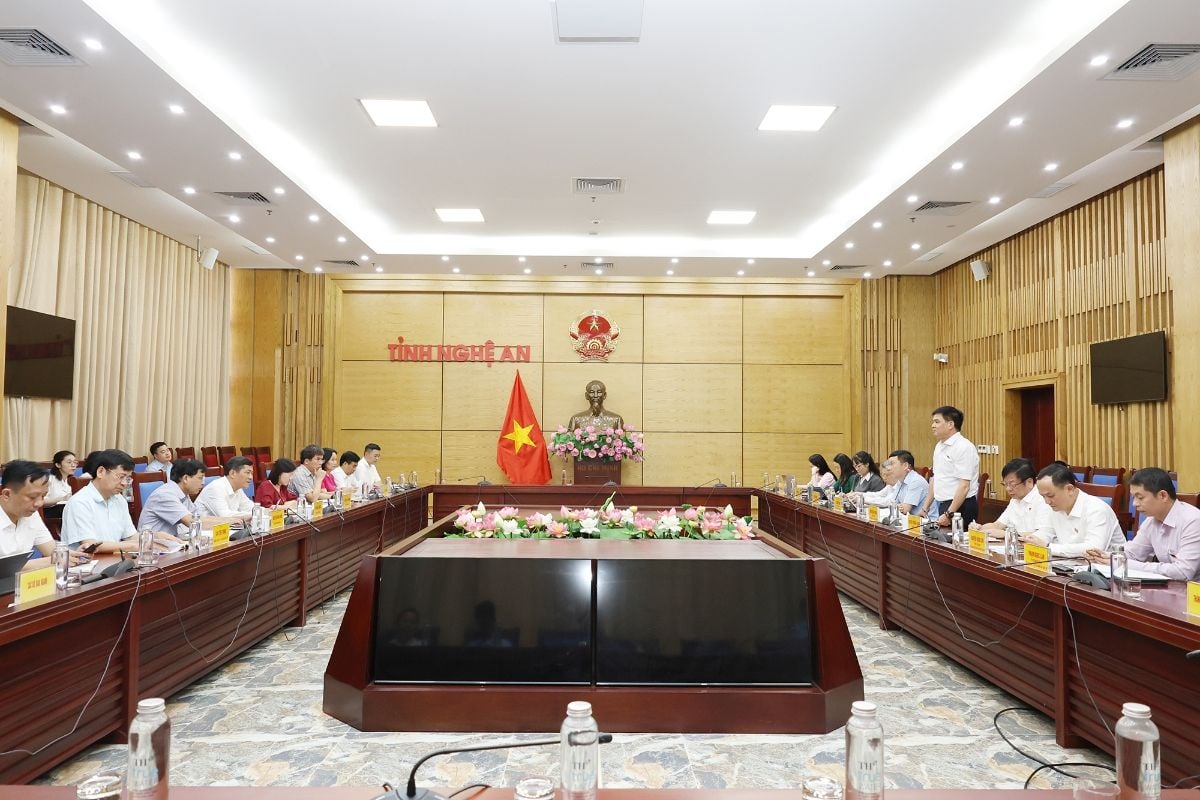
On the afternoon of May 11, a fact-finding delegation from the National Assembly’s Committee on Economics and Finance held a working session with leaders of Nghệ An to discuss the implementation of Party resolutions and National Assembly resolutions aimed at achieving two-digit growth and advancing key national transport projects.
According to the report presented at the session, in the first four months of 2026, despite ongoing difficulties and challenges, Nghệ An’s socio-economic performance continued to produce positive results, with growth momentum sustained across multiple industries and sectors.
GRDP growth for Q1 is estimated at 8.15%, compared with 6.95% in the same period of 2025, and aligned with the growth scenario set out. State budget revenue reached 11,863 billion VND, equivalent to 50.8% of the estimate and up 30.2% year-on-year.
The session highlighted that investment attraction continued to deliver positive outcomes, particularly foreign direct investment (FDI). Total newly licensed and additional investment capital reached over 65,219 billion VND, which is 8.74 times higher than the same period in 2025.
Leaders noted that the province’s investment and business environment has continued to improve, gradually strengthening confidence among the business community and major investors.
For the Vinh – Thanh Thủy expressway project—approved as a national priority project by the National Assembly with total investment of more than 23,940 billion VND—the province is focusing on meeting the schedule for implementation in the 2026–2029 period. A formal groundbreaking is scheduled for May 18.
Speaking at the session, Mr. Thái Văn Thành, Vice Chairman of Nghệ An Province’s People’s Committee, said the province is making efforts to stay on course to achieve two-digit growth, even as the government’s socio-economic development target is higher than the province’s initial target.
The vice chairman said Nghệ An is prioritizing infrastructure investment to create interregional and international development space. The province also identifies science and technology and innovation as important growth drivers in the near future.
On investment promotion, Nghệ An plans to intensify efforts to attract FDI by completing VSIP 4 to be ready for licensing. The province is also inviting large corporations to invest in spiritual tourism, aiming to elevate the sector into a key economic field.
The delegation said the two-digit growth target is a key development requirement for Nghệ An in the new period. Based on analysis and comparison with other localities, the delegation believes the province should identify a “super project” or a leading economic sector capable of creating spillover effects and guiding provincial GRDP growth.
Many opinions emphasized the need to move from a mindset of “dispersed growth” to “concentrated growth along pillars.” The Southeast Economic Zone was identified as the growth core, with key sectors including processing industries, energy, and logistics services.
In addition, leveraging the advantages of Cửa Lò Port to develop into a regional logistics hub in the North Central region was cited as an important task in the province’s long-term development strategy.
Delegates assessed that Nghệ An has significant development potential but still has room for further utilization. To create a more favorable environment for businesses and investors, the province is actively reducing administrative procedures by 30% to 50%.
The province is also developing flexible growth scenarios linked to disaster risk management and climate change adaptation to support sustainable development.
Phó Chủ nhiệm Ủy ban Kinh tế và Tài chính của Quốc hội Nguyễn Hữu Toàn (Deputy Chair of the Economic and Financial Committee of the National Assembly) said the delegation recognizes Nghệ An’s proactive and decisive approach in implementing Party resolutions and National Assembly resolutions related to the economy and finance to achieve two-digit growth.
He urged the province to accelerate capital allocation and to promote the leading role of public investment in socio-economic development. For local recommendations, the delegation said it will compile and report to the Standing Committee of the National Assembly and relevant agencies to consider and propose suitable solutions.
Premium gym chains are entering a “golden era” that is ending or already in decline, as rising operating costs collide with shifting consumer preferences toward more flexible, community-based ways to exercise. Long-term memberships are shrinking, margins are pressured by higher rents and facility expenses, and competition from smaller, more personalized…