•
•
•
•
•
•
•
•
•
•
•
•
•
•
•
•
•
•
•
•
•
•
•
•
•
•
•
•
•
•
•
•
•


The United States is expected to press China to buy more oil and natural gas when President Donald Trump visits Beijing on May 14-15, his first trip to China in his second term. The discussions are expected to cover trade and technology, as well as strategic minerals and the Middle East conflict.
U.S. officials have indicated the two sides are considering an agreement that would help Washington sell more energy to Beijing. Trump is expected to urge China to commit to purchasing more oil and natural gas, which the United States produces in large volumes.
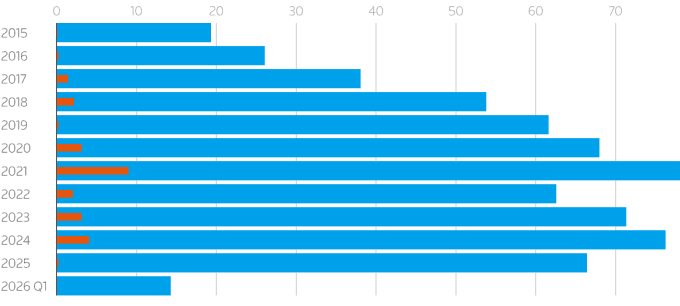
Last year, tariffs imposed by Washington on Beijing nearly blocked U.S. oil and LNG shipments to China. In 2024, before Trump took office, the export value of these products stood at about $8.4 billion.
During the 2019 trade tensions in Trump’s first term, China reduced LNG purchases from the United States to about 260,000 tonnes, while total LNG imports rose by about 15% to 59.4 million tonnes.
In 2021, after a trade agreement was reached, the United States exported nearly 9 million tonnes of LNG to China and became the country’s third-largest supplier of natural gas, behind Qatar and second-place supplier rankings.
By 2024, LNG imports from the United States had fallen to 4.15 million tonnes, and to 26,000 tonnes in 2025 after China imposed a 25% retaliatory tariff on U.S. LNG. Some Chinese firms, including PetroChina and CNOOC, placed orders for U.S. LNG under long-term contracts from 2021-2023, with cargoes often being resold to Europe to avoid domestic import taxes.
Energy consultancy Rystad Energy estimates that about 12 million tonnes of LNG will be delivered this year under those contracts.
Analysts say that if China eliminates the 25% import tax, U.S. LNG would likely be cheaper than current spot LNG cargoes in Asia, partly due to disruptions in Middle East supply. However, they also note that volumes sold to China may not rise sharply if demand remains weak.
China is the world’s largest importer of crude oil, but Washington has not been a major supplier of this commodity to Beijing. In 2020, after the Phase One trade deal, U.S. crude oil imports by China reached a record 395,000 barrels per day, but that represented less than 4% of China’s total crude oil imports.
Oil purchases by China fell by about half in 2023 to roughly $6 billion. From May 2025, China largely stopped importing U.S. oil due to a 20% tariff, instead increasing purchases from Canada and Brazil to bolster domestic supply.
A key feedstock for plastics, ethane and propane, could also become an area of increased imports from the United States despite tensions. The United States remains the sole provider of ethane to China.
Last year, China imported about 5.95 million tonnes of ethane, worth nearly $3 billion, according to customs data. The first quarter of this year showed a 50% year-on-year increase.
China’s reliance on imported ethane was highlighted last year when Beijing scrapped a 125% retaliatory tariff on ethane imports after the U.S. reduced exports of the product for several months.
Similarly, the United States remains China’s largest supplier of propane in 2025 despite tariffs. Exports of propane to Beijing exceeded $6.6 billion last year.
Many analysts say China could agree to buy U.S. energy in the near term. Still, they note the volatile relationship between the two countries could limit progress on broader energy cooperation.
Analysts also say Trump aims to press China for higher-value purchases, including energy, agricultural projects, and Boeing aircraft.
In the long term, the Middle East conflict is seen as a catalyst for China to pursue energy self-sufficiency by increasing the use of domestic energy resources, especially nonfossil energy.
Victor Gao, vice president of the China Energy Security Institute, said Beijing remains cautious about long-term dependence on U.S. energy, adding that Chinese refineries would need to redesign infrastructure if they shift to U.S. crude.
Harvard Business School researcher Daniel Fu said both sides are likely to work toward some agreement, and that Trump appears to need a victory at this moment.
Premium gym chains are entering a “golden era” that is ending or already in decline, as rising operating costs collide with shifting consumer preferences toward more flexible, community-based ways to exercise. Long-term memberships are shrinking, margins are pressured by higher rents and facility expenses, and competition from smaller, more personalized…