•
•
•
•
•
•
•
•
•
•
•
•
•
•
•
•
•
•
•
•
•
•
•
•
•
•
•
•
•
•
•
•
•


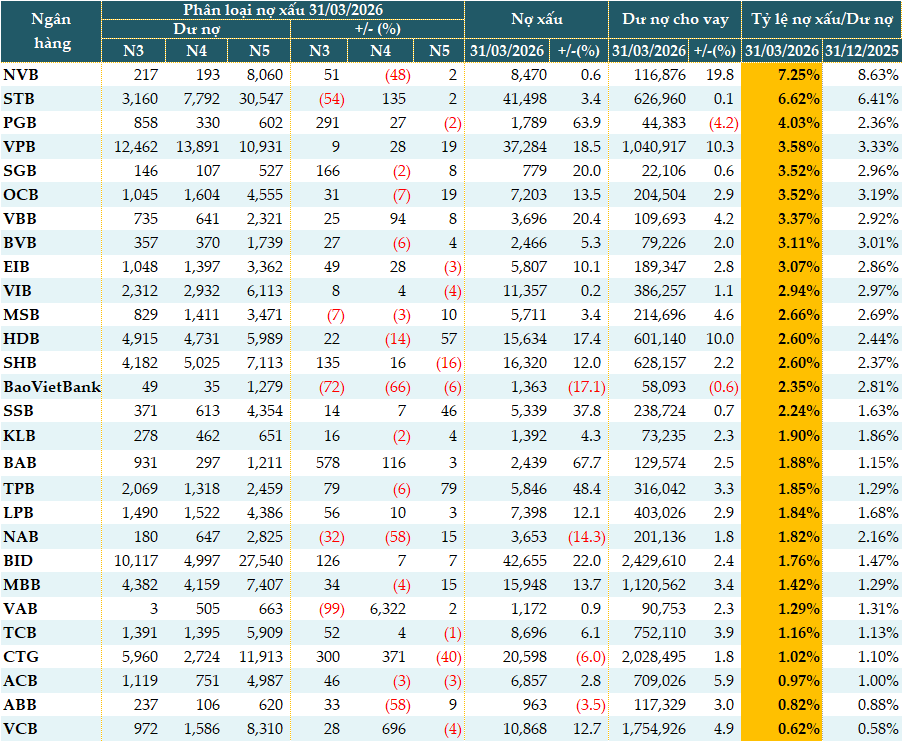
Bank risk-absorption capacity is weakening as non-performing loans (NPLs) rise and loan-loss coverage falls. This increases the sensitivity of profits in subsequent quarters to provisioning costs. The current risk therefore reflects not only higher bad debts, but also a reduced ability of some banks to absorb losses compared with earlier periods.
According to VietstockFinance data, as of 31/03/2026, total outstanding loans of 28 banks that published Q1 results reached 14.68 quadrillion dong, up 3.74% from the start of the year. Excluding PGBank (-4.2%) and BaoVietBank (-0.6%), credit growth among the remaining banks was positive.
The strongest loan growth was recorded at NCB (NVB) (+19.8%), followed by VPBank (+10.3%), HDBank (+10%), and ACB (+5.9%).
Total NPLs at end-Q1 2026 for these 28 banks were 293,201 billion dong, up nearly 11% from the start of the year. The NPL/loan ratio rose to 2% from 1.87% at the start.
Only four banks recorded lower NPLs by end-Q1 2026 (eight at the start), with an average decline of about 10%. Banks cited as showing improving asset quality include ABBank (-3.5%), VietinBank (CTG) (-6%), Nam A Bank (NAB) (-14.3%), and BaoVietBank (-17.1%).
By contrast, Bac A Bank (BAB) recorded the largest surge in NPLs, up about 68% to 2,439 billion dong, followed by PGBank up nearly 64% to 1,789 billion.
In terms of NPL composition, underperforming loans (Group 3) rose nearly 36%, doubtful loans (Group 4) rose more than 22%, while loss loans (Group 5) rose only about 1%. Despite the slower growth in Group 5, it accounted for almost 58% of total NPLs, while Groups 3 and 4 each accounted for about 21%.
As of 31/03/2026, 19 of the 28 banks had higher NPL ratios than at the start of the year. The number of banks with NPL ratios above 3% increased to 9 from 5. Some banks showed broader improvement by reducing all NPL bands, including BaoVietBank and across NAB, ACB, and MSB.
Beyond on-balance-sheet NPLs, the article highlights the importance of NPL 2 and the NPL coverage ratio to assess risk more fully. The observed NPL ratio for banks in Q1 2026 is around 1.85%, close to the high range seen in 2024–2025. NPL 2 declined to about 1.29%, well below 2.23% in Q1/2024; however, this alone does not indicate broad asset-quality improvement.
The coverage ratio fell to around 87.65% in Q1/2026, lower than the above-100% levels seen in many quarters of 2024. The article notes that when NPLs rise while coverage declines, profits in subsequent quarters become more sensitive to provisioning costs. Overall, the risk is driven by both increasing NPLs and diminished risk-absorption capacity relative to earlier periods.
Expert commentary characterizes the Q1/2026 NPL trend as a signal to monitor rather than an immediate systemic risk. Key drivers cited include: (1) uneven recovery in cash flow for enterprises and borrowers after periods of high rates and a subdued real estate market, with sectors such as real estate, construction, SMEs, retail, and logistics more affected; (2) rising funding costs making loan rates less likely to fall sharply, while many borrowers remain under liquidity pressure; and (3) some restructured debt from prior periods surfacing as credit-quality assessments are revisited.
The article also notes that some stressed loans may have already been resolved, recovered, or moved into actual NPLs, while the NPL ratio remains elevated. It concludes that the system’s overall liquidity remains broadly stable and that many large banks still maintain relatively safe provisioning buffers, indicating a cyclical adjustment rather than a sudden deterioration across the system.

Premium gym chains are entering a “golden era” that is ending or already in decline, as rising operating costs collide with shifting consumer preferences toward more flexible, community-based ways to exercise. Long-term memberships are shrinking, margins are pressured by higher rents and facility expenses, and competition from smaller, more personalized…