•
•
•
•
•
•
•
•
•
•
•
•
•
•
•
•
•
•
•
•
•
•
•
•
•
•
•
•
•
•
•
•
•


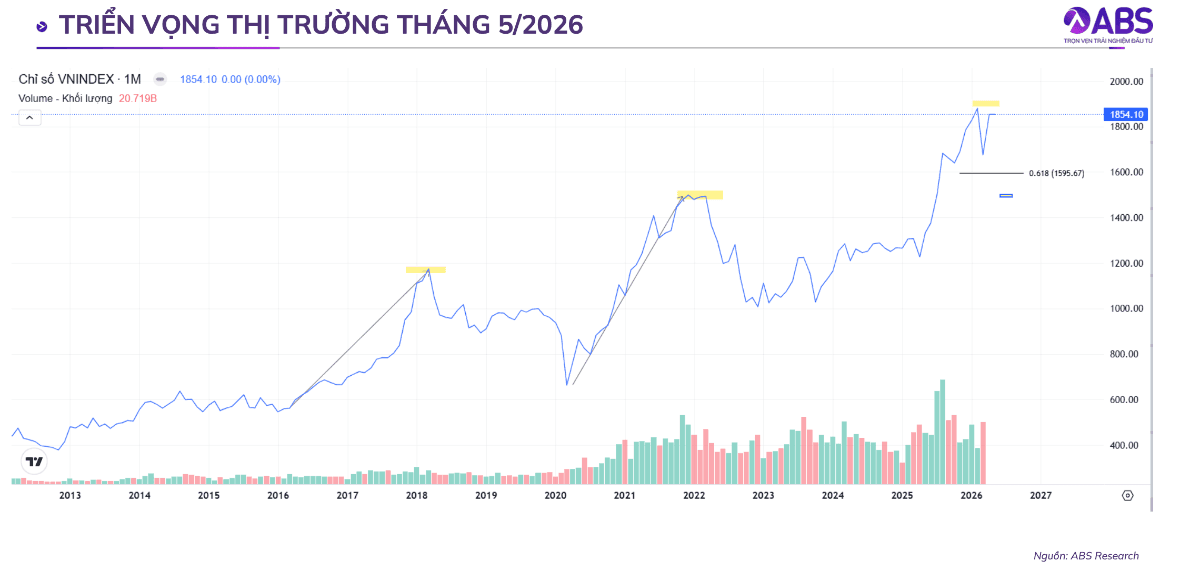
Global markets are increasingly focused on the likelihood that the United States and Iran will reach an agreement to end the conflict, a development ABS Research says is highly feasible. In its latest macro and stock market outlook update, the firm expects Vietnam to sustain strong economic growth in the coming quarters, while highlighting that inflation, exchange rates, and interest rates remain the key macro headwinds.
The prospect of a US-Iran deal is the main factor being watched by major markets. ABS Research notes that if the Hormuz Strait is opened and, as recently reported, the US, UAE, and OPEC members increase oil supply, global oil prices could fall significantly. That would likely ease inflationary pressures worldwide.
With lower oil prices, central banks in major economies may accelerate interest-rate cuts. For Vietnam, ABS expects near-term easing in inflation, interest rates, and exchange rates, supported by reduced pressure on gasoline and production input imports. The firm also points to weaker gold prices and the DXY as additional factors that could help improve Vietnam’s macro conditions, supporting demand and profit margins for Vietnamese goods.
ABS Research forecasts full-year Vietnam GDP growth of 8.6% for 2026. Despite the growth outlook, it reiterates that inflation, exchange rates, and interest rates are still the main macro headwinds. It also expects obstacles to be resolved relatively soon, citing a narrowing credit-deposit gap in the banking system and the possibility of further interest-rate easing in May.
Profit prospects for listed companies over the remainder of the year are expected to diverge. ABS Research says higher production costs and higher interest rates could squeeze margins and sales, particularly for highly leveraged firms dependent on energy inputs and transport. It also expects banks’ net interest margins to face downward pressure due to funding balance pressures and rising non-performing loans.
Several sectors are expected to continue posting positive profitability in the coming quarters, supported by public investment and increased real estate supply. ABS highlights the following areas:
ABS also points to potential gains for industries that remain constrained by export bans in large export nations but still have production capacity in Vietnam, including fertilizers. It adds that BOT infrastructure companies could benefit from traffic shifting from air to road as airfares rise. In addition, the electricity sector is expected to increase generation to meet production and household demand, with El Niño expected to return from Q2 2026.
On valuation, ABS estimates the VN-Index forward P/E at around 13.4x, close to the long-term average. The firm notes that removing the Vingroup group lowers the P/E to approximately 10.5x, which it describes as still attractive for medium- to long-term investment.
ABS says positive information continues to emerge in May, improving Vietnam’s appeal to international capital. It cites Moody’s upgrading Vietnam’s sovereign outlook from “stable” to “positive”. The firm also references discussion that Vietnam could be added to MSCI’s Watch List in the June 2026 review, having met 10 of 18 market-access criteria and actively improving the remaining ones.
ABS expects domestic liquidity to improve as macro pressures ease. It adds that if Circular 22 is amended with reasonable rules and a practical implementation timeline, market liquidity could improve further.
Based on these factors, ABS proposes two market scenarios:
ABS expects the VN-Index to clear the old high near 1,920 points, supported by broad-based liquidity and increasing capital inflows. This would reinforce the uptrend toward the nearest target range of 2,084–2,145 points.
If the Middle East conflict continues to weigh on the global economy, ABS says the market could test 1,750–1,800 points support. The firm characterizes this area as a test of the uptrend, with a possible pause or pullback within the broader trend.
ABS states that stock risk factors have diminished significantly, making it relatively safe to expand mid-term holdings while the market trend remains uncertain. It also suggests that investors who built positions based on March–April reports can hold or add stocks aligned with their objectives.
For short-term traders, ABS recommends increasing trading frequency based on existing support and resistance levels, with preference for stocks that have formed a bottom and are rising in the near term.
The firm highlights companies with positive earnings prospects, solid financial structures, high dividends, reasonable valuations, and stocks likely to attract foreign capital if Vietnam is upgraded.
Premium gym chains are entering a “golden era” that is ending or already in decline, as rising operating costs collide with shifting consumer preferences toward more flexible, community-based ways to exercise. Long-term memberships are shrinking, margins are pressured by higher rents and facility expenses, and competition from smaller, more personalized…