•
•
•
•
•
•
•
•
•
•
•
•
•
•
•
•
•
•
•
•
•
•
•
•
•
•
•
•
•
•
•
•
•


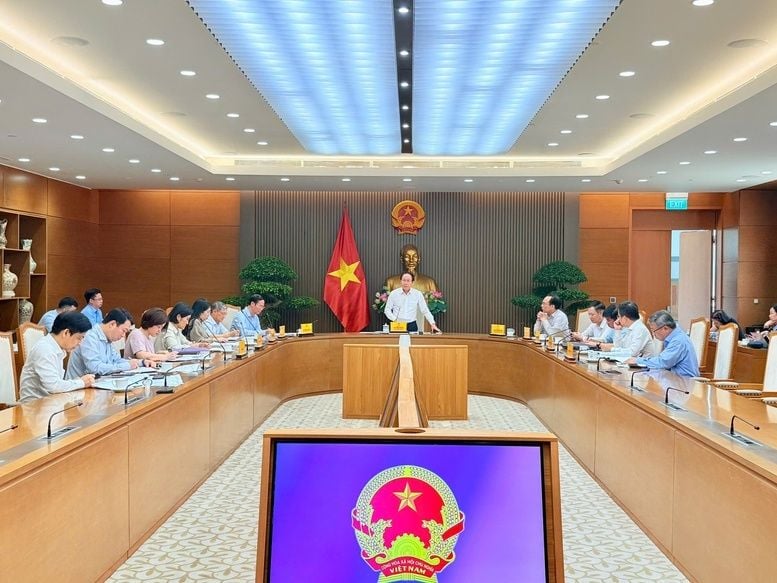
Deputy Prime Minister Le Tien Chau has directed the Ministry of Education and Training to urgently complete the Project on developing several major universities in Southeast Vietnam, while standardizing ranking and evaluation criteria to prevent each project from using different standards.
On the morning of 28 April, Deputy Prime Minister Le Tien Chau chaired a meeting with the Ministry of Education and Training, relevant ministries and agencies, and representatives from several universities in the Southeast region to discuss the Project for developing several large universities in Southeast Vietnam to reach the level of being among Asia’s leading institutions (the Project).
According to the report presented by Minister of Education and Training Hoang Minh Son, the Ministry has built and completed the Project based on input from relevant ministries and agencies and has updated it in line with Party and State policies.
The Project is designed to remain consistent with the national macro orientation for the higher education system and with existing planning, programs, and projects already implemented or underway.
The selection and development investment for three higher education institutions—Ho Chi Minh City University of Economics, Ho Chi Minh City University of Medicine and Pharmacy, and Vietnam-Germany University—will follow a rigorous review process to ensure priority areas, objectivity, and transparency.
The Project’s selection criteria include public flagship universities with high autonomy and existing international prestige. It also emphasizes programs and fields aligned with the region’s strategic labor needs, with a focus on addressing bottlenecks in high-skill manpower such as semiconductor microchips, international finance, smart medicine, and core technologies.
The Project also aims to align goals and resources through three pillars: financial resources, infrastructure, and policy mechanisms.
While agreeing in principle with the Project’s content, Deputy Prime Minister Le Tien Chau asked the Ministry of Education and Training to strengthen understanding of the real situation and to work directly with local leaders.
“Education is not only the work of the Ministry of Education and Training and the education sector, but the entire political system works together, with localities’ roles and responsibilities being very significant,” the Deputy Prime Minister emphasized.
He also required the Ministry to urgently finalize related proposals to achieve the targets set out in Politburo Resolution No. 71-NQ/TW dated 22 August 2025 on a breakthrough in the development of education and training through 2030.
The Deputy Prime Minister set out targets including: at least eight universities in Asia’s top 200 and at least one university in the world’s top 100 in certain fields according to reputable international rankings. He noted that the projects must be completed no later than the end of June.
For the three selected institutions, Ho Chi Minh City University of Economics and Ho Chi Minh City University of Medicine and Pharmacy have concretized development targets. The Deputy Prime Minister requested that the target for Vietnam-Germany University be clearly defined within Asia’s ranking groups.
He stressed the need to specify which ranking tables will be used in the Project and to ensure consistency across MOET projects and plans, so that no project or institution relies on different ranking tables or evaluation criteria. He further requested continued review of component indicators to ensure alignment with the ranking criteria.
The Ministry of Education and Training was asked to review and develop a more detailed list of tasks for each ministry and locality, clarifying tasks, lead units, coordinating units, deliverables, and deadlines.
The Deputy Prime Minister described this as a governance tool to monitor and urge progress regularly, and to assess the completion level of tasks by each ministry, agency, and locality, linked to the responsibility of heads and implementation results.
Resolution No. 71-NQ/TW continues to set a target to allocate at least 20% of the national budget for education and training. To ensure feasibility, Deputy Prime Minister Le Tien Chau asked ministries to work closely with the Ministry of Finance to carefully review the portion of state budget funds planned for allocation. The Ministry of Finance is responsible for budgeting to fully realize the Project’s goals, tasks, and solutions.
Based on contributions from ministries and agencies, the MOET will lead and coordinate to absorb valid opinions and promptly finalize the Project, dossiers, and related documents. The Deputy Prime Minister set a deadline for submitting the finalized Project by May 10, and no later than May, to issue an Action Program.

Premium gym chains are entering a “golden era” that is ending or already in decline, as rising operating costs collide with shifting consumer preferences toward more flexible, community-based ways to exercise. Long-term memberships are shrinking, margins are pressured by higher rents and facility expenses, and competition from smaller, more personalized…