•
•
•
•
•
•
•
•
•
•
•
•
•
•
•
•
•
•
•
•
•
•
•
•
•
•
•
•
•
•
•
•
•



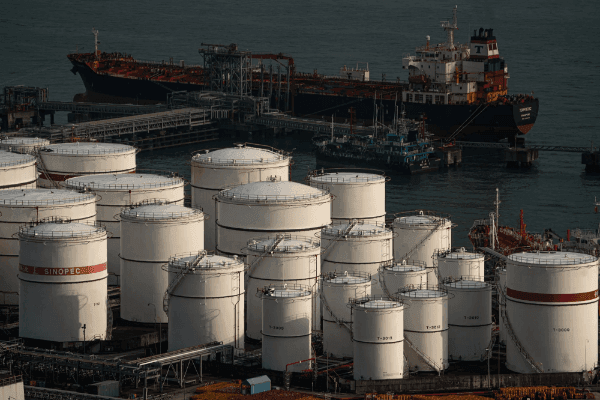
Russia and Iran’s crude oil exports rose by more than 5% in March 2026, according to ship-tracking data cited by Nikkei Asia, despite U.S. efforts to curb earnings for both countries.
Iran’s crude exports reached 1.84 million barrels per day (bpd) in March 2026, up 7% from the prior 12-month average, Nikkei Asia reported, citing data from Kpler.
India resumed imports of Iranian crude in February 2026 after a pause since 2019. Shipments to India in March rose about 80% from February to 130,000 bpd. The report said Iraqi and Saudi supplies—previously a large share of India’s imports—were disrupted by the U.S.-Iran conflict, pushing India to diversify quickly.
At the same time, crude exports via the Hormuz Strait fell sharply. In March 2026, exports through Hormuz declined by 86% from February to 2.07 million bpd.
Saudi Arabia’s total crude exports fell 31% from the 12-month average in March 2026 to 4.32 million bpd. Kpler data cited by Nikkei Asia showed no Saudi shipments through Hormuz since March 6, 2026.
To offset Hormuz disruptions, Saudi Arabia has been exporting crude via pipelines to its western coast and then routing it through Bab el-Mandeb, the gateway to the Red Sea, for shipment to Asia. Crude volumes moved through this route rose 90% in March versus February.
The report said Saudi Arabia is considering expanding the capacity of a new pipeline, while Iran has threatened to close Bab el-Mandeb—both of which could affect global supply flows.
Other Gulf exporters also saw declines: total exports from the United Arab Emirates dropped 37% in March 2026, and from Kuwait fell 80%. Asian demand for Middle Eastern crude imports also fell sharply in March.
The International Energy Agency (IEA) estimated that if a Hormuz closure persists, crude supply through the strait could fall by about 13 million bpd from pre-war levels, equivalent to more than 10% of global supply.
Against this backdrop, Russia increased exports to 5.31 million bpd in March 2026, up 6% from the 12-month average.
The report said the United States has somewhat eased sanctions on purchases of Russian crude to reduce upward pressure on global oil prices. South Korea is also considering buying Russian oil, with KNOC data indicating it would be Korea’s first Russian oil purchase since 2022.
Southeast Asian countries are likewise considering Russia as an alternative supplier. Indonesian President Prabowo Subianto visited Moscow on April 13, 2026, with a request for Russian oil products.
“Crude shipments from western Russia, including Russian and Kazakh oil, have risen sharply since early April 2026,” said Yui Torikata, senior market analyst at Kpler.
Russian oil prices have been rising on stronger demand. LSEG data cited by Nikkei Asia said Urals, Russia’s main export grade, traded near $98 per barrel at the start of the week—about 70% higher than before the U.S.-Iran conflict. Russian crude at the start of the week also traded at a premium to U.S. WTI futures and Brent futures in London.
Earlier, the report said Western sanctions on Russian oil and the G7 price cap had kept Russian crude cheaper than U.S. and European grades.
Exports from Western Hemisphere producers have also increased. Brazil’s crude exports rose 20% in March 2026, while Guyana and the United States also increased shipments. Crude shipments through the Panama Canal in March rose 170% versus February 2026.
Kpler projected that U.S. crude exports would rise 40–50% in April 2026. The report said Washington has urged major oil companies to boost production, but the United States faces constraints on ports capable of handling very large crude carriers, leaving Asia’s ability to absorb additional supply uncertain.




Premium gym chains are entering a “golden era” that is ending or already in decline, as rising operating costs collide with shifting consumer preferences toward more flexible, community-based ways to exercise. Long-term memberships are shrinking, margins are pressured by higher rents and facility expenses, and competition from smaller, more personalized…