•
•
•
•
•
•
•
•
•
•
•
•
•
•
•
•
•
•
•
•
•
•
•
•
•
•
•
•
•
•
•
•
•


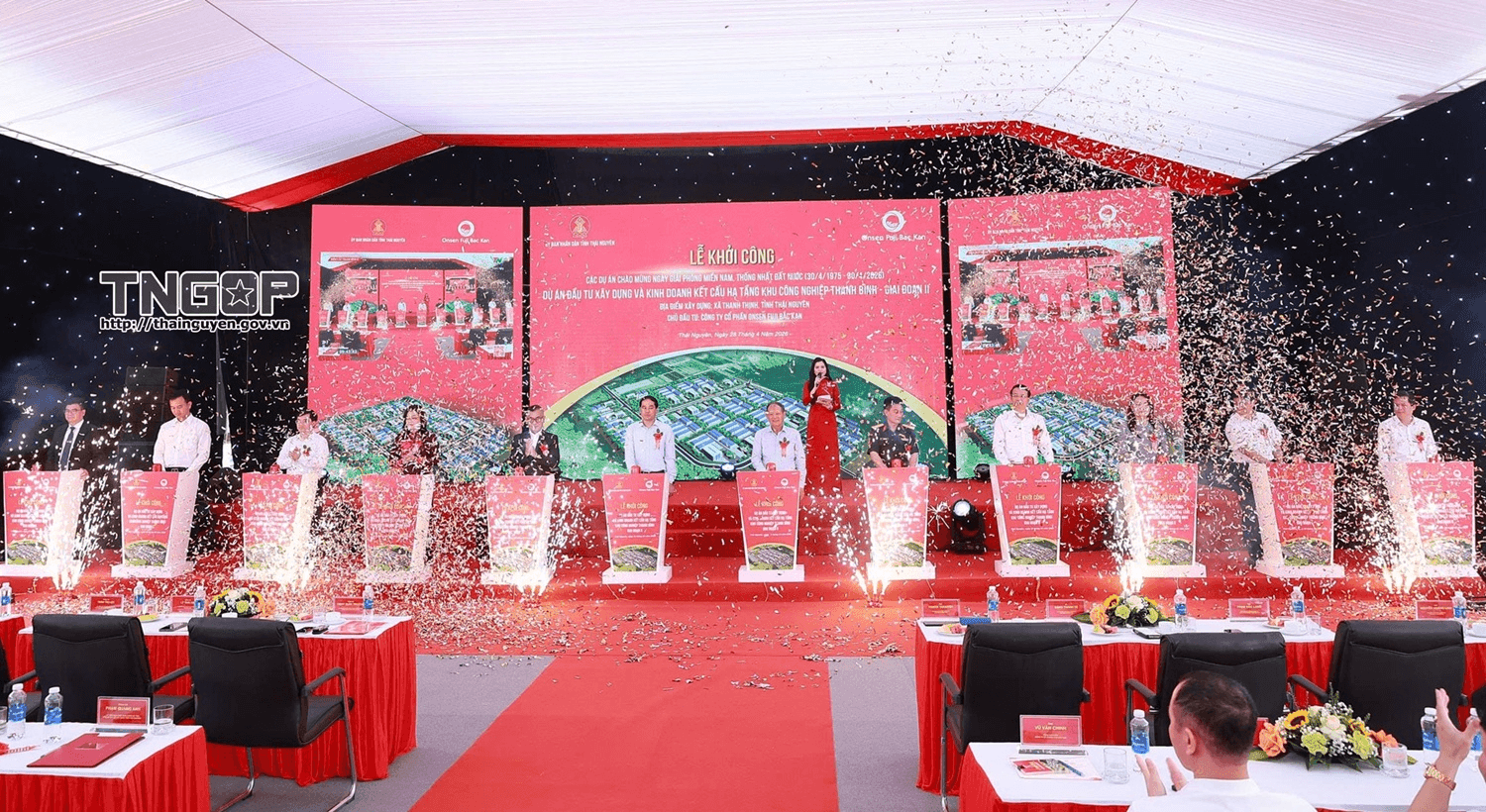
On the morning of April 28, Thai Nguyen Province concurrently launched 10 projects with a total investment of nearly VND 8.5 trillion, spanning infrastructure, industrial parks, herbal medicine processing, urban development and social housing. The ceremony was broadcast live and online from the Thanh Bình Industrial Park infrastructure project – Phase II, connecting with eight other sites in the province. Provincial leaders, representatives of departments and local authorities, and investors, consultants and contractors attended the event. The decision to launch 10 projects with a total investment of nearly VND 8.5 trillion was described as a milestone and a new driver for the province’s socio-economic development.
At Thanh Thịnh commune, the Thanh Bình II infrastructure project covers 80.3 hectares with an investment of over VND 493 billion. The project is led by Onsen Fuji Bac Kan JSC and is expected to attract about 4,724 workers. The industrial park is intended to draw industries including agro-forestry and fishery processing; food and beverage production and packaging; lightweight building materials and new materials; mechanical and electrical-electronic; textiles and footwear; as well as supporting industries and logistics services.
In Diêm Thụy commune, two infrastructure projects for the Hạ Châu 1 and Hạ Châu 2 industrial clusters were launched. Hạ Châu 1 is led by Minh Đức Group, covering 44.69 hectares with total investment of VND 643.64 billion. Hạ Châu 2 is led by Thuong Dinh Group, covering 48.34 hectares with investment of VND 706.88 billion. The clusters are positioned to connect Thai Nguyen with Bac Ninh and other major northern industrial centers, supporting access to logistics systems, supply chains and regional markets.
In Thượng Minh commune, the DONAVI herbal medicine plant project has an investment of VND 229 billion on an area of 4.86 hectares, led by Dong Nam Viet Trading Co. The project focuses on building processing facilities, warehousing for raw materials, modern infrastructure and ancillary works. Upon completion, it is expected to advance deep processing of various herbal medicines, increase product value, create local jobs and promote linked production chains in the herbal medicine sector.
Alongside industrial projects, several urban development and housing projects were also inaugurated, aimed at improving infrastructure and living standards. These include social housing projects in urban areas such as Cái Đan ward, Túc Duyên and An Phú, as well as social housing for workers in Tân Đức commune.
Provincial leadership emphasized rapid and efficient project realization, mobilizing resources and selecting capable contractors to ensure timely delivery with high quality and safety, while complying with laws and environmental protections. Deputy Secretary of the Provincial Party Committee and Chairman of the Provincial People’s Committee, Vương Quốc Tuấn, said Thai Nguyen’s role as a gateway to Vietnam’s Northeast and major northern industrial centers strengthens the province as a growth engine and helps unlock potential across sectors.
The province also continues to prioritize internal and external transport connectivity, strengthen inter-provincial and regional links, expand and upgrade industrial zones and clusters, and promote urban development and social housing for workers to improve the infrastructure and investment environment.
The simultaneous groundbreaking was presented as part of Thai Nguyen’s determination to create new growth drivers for 2026 and beyond. At the eleventh session of the Thai Nguyen Provincial People’s Council, the amendment to the 2021–2030 provincial plan with a vision to 2050 was approved. The plan targets making Thai Nguyen a modern industrial center with high per-capita income by 2030, and by 2050, a centrally administered city with green, smart growth and a strong cultural identity. It also aims to develop Thai Nguyen into a national high-tech industrial center with advanced research, education and healthcare excellence.



Premium gym chains are entering a “golden era” that is ending or already in decline, as rising operating costs collide with shifting consumer preferences toward more flexible, community-based ways to exercise. Long-term memberships are shrinking, margins are pressured by higher rents and facility expenses, and competition from smaller, more personalized…