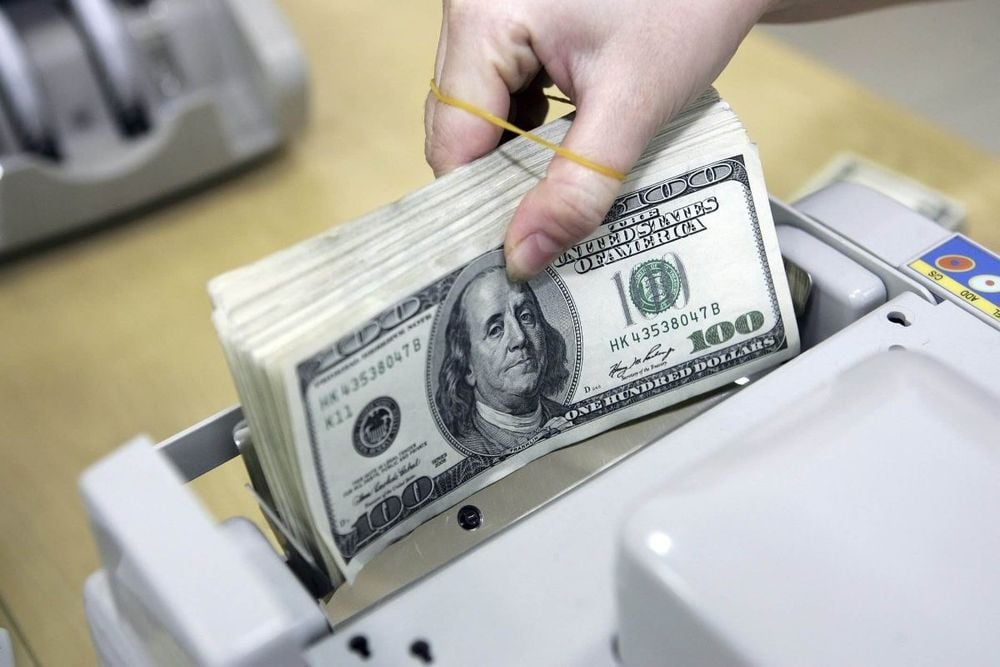
On May 12, the USD exchange rate at banks remained near the operating ceiling, while the free-market USD price fell sharply, narrowing the gap between the two markets to nearly zero. This rare development occurred as the regulator intensified oversight and tightened discipline in the gold and
foreign exchange market in recent times.
Today, the State Bank of Vietnam published the central rate for USD/VND at 25,123, up 5 dong from the May 11 session and up 11 dong from the end of last week. With a +/-5% band, the ceiling rate was raised to 26,379 dong.
A survey of indicative quotes from more than 30 banks at 3:00 PM on May 12 showed the USD selling rate nearly uniformly anchored at 26,379 dong, close to the ceiling allowed by the State Bank. Only a few banks quoted lower rates, such as HSBC at 26,378 dong, Indovina 26,375, MBV 26,368, and VietinBank 26,373.
On May 12, the USD/VND interbank rate traded around 26,330 dong, up about 0.04% from the previous session and up 1.37% from a year earlier. This level remains about 0.39% below the 52-week high of 26,433.
Meanwhile, the DXY index (which measures the dollar’s strength against a basket of six major currencies) rose to 98.15, up 0.19% on the day. Since the start of the year, however, the DXY has fallen about 0.18% and is down 3.58% from the same period last year.
On the buying side, the prevailing bid range typically centers in the 26,090–26,140 dong band. Major banks such as Vietcombank, BIDV, MB, ACB, Eximbank, Sacombank, LPBank, TPBank, etc., quoted buying rates around this band. The highest buying rates were recorded at HSBC and VPBank, at 26,174 dong and 26,166 dong respectively; the lowest was at NCB with 25,770 dong, followed by VietinBank at 25,960.
Because the selling rate remains nearly fixed at 26,379, the spread between banks depends mainly on the buying rate.
The typical spread ranges about 240–280 dong. The group with the smallest spreads is HSBC and VPBank, around 204–213 dong. NCB shows the largest spread, up to about 609 dong due to lower cash buying price. VietinBank also sits in the high-spread group, around 413 dong.
Meanwhile, in the afternoon of May 12, the selling rate for USD in the free market fell by 90 dong versus the previous day, to 26,380 dong.
Thus, the spread between the banking and free-market selling prices is roughly 1 dong. On the buying side, the free-market USD trades around 26,350 dong, about 251 dong higher than the buying rate at banks.
Recent dynamics of USD in the free market show that speculative pressure has cooled significantly. If at the end of March the free-market selling price jumped to around 28,080 dong (about 4.7% higher than the start of the year), by May 12 it had fallen to around 26,380 dong, about 1.64% below the year start.
Notably, the gap between the free market and banks has nearly disappeared, whereas there were times when the free-market USD sold for 1,500–1,700 dong higher per USD. This partly reflects the regulator’s tightening of oversight on the gold and foreign exchange markets, reducing hoarding behavior and helping stabilize exchange-rate expectations.