•
•
•
•
•
•
•
•
•
•
•
•
•
•
•
•
•
•
•
•
•
•
•
•
•
•
•
•
•
•
•
•
•


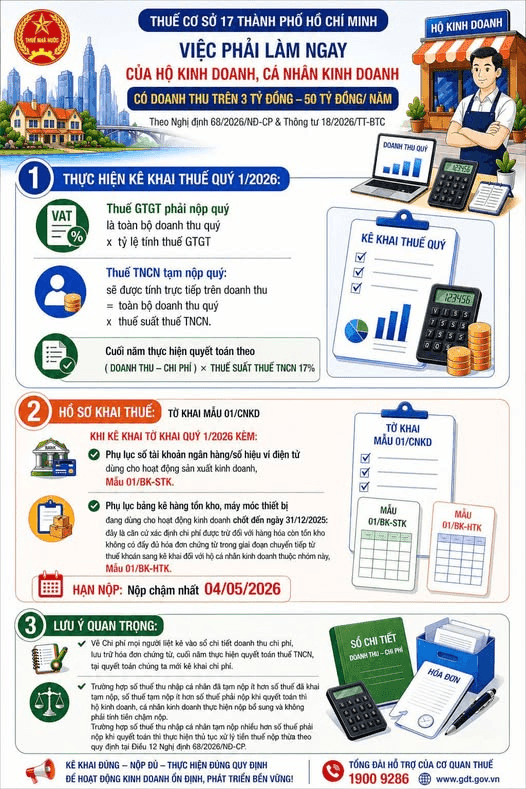
Households and individual businesses with annual revenue of 3–50 billion VND are required to promptly declare taxes, prepare documentation, and file on time under Decree 68/2026/ND-CP and Circular 18/2026/TT-BTC.
Tax authorities urged taxpayers to proactively declare, prepare documents, and meet tax obligations on schedule to support stable business operations and legal compliance.
For tax filing, taxpayers must use Form 01/CNKD. When submitting Q1/2026 tax declarations, related appendices must be attached.
Tax authority guidance states that the inventory declaration appendix must reflect the full value of goods still existing at year-end. If machinery and equipment are used for business activities, taxpayers must declare them clearly to support tax administration.
The deadline to file Q1/2026 tax declarations is May 4, 2026 at the latest. Tax authorities advised business households to prepare records, verify data, and complete declarations before the deadline to avoid violations or penalties for late submission.
Authorities also noted that only expenses supported by proper documentation may be deducted as legitimate costs. Taxpayers should retain these records to support PIT finalization and to provide explanations if requested by tax authorities.
If the provisional tax paid is less than the final tax payable, taxpayers must settle the difference as required. If the provisional tax paid is higher than the final tax payable, the excess will be handled in accordance with current tax law.
For households subject to the declared tax method, maintaining complete books, documentation, and related files is essential for transparency in business operations and tax management.
If any issues arise, households and individuals may contact their managing tax authority or the nearest tax office for timely guidance and assistance.







Premium gym chains are entering a “golden era” that is ending or already in decline, as rising operating costs collide with shifting consumer preferences toward more flexible, community-based ways to exercise. Long-term memberships are shrinking, margins are pressured by higher rents and facility expenses, and competition from smaller, more personalized…