•
•
•
•
•
•
•
•
•
•
•
•
•
•
•
•
•
•
•
•
•
•
•
•
•
•
•
•
•
•
•
•
•
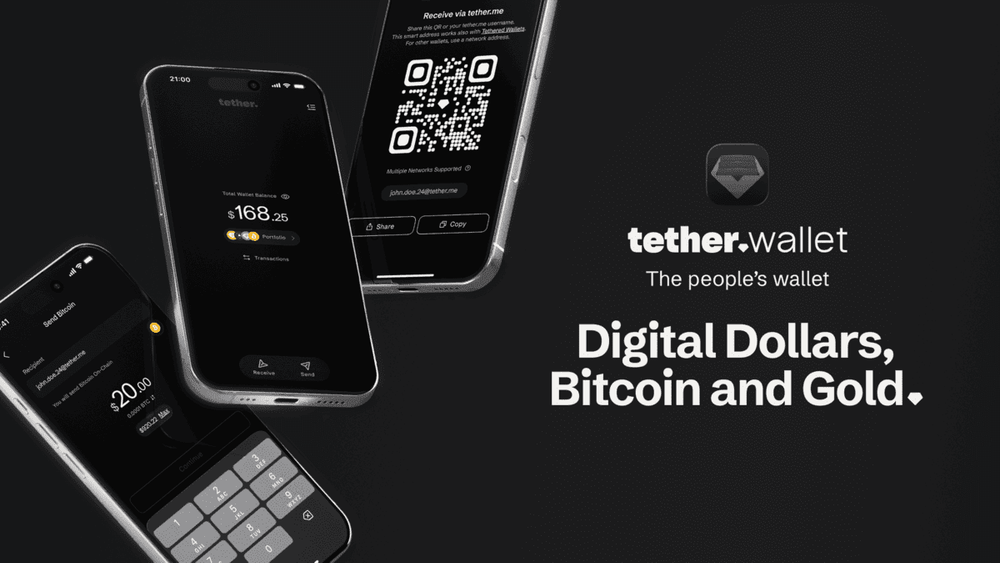
Tether launched a self-custody wallet that enables users to send and receive USDT, USAT, XAUT and bitcoin directly, without intermediaries and across multiple blockchains. The initiative represents a strategic shift for the company, moving beyond operating primarily as infrastructure for exchanges and payment networks to offering a product directly aimed at end users.
The wallet is designed to address two key barriers to broader crypto payments adoption. First, it allows transaction fees to be paid using the same asset being sent, removing the need to hold additional gas tokens. Second, it replaces long wallet address strings with human-readable identifiers such as “name@tether.me,” simplifying the user experience.
Tether said more than 570 million people already interact with its technology, typically indirectly via exchanges or payment rails. With the new wallet, those functions are brought into a direct interface where users control their own private keys and sign transactions from their own devices.
The wallet was developed using the Wallet Development Kit (WDK), an open-source toolkit Tether had previously created for third-party projects. Tether cited the Rumble wallet as a notable example that uses Tether’s infrastructure to support payments to content creators and peer-to-peer transfers.
CEO Paolo Ardoino described the product as “the People’s Wallet” and framed it as an evolution of Tether’s role—from building the foundations of the digital asset economy to making them directly accessible to anyone. Ardoino also referenced a future in which tens of billions of humans, machines and trillions of artificial intelligence agents transact seamlessly and at the speed of light.
Bitcoin (BTC) investors who use steady dollar-cost averaging (DCA) may be underperforming versus strategies that adjust exposure to the market’s cycle, according to new research arguing that Bitcoin’s behavior differs from traditional long-duration assets.
In a report cited by Markus Thielen of 10x Research, Bitcoin’s market…