•
•
•
•
•
•
•
•
•
•
•
•
•
•
•
•
•
•
•
•
•
•
•
•
•
•
•
•
•
•
•
•
•


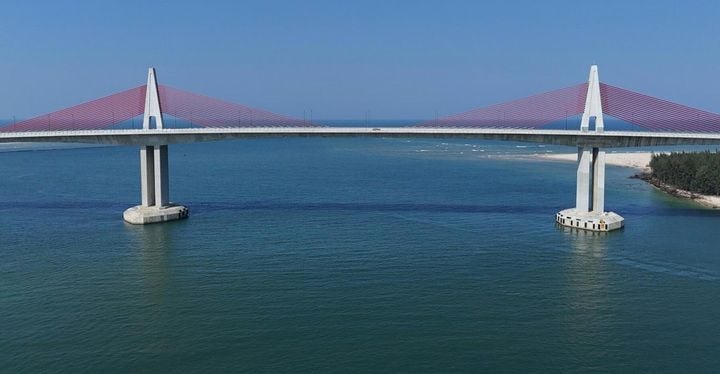
On the morning of April 30, the Huế City Project Management Board announced that the Thuận An sea-crossing bridge had officially opened to traffic.
According to the board, the project has basically completed the main components, including the asphalt pavement, lighting system, guardrails, signs, and lane markings, enabling initial operation.
Some auxiliary items, such as sidewalks and the drainage system at the end of the route, will continue to be completed in the near future. The entire route is expected to be completed in sync by June 30.
The Thuận An sea-crossing bridge, described as the longest sea-crossing bridge in Central Vietnam, officially opened to traffic on the morning of April 30.
The project route along the coastal road through Huế and the Thuận An sea-crossing bridge began on March 24, 2022. It was initially planned for completion by March 2025, but progress was delayed due to issues with land clearance.
Phase 1 has a total investment of about 2,400 billion VND, of which the bridge construction cost is over 2,088 billion VND.
To date, the Thuận An crossing bridge is the longest sea-crossing bridge in Central Vietnam, with a length of 2.36 km and a width of 20 m. The bridge has four lanes, and its main spans exceed 200 m.
The structure uses permanent reinforced concrete and prestressed reinforced concrete, combining girder and cable-supported spans for the main spans, with the longest span over 200 m.
The investor is the Huế City Project Management Board. The contractor consortium includes Tan Nam Construction Joint Stock Company, Dat Phuong Group, and Hoa Bình 479 Joint Stock Company.
When completed, the road and bridge are expected to contribute to coastal infrastructure connectivity and promote economic and tourism development in the Thuận An estuary area and surrounding regions.






Premium gym chains are entering a “golden era” that is ending or already in decline, as rising operating costs collide with shifting consumer preferences toward more flexible, community-based ways to exercise. Long-term memberships are shrinking, margins are pressured by higher rents and facility expenses, and competition from smaller, more personalized…