•
•
•
•
•
•
•
•
•
•
•
•
•
•
•
•
•
•
•
•
•
•
•
•
•
•
•
•
•
•
•
•
•


The U17 Southeast Asia Championship 2026 title run by coach Cristiano Roland has highlighted a different kind of success: a structured system built around Hanoi FC’s training ecosystem. From a semifinal turning point to a final that confirmed the team’s level, U17 Vietnam’s performances reflected repeatable preparation and coordinated execution.
U17 Vietnam’s 2-1 semifinal win over U17 Australia was a hinge moment, not only because it secured a place in the final, but also because of how the team responded after falling behind. Rather than breaking down, the young players maintained structure, controlled the tempo, and waited for their moment.
The decisive 2-1 goal came from Nguyen Luc via a set piece. Roland said he had prepared for scenarios even if the team conceded first, underscoring the level of initiative and meticulous planning in how the approach was communicated to the players.
In the final against Malaysia, U17 Vietnam faced an opponent that used two compact defensive lines. The team did not rush. Instead, it built attacks patiently, stretched Malaysia’s block, and attacked weaknesses.
U17 Vietnam’s goals reflected the same system-driven approach: the opening goal by Quy Vuong came from a set piece, the second goal was marked by Nguyen Luc with a through pass to Van Duong for 2-0, and the third goal came from a coordinated move. U17 Vietnam won 3-0 by dominating the match, controlling tempo, and solving the game with multiple options.
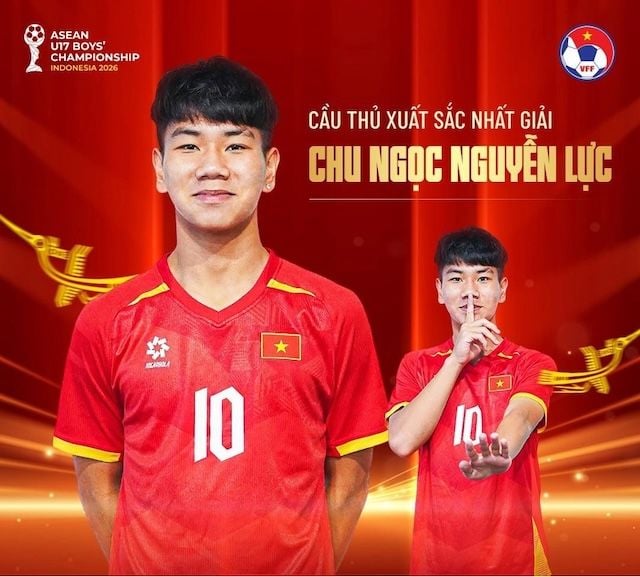
Chu Ngoc Nguyen Luc was awarded the tournament’s Best Player. Born in 2009, he stood out with four goals and a playmaking role within Roland’s 4-1-4-1 formation. He connected lines, regulated tempo, and created decisive moments at key times.
His influence extended across the tournament. In the group stage, his double free kicks contributed to a 10-0 win over East Timor. In the semifinal, he scored the decisive set-piece goal against Australia. In the final, although he did not score, his through ball opened the path for Van Duong to make it 2-0, enabling U17 Vietnam to control the match and finish 3-0.
The award, the article notes, was not simply tied to top scoring. Nguyen Luc’s impact came from controlling the game, reading play, and making timely decisions—an individual outcome presented as a product of the broader system.
Roland’s approach is described as one that builds teams through structure rather than inspiration alone. Starting from the player base at Hanoi FC, he shaped a philosophy centered on organization, discipline, and repeatable processes.
Under Roland, U17 Vietnam showed stability in the early phase of the tournament. The victory over Australia is described as a turning point, shifting the team from being difficult to beat to one capable of defeating strong opponents. The article also links Roland’s development to Hanoi FC’s long-term thinking, including the club’s role in developing both players and coaches.
Hanoi FC contributed five players to Vietnam’s U17 squad, with their value presented as an operating hub within the team. Nguyen Luc and Quy Vuong are highlighted as two key links: Nguyen Luc plays deeper, controlling tempo, connecting midfield, and creating decisive passes, while Quy Vuong operates higher and appears in critical moments, including set pieces and penetrating the box.
Because both players were trained in the same environment under the same philosophy, their on-field understanding is described as natural and highly repeatable—especially in set pieces and transitions. The article attributes this coherence to an open training model supported by a satellite network, broad talent scouting, and standardized player development.
The article points to a 16-match unbeaten run for U17 Vietnam, consisting of 10 wins and 6 draws, alongside 55 goals scored and only 5 conceded. It also emphasizes that the team could win in multiple ways—set pieces, transitions, and collective moves—presenting the title as the result of a complete, system-based team rather than a single moment.
From Cristiano Roland’s step-by-step elevation of the team to the Hanoi ecosystem that produced pillars such as Nguyen Luc and Quy Vuong, the squad is described as one that not only knows how to play but knows how to win. With a 17-year-old playmaker able to command matches, score at decisive moments, and be named Best Player, the article frames the achievement as evidence that the system behind Vietnamese youth football is operating correctly and setting new standards.
Premium gym chains are entering a “golden era” that is ending or already in decline, as rising operating costs collide with shifting consumer preferences toward more flexible, community-based ways to exercise. Long-term memberships are shrinking, margins are pressured by higher rents and facility expenses, and competition from smaller, more personalized…