•
•
•
•
•
•
•
•
•
•
•
•
•
•
•
•
•
•
•
•
•
•
•
•
•
•
•
•
•
•
•
•
•


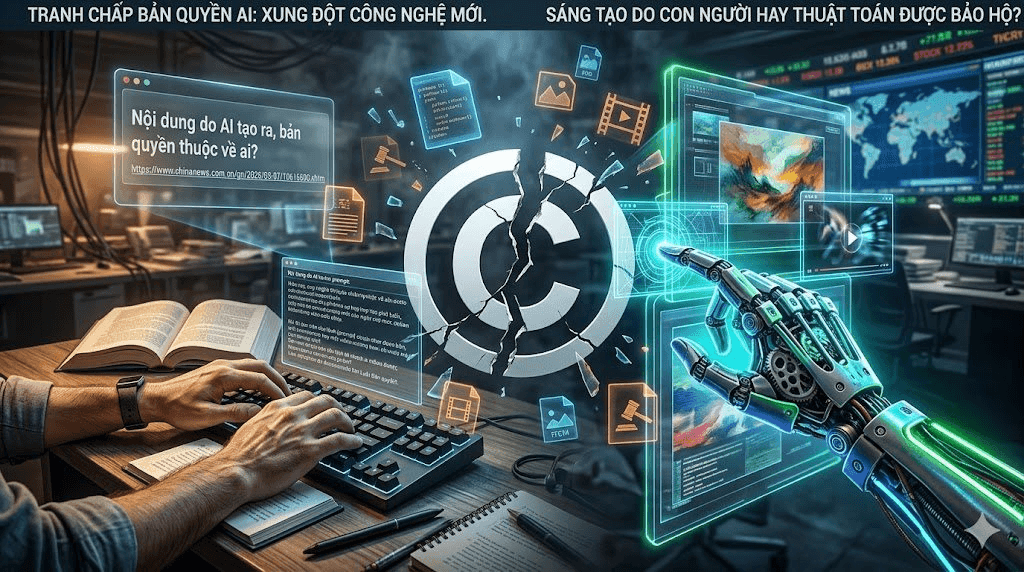
As works produced through cooperation between humans and machines become more common, copyright disputes associated with them have also been increasing. Generative artificial intelligence (AIGC) is accelerating development and dissemination, and human–machine collaborative works are penetrating many aspects of life. When AI uses a user’s prompt to generate text, images, or video, questions arise over who should own the copyright, whether user prompts count as works themselves, and how copyright law should apply.
The rapid expansion of generative AI is reshaping content creation. From graphic design and video production to advertising content, AI is increasingly used as a toolkit across multiple fields. It is also opening new avenues for individual creators.
Tiểu Vũ, a Chinese content creator who makes short videos using AI, frequently uploads AI-generated videos and shorts to his personal account. His content covers topics ranging from science fiction and history to pets. Some videos have attracted large audiences and generated revenue.
According to Tiểu Vũ, producing a video with AI has been simplified. After uploading a still image of the main character, users can select camera angles, lighting parameters, and the number of scenes within the AI software. Users then enter reference content and prompts based on a predesigned template, and the system automatically generates a complete video product.
This workflow, he says, improves efficiency and enables “super individuals” to complete tasks that previously required an entire team.
A China IP innovation survey shows that roughly 80% of respondents hold a positive attitude toward AI, while over 50% say their companies have deployed AI technology. Despite this adoption, debates over authorship rights for AI-assisted content are increasing.
Zhao Hu, a partner at Zhongwen Beijing Law Firm, said the current disputes resemble early questions raised by photography technology—whether a photographer’s image should be protected by copyright. Zhao Hu suggested that future determinations of authorship for AI-created products may depend on the extent of human participation and intellectual contribution, and whether those contributions make the work original.
“The key lies in human investment in originality.”
For Tiểu Vũ, a key concern is whether he can defend his rights if an AI-made video he produced is copied and reposted by others for profit.
In practice, AI copyright disputes are being adjudicated in different directions by different courts.
In April of this year, the Datan and Resource Court of Wuxi City, Jiangsu Province, heard a case involving an AI-generated video. A blogger named Li was copied by another person, Feng, who reposted the videos and profited from them.
The court found that Li was the direct creator of the scripts, narration, and subtitles, and that Li repeatedly adjusted the prompts and instructions provided to the AI system. The court said these actions reflected the creator’s aesthetic choices and personal imprint, while the AI functioned as a technical tool.
As a result, the court concluded that Li’s final video was an original audiovisual work protected by copyright law. Li was recognized as the author, and Feng was ordered to pay Li 100,000 yuan in damages plus legal costs.
In another case heard by the Huangpu District People’s Court of Shanghai, a creative-art company claimed that prompts it authored were used directly by others to generate images from text.
The court determined that the prompts were only a simple list of elements without syntactic coherence and did not show the author’s personal creative imprint. It therefore concluded the content was not a work and did not receive copyright protection.
Chu Yu, an associate professor at the Chinese People’s Public Security University, argued that in AI content creation, if a user’s labor aligns with the Sweat of the Brow principle, the author may obtain copyright through effort. He also said that content expressing originality in a fixed form is generally protectable as an author’s work.
However, not all AI-related content is automatically protected. Zhao Hu said originality can be understood in two ways: first, the work must be independently created and not copied from others; second, it must reach a certain level of creativity. He added that copyright protects a “work,” not a “product,” and that functional products fall within patent law.
As AI becomes more common, additional issues are emerging, including AI rewriting articles, AI-generated misinformation, and using AI to edit original works for profit. Chinese and other countries’ illustrators and photographers have reported that their works have been modified by AI and exploited commercially without permission.
According to Xinhua News Agency, using AI to “lightly modify” original works is still considered copyright infringement. It also noted that posting AI-generated information without verification can be viewed as unfair competition.
To protect their rights, Chinese experts advise creators to document the entire AI-assisted creation process, including prompts, adjustment steps, parameters, and related instructions. They also recommend checking copyright terms in platform agreements and considering registering copyright rights soon after completing a work.
Chu Yu identified three principles for AI-generated content: do not infringe on others’ rights; do not contravene public interest or societal ethics; and comply with legal obligations, such as labeling AI-generated content as required.

Premium gym chains are entering a “golden era” that is ending or already in decline, as rising operating costs collide with shifting consumer preferences toward more flexible, community-based ways to exercise. Long-term memberships are shrinking, margins are pressured by higher rents and facility expenses, and competition from smaller, more personalized…