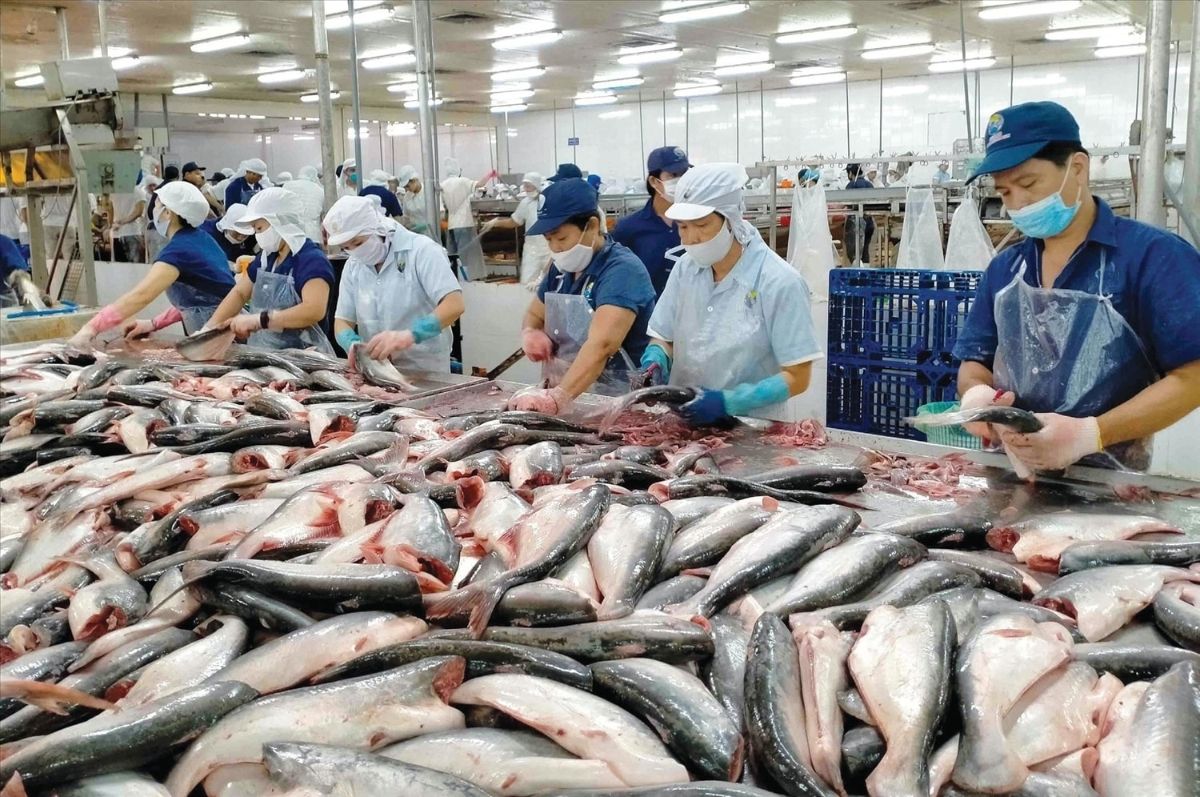
Vietnam’s seafood exports continued to recover in the first four months of 2026, rising 15% year-on-year. The Chinese market posted the strongest growth, while exports to the United States declined.
In April, seafood exports reached $947.8 million, lifting the four-month total to $3.7 billion, up nearly 15% year-on-year.
China, Japan and the United States remained the top three export markets over the period, accounting for 26.7%, 13.8% and 13.0% of total export value, respectively.
To reach $12 billion in annual seafood exports for 2026, VASEP said the sector needs urgent removal of barriers related to institutions, inputs and administrative procedures.
Speaking at the conference “Promoting exports of agricultural, forestry and seafood products, ensuring the growth target for 2026” in Ho Chi Minh City, Nguyen Hoai Nam, General Secretary of VASEP, said the seafood sector still has an opportunity to achieve an 8–10% growth target. That would correspond to export value of above $12 billion in 2026 if timely support is provided by the Government, ministries and local authorities through institutional reform, reducing compliance costs, and addressing international trade barriers.
VASEP said the sector is still facing multiple challenges, including raw material shortages, labor shortages, high production costs, disease, anti-dumping investigations, and stringent technical regulations and import requirements from major markets.
The association also highlighted the need for more flexible administrative procedures—particularly around the issuance of documents for export shipments—to avoid additional costs and delivery delays.
VASEP urged the Ministry of Agriculture and Environment to promptly amend Circular 81/2025 and Circular 74/2025 to remove obstacles in exporting seafood from wild capture to the EU and US markets. VASEP said the amendments should support digitization of processes, simplify paperwork, and standardize procedures across localities, especially for small-scale fishing to meet origin-tracing requirements while supporting fishermen’s livelihoods.
On anti-capture IUU measures, VASEP proposed reviewing the concept of “bulk cargo” for seafood imports to better match real trade practices, and adjusting regional harvest regulations to reflect domestic fishing characteristics.
VASEP noted that many fishing vessels longer than 15m but with small capacity could face higher costs if forced to operate far offshore, affecting fishermen’s livelihoods and the supply of legally sourced materials for processing exports.
The Government and the Ministry of Agriculture and Environment should task VASEP with researching and developing a plan to advance the supply of seafood raw materials for processing and export, aiming to reach 15–20 billion USD in export value per year in the next period.
VASEP said labor shortages remain a major concern for seafood processing. The association called on the Government and localities to implement measures to stabilize the workforce, limit mass outward labor migration in regions with labor shortages, and rationally plan occupational sectors within the same locality to avoid labor competition.
For raw material development, VASEP proposed a comprehensive program to stabilize and develop supply from domestic farming and fishing as well as imported materials. The plan should focus on improving broodstock quality, disease control, reducing production costs, and continuing investments in fishing infrastructure, ports, vessel monitoring and origin-tracing databases to support anti-IUU efforts.
VASEP also proposed amendments to the Food Safety Law and Environmental Protection Law toward risk-based management, along with higher post-inspection checks, to facilitate export-oriented production.
In addition, the association suggested allowing enterprises in industrial zones to flexibly connect to, or be exempt from, centralized wastewater treatment if they have invested in and installed compliant treatment systems with automatic monitoring.
On infrastructure investment, VASEP recommended that the Government study mechanisms to attract private investment in irrigation and aquaculture infrastructure, and publish a provision to allow the establishment of an Export Promotion Fund to help companies expand markets.
For credit and international trade, VASEP called for continued favorable credit packages for the agricultural, forestry and fishery sectors to facilitate access to capital, alongside stronger economic diplomacy and trade promotion in major markets including the United States, EU, China, Japan, Korea and the Middle East.
VASEP also asked ministries to continue supporting enterprises in responding to anti-dumping, anti-subsidy, environmental regulations, origin tracing and forced labor requirements in major import markets.
VASEP said the seafood industry will continue to innovate technology, improve compliance, develop value-added products and diversify markets, aiming to build Vietnam’s seafood industry as transparent, responsible and sustainable.