•
•
•
•
•
•
•
•
•
•
•
•
•
•
•
•
•
•
•
•
•
•
•
•
•
•
•
•
•
•
•
•
•


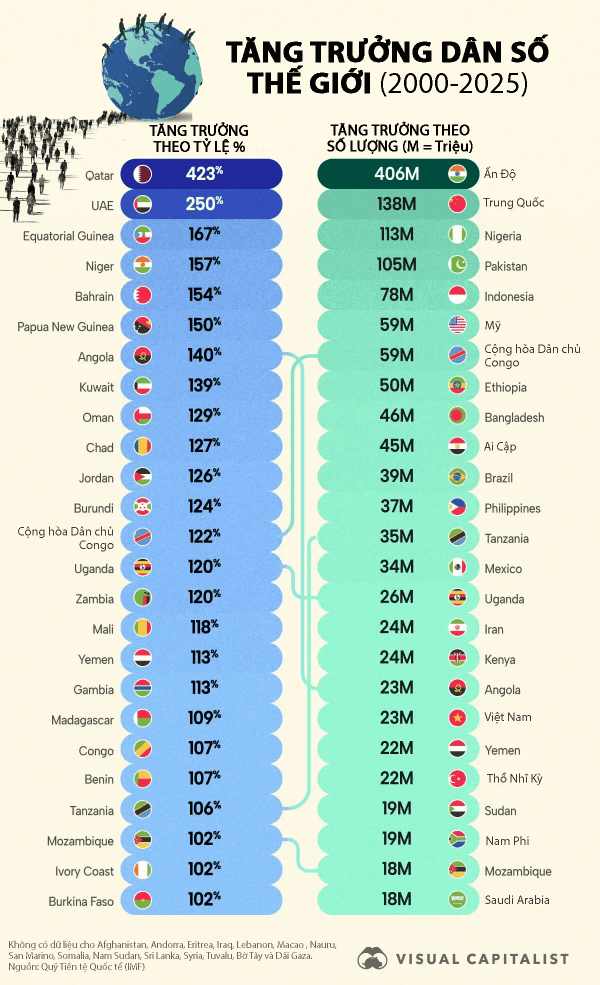
According to data from the International Monetary Fund (IMF), the global population growth picture for the period 2000–2025 shows a clear difference between the two leading groups depending on whether growth is measured by percentage or by the number of people added.
When assessed by percentage, the list mainly consists of small-population economies in the Gulf and Africa. The world leader in population growth rate by percentage is Qatar, with a 423% increase over the past 25 years. Behind it are the United Arab Emirates (UAE) with 250%, Equatorial Guinea with 167%, Niger with 157%, and Bahrain with 154%.
This pattern indicates that in countries with smaller initial population sizes, percentage increases tend to be more pronounced.
When assessed by the number of people added, Asia and Africa dominate the ranking. India ranks first with an increase of 406 million people over 2000–2025, nearly three times China’s increase of 138 million. Nigeria is third with 113 million added, followed by Pakistan with 105 million and Indonesia with 78 million. The United States is also in the top group, with an increase of 59 million people.
Some countries appear in both the percentage and absolute growth lists, including the Democratic Republic of Congo (DRC), Uganda, Angola, Yemen, Tanzania, and Mozambique. This suggests that population growth in these countries is occurring rapidly both in relative terms and in absolute numbers.
Vietnam appears among the countries with the strongest population growth in absolute terms, with a population increase of 23 million people over the 2000–2025 period.






Premium gym chains are entering a “golden era” that is ending or already in decline, as rising operating costs collide with shifting consumer preferences toward more flexible, community-based ways to exercise. Long-term memberships are shrinking, margins are pressured by higher rents and facility expenses, and competition from smaller, more personalized…