•
•
•
•
•
•
•
•
•
•
•
•
•
•
•
•
•
•
•
•
•
•
•
•
•
•
•
•
•
•
•
•
•


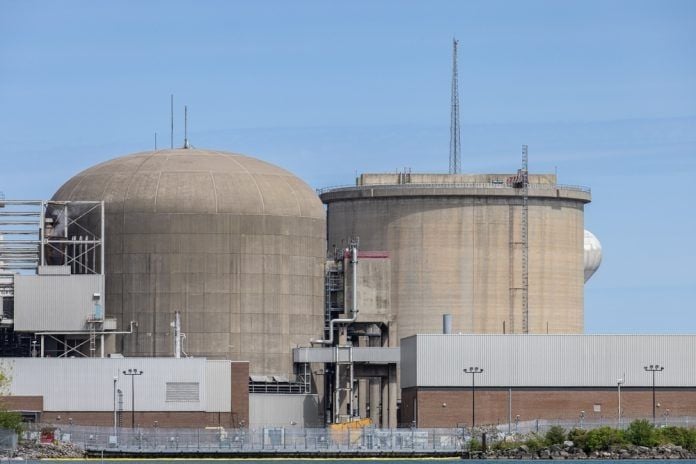
With about 80 years of experience operating its own nuclear technology, Canada has not only the technology but also an industrial ecosystem, uranium resources, training expertise, and operating capability—factors that, according to Dr. Trần Thu Quỳnh, make the country a suitable partner for Vietnam.
Canada’s peaceful development strategy for nuclear energy through 2035, with a vision to 2050, aims to develop and apply nuclear energy in a safe, secure, and efficient manner to support socioeconomic development, improve living standards, protect the environment, and strengthen national energy security, while contributing to the net-zero emissions pledge by 2050.
The country is accelerating investments in nuclear research and development, with billions of dollars in funding to build modern research infrastructure, develop advanced nuclear materials, and provide solutions for radioactive waste handling and management.
Dr. Trần Thu Quỳnh said Canada’s integrated nuclear energy ecosystem—built over decades—demonstrates its potential as a partner for Vietnam. She highlighted strengths not only in technology, but also in training personnel, operating plants, safety management, and deploying technical solutions for the nuclear industry.
For decades, Canada has built its position in the global nuclear industry through CANDU (Canada Deuterium Uranium) reactor technology, a heavy-water reactor using natural uranium.
Dr. Trần Thu Quỳnh emphasized Canada’s expertise across nuclear materials research, reactor design, workforce training, safety management, radioactive waste handling, and developing the industrial supply chain.
Beyond CANDU, Canada is also investing in small modular reactor (SMR) technologies, and is described as the first G7 country to implement a real SMR-based nuclear project.
However, Dr. Trần Thu Quỳnh pointed to practical challenges, including SMR project delays and cost overruns in Ontario. She said each reactor was initially expected to cost about US$1 billion, but current costs have risen roughly sevenfold.
“One major concern is that the actual electricity price from SMRs is not significantly cheaper compared to traditional large-scale reactors,” she noted, adding that this is a consideration for countries such as Vietnam when shaping future nuclear development strategies.
Despite these issues, Canada remains committed to long-term SMR investment. Several provinces—Saskatchewan, Alberta, and New Brunswick—are advancing SMR plans, and the country’s geography, dispersed population, and electricity demand in remote areas are cited as factors making SMRs suitable for Canada.
Dr. Trần Thu Quỳnh said Canada’s direction goes beyond building a limited number of nuclear plants. The broader goal is to establish a comprehensive nuclear industry ecosystem in which Canada plays a central role in the global supply chain.
She cited an agreement worth about US$1 billion between Canada and Poland to develop SMR components manufactured in Ontario. Canada is also expanding financing packages and credit support for countries developing nuclear power. Romania has reportedly received up to US$3 billion in credits from Canada for nuclear projects, and Poland is said to be negotiating similar funding.
Dr. Trần Thu Quỳnh also noted that several Southeast Asian countries—including Singapore, Indonesia, the Philippines, and Thailand—are actively engaging Canada for nuclear cooperation opportunities. She said Canada has launched training programs for Southeast Asian partners, initially focusing on the Philippines and Thailand.
These programs are designed to train engineers and to build a cadre of “trainers” to develop long-term domestic training capacity in partner countries.
“We are seeking similar funding sources to raise Vietnam’s university capacity in the field of nuclear energy,” she said.
Dr. Trần Thu Quỳnh stressed that nuclear development cannot focus solely on technology. It must be accompanied by capacity building, workforce training, and a robust legal framework.
She said Vietnam should prioritize building capacity and the legal framework before selecting a technology—an area where Canada can support Vietnam effectively, given its decades of experience in safety standards, plant operation, fuel management, and workforce development.
Despite challenges, Dr. Trần Thu Quỳnh assessed that Canada remains a highly suitable partner for Vietnam in the nuclear energy sector. She pointed to Canada’s technology base and uranium supply, alongside training experience, safety management, operating know-how, and financial support capabilities.
She also noted that many important nuclear technologies today involve deep Canadian participation. Since late 2023, Westinghouse—described as the U.S. AP1000 technology proprietor—has been acquired by Canadian groups, signaling Canada’s growing influence in the global nuclear industry.
In the context of Vietnam seeking long-term energy security and carbon emission reductions, she said cooperation with Canada in nuclear energy could be a natural step in the bilateral relationship—supporting Vietnam in building internal capacity and gradually participating in a globally strategic industry.
Premium gym chains are entering a “golden era” that is ending or already in decline, as rising operating costs collide with shifting consumer preferences toward more flexible, community-based ways to exercise. Long-term memberships are shrinking, margins are pressured by higher rents and facility expenses, and competition from smaller, more personalized…