•
•
•
•
•
•
•
•
•
•
•
•
•
•
•
•
•
•
•
•
•
•
•
•
•
•
•
•
•
•
•
•
•


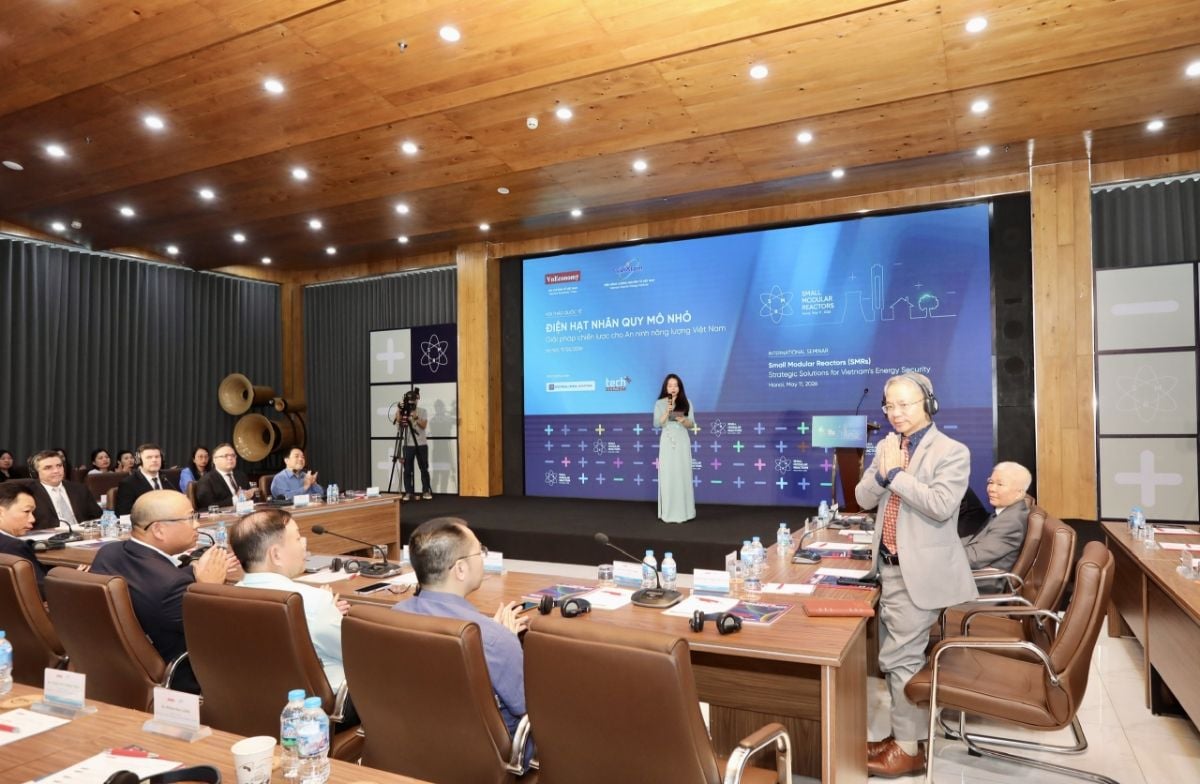
On May 11, at the BMC Center in Hanoi, Vietnam Economic Times/VnEconomy, in collaboration with the Vietnam Institute of Nuclear Energy (VINATOM), hosted an international workshop titled “Small Modular Nuclear Power: Strategic Solution for Vietnam's Energy Security.” Susie Ho, CEO of Laurentis Energy Partners, said the global nuclear sector has entered a “deployment era,” with countries moving from discussion to building real projects.
Ho said nuclear energy for decades has largely been framed around “if” and “when,” but the situation has changed. Countries are no longer only envisioning future nuclear use; they have started implementing concrete projects.
She pointed to 2024 as a turning point, noting that at COP28 more than 20 countries pledged a target to triple global nuclear capacity by 2050. However, Ho said the industry now faces a practical question by 2026: whether commitments can be translated into delivery.
According to Laurentis Energy Partners, nuclear power deployment depends on three core factors: speeding up licensing, ensuring supply-chain readiness, and building a long-term workforce for the coming decades.
Ho added that while earlier years focused on planning, the next five years are expected to be the period for turning plans into reality. She said nuclear power is being driven by decarbonization needs, energy security requirements, and the AI boom.
Ho said the rapid growth of data centers is increasing pressure on power grids. Tech companies, she noted, require green electricity and reliable 24/7 power, and modular small reactors (SMRs) are viewed as one of the most feasible options.
Beyond AI, Ho said heavy industries—including mining, chemical production, hydrogen, and bitumen—are also showing growing interest in SMRs to meet high-temperature industrial heat needs.
Ho referenced the “strategy for peaceful use of atomic energy through 2035, with a vision to 2050,” which aims to develop and apply nuclear energy safely and securely to support economic and social development, protect the environment, strengthen energy security, and contribute to achieving net-zero emissions by 2050.
She forecast that by 2030 there could be 20–30 SMR projects under construction or in advanced licensing, with a total market size of $100–150 billion. Looking to 2050, Ho cited IAEA projections of 400–600 new nuclear projects deployed or operating worldwide, including about 200 SMR projects. She said the global market could reach $1 trillion.
Ho described the deployment era as more than growth in a single market, saying it represents a global energy transition in which ambitions become infrastructure. She said four major trends converge: geopolitical energy security and the non-negotiable nature of energy independence in 2026.
Ho cited several international cases to illustrate how deployment is being pursued.
In Poland, the Orlen Synthos Green Energy (OSGE) joint venture plans to deploy 24 BWRX-300 reactors at six sites. The project is intended to replace old coal-fired plants with SMRs to provide high-temperature steam for heavy industry. Ho said OSGE positions SMRs as the only feasible clean electricity solution for AI-driven economies.
Ho said Sweden is viewed as a model for converting political will into practical deployment programs. After decades of pursuing nuclear phase-out, Sweden now targets adding 2,500 MW of new nuclear capacity by 2045. She said the government has introduced large-scale financial support, including tens of billions of dollars in loans and contingency funds to reduce capital costs, along with investment-protection mechanisms to strengthen private-sector confidence. Ho also said Sweden has refined licensing processes to shorten project lead times.
Ho said Canada is among the pioneers in SMR deployment. She pointed to the Darlington project in Ontario as laying groundwork for the world’s first Western SMR. Ho said Canada is using decades of nuclear experience to reduce risk and extend deployment to Saskatchewan, Bruce Power, and West Levs.
Ho cautioned that the nuclear industry faces significant challenges, including labor shortages, reduced implementation capacity after decades of delays, and supply-chain gaps in meeting nuclear-grade standards. She said many suppliers lack the capability to meet stringent nuclear-quality requirements, and that obtaining international certifications such as ISO 9001 requires substantial investment.
She also highlighted a contracting dilemma: suppliers may be unwilling to invest without contracts, while they cannot win contracts without certified programs.
In addition, Ho said nuclear energy must compete with AI for strategic resources such as copper and high-voltage equipment, with the AI data-center boom contributing to higher prices for many materials. She also cited regulatory fragmentation across countries as a hurdle, arguing that harmonizing standards and legal procedures will be critical to forming a global SMR market.
Beyond technical and human-resource issues, Ho said financing remains the biggest barrier. She noted that nuclear projects require very high upfront costs, with payback periods spanning decades.
Ho said many countries have introduced financial models to reduce investor risk. In the UK, she said the RAB model allows developers to recover some costs during construction rather than waiting for plant operation. In Ontario, Canada, Ho said the CCR mechanism enables recovery of construction-era interest to avoid excessive financing costs.
She added that long-term power-purchase agreements (PPAs) are increasingly important for ensuring project cash flow. Ho said large technology firms—including Microsoft, Google, Meta, and Amazon—are not only electricity consumers but also financial supporters of SMR projects through long-term power contracts.
Ho concluded that Vietnam does not need to carry all financing pressures for its nuclear program. With the right financing mechanism, she said Vietnam can balance state interests, electricity consumers, and international investors, turning substantial capital needs into a long-term growth driver that can be managed as the nuclear program develops.
She said the “deployment era has arrived” and that the world is watching which country will lead the energy order operated by nuclear power. Ho emphasized that Vietnam has both ambition and potential to join the race, and that the key is building the infrastructure needed to turn the country into a new industrial powerhouse in the era of clean energy.

Premium gym chains are entering a “golden era” that is ending or already in decline, as rising operating costs collide with shifting consumer preferences toward more flexible, community-based ways to exercise. Long-term memberships are shrinking, margins are pressured by higher rents and facility expenses, and competition from smaller, more personalized…