•
•
•
•
•
•
•
•
•
•
•
•
•
•
•
•
•
•
•
•
•
•
•
•
•
•
•
•
•
•
•
•
•
With karst geological conditions and challenging terrain, alongside prolonged periods of floods and storms, the Dong Dang–Tra Linh expressway is among the most difficult expressway projects in the country. The project is approaching a key milestone on May 19, when a 62-km technical segment is planned to open.
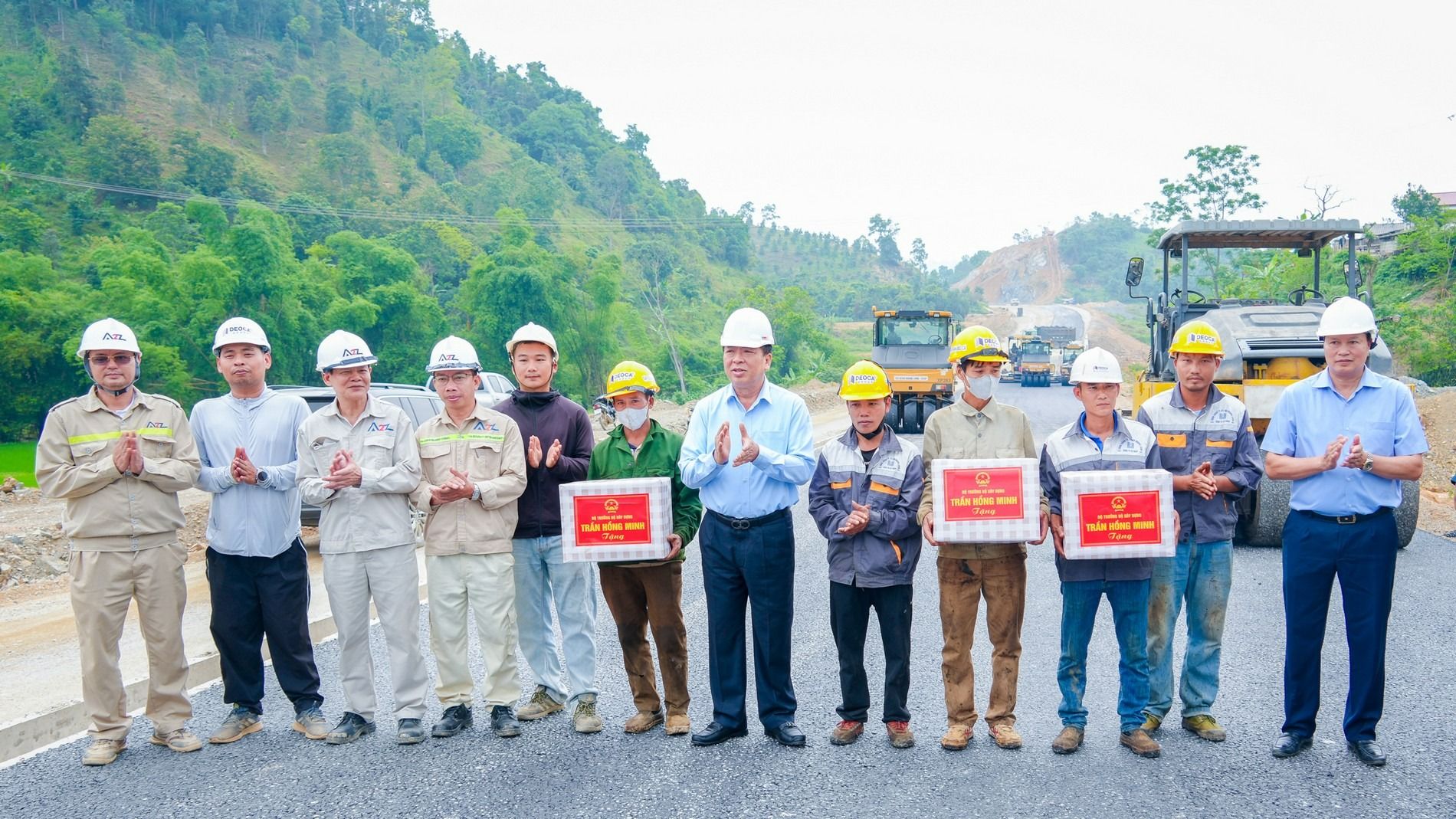
On May 6, Minister of Construction Tran Hong Minh led a working delegation to inspect construction activities on the Dong Dang (Lang Son)–Tra Linh (Cao Bang) expressway. The visit took place as the project nears the crucial opening date of May 19.
According to Dang Tien Thang, CEO of the Phase 1 project, the site currently has 132 construction fronts for bridges, tunnels, and roads, with nearly 900 machines and equipment and more than 2,000 personnel. Some road sections are also widening the roadbed from 17m to 22m in line with the scale of Phase 2.
The contractor is mobilizing four large asphalt concrete laying trains to complete the road surface. To date, the total value of completed civil works for the packages stands at 8,726 out of 14,628 billion dong, equivalent to about 74% of the contract value.
Under the plan, by May 19 the project will open the 62-km technical segment from the Dong Dang border gate (Lang Son) to Dong Khe commune (Cao Bang). The remaining segments will be opened on the existing road. In December, the unit is expected to complete 93km from Dong Dang to Dong Khe on a 22m-wide roadbed.
The Dong Dang–Tra Linh expressway has a total length of 121km and an investment of 26,000 billion dong, connecting Lang Son and Cao Bang provinces. The project faces difficulties due to karst geology, rugged terrain, and the ongoing impacts of floods and heavy rains.
The project is implemented in two stages. Stage 1 covers 93.3km, including 64 bridges crossing the Ky Cung River, Bang Giang River, and many streams and provincial roads. Stage 2 widens 93.35km of Stage 1 and adds 26.47km of new routes to Tra Linh Border Gate (Cao Bang).
When completed, the Dong Dang–Tra Linh expressway will connect with the Huu Nghi–Chi Lang and Bac Giang–Lang Son expressways, forming a major outward-facing highway axis. The route is intended to support goods trade from Vietnam to China and Europe, and to contribute to improved competitiveness and new momentum for economic and social development in Vietnam’s Northeast region.
To accelerate progress, in February the government launched the “Dong Khê 2026” campaign, targeting completion of Phase 1 before May 19. On February 8, the Cao Bang Provincial Military Command organized a send-off ceremony and launched a high-intensity mobilization to implement the campaign, mobilizing hundreds of officers and soldiers.
In the afternoon of May 6, the Cao Bang Provincial Military Command delegation visited to encourage the officers and soldiers of Company 1, Battalion 5, Regiment 852, who are carrying out their duties. The unit reported that in recent times nearly 30 officers and soldiers have overcome weather conditions and difficult terrain, actively assisting construction units by building and reinforcing drainage ditches, rock revetments, pouring concrete at dry streams, making rock gabions, and performing other auxiliary works as required.
The crypto bear market remained in force on Wednesday, with bitcoin slipping back toward the $60,000 area. Sharp pullbacks in gold and oil also weighed on the 2025 “debasement trade,” which had supported hard assets amid concerns about government debt and fiat currencies. Meanwhile, tech—particularly the AI boom—continued…