•
•
•
•
•
•
•
•
•
•
•
•
•
•
•
•
•
•
•
•
•
•
•
•
•
•
•
•
•
•
•
•
•


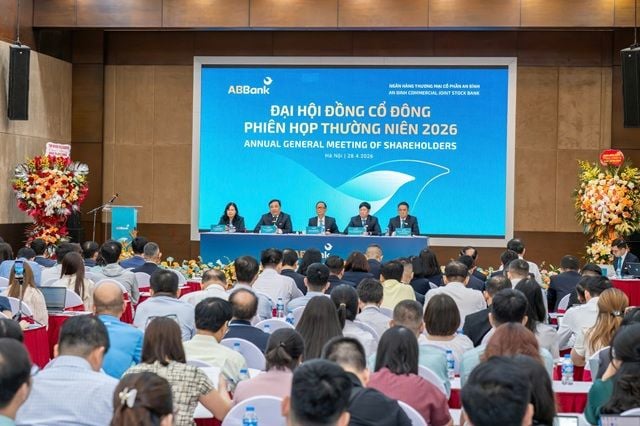
Morning of April 28, ABBank Joint Stock Commercial Bank (UPCoM: ABB) held its 2026 annual general meeting, presenting proposals including the business plan, profit distribution, a capital increase, and a plan to list on the Ho Chi Minh Stock Exchange (HOSE).
For 2026, ABBank set ambitious profitability goals amid constraints on credit growth. Chairman Vu Van Tien said the bank’s profitability drivers include its ability to recover previously classified bad debts, with the Board instructing management to monitor recovery work from the start of the year. Each recovered bad debt is expected to contribute directly to the bank’s 2026 profit.
In response to questions about how ABBank will balance funding and lending efficiency given a wide gap between mobilized funds and lending capacity, CEO Le Man Hung explained that the bank previously maintained a high credit-to-deposit ratio (LDR). In 2024, ABBank’s LDR was consistently between 110% and 120%, at times exceeding 130%, relying on interbank funding (Market 2) to support lending (Market 1). The CEO said that if this approach continued into 2025 when interbank rates rise, it would carry significant cost risk.
Accordingly, the bank’s ALCO Committee reduced the LDR to a safer level of 75%. The CEO also described the current funding position: ABBank mobilizes more than VND 170,000 billion, with outstanding loans around VND 130,000 billion and approximately VND 40,000 billion of liquidity. The bank uses this liquidity in the interbank market to generate profit through a strong net interest margin (NIM), rather than extending loans at lower rates to large corporate borrowers in Market 1.
ABBank also outlined plans to expand non-credit income. The CEO cited credit card development among a customer base of 2.5 million, noting that about 100,000 customers are active in credit transactions. The bank targets issuing 100,000 credit cards with an annual fee of about VND 1 million per card, which would generate roughly VND 100 billion in profit.
On bancassurance, ABBank said it will restructure product distribution by bundling insurance with real-life benefits such as education savings and retirement plans, aiming to generate service-fee income while attracting long-term deposits at reasonable costs.
At the meeting, CEO Le Man Hung said ABBank plans to increase capital by more than VND 20,000 billion through two issuances. He addressed concerns about market uptake by stating he has “absolute confidence” in subscription, linking it to improved operational efficiency and sustained return on equity (ROE) above 20% per year. He added that not only current shareholders but also strategic partners such as Maybank would be willing to participate and inject additional capital.
Chairman Vu Van Tien said the bank’s new brand identity will only “shine” if internal strength is solid. He described the new dove logo as representing peace, happiness, and sustainable development.
On leadership changes, the chairman said his return as chairman is intended to prevent ABBank from becoming complacent under the “An Binh” name over several years, emphasizing that the market is changing and the bank needs a “breakthrough.” He said he has called for streamlining the organization, reforming the business system, and clearly assigning leadership responsibilities. He also said the appointment of a decisive CEO is expected to support progress by combining leadership creativity with the flexibility of a mid-sized bank.
The meeting also highlighted that the 2026 profit target rises by 28%.
ABBank reported after-tax profit in 2025 of VND 2,798 billion. After reserving funds, the bank had VND 5,126 billion. Adding VND 2,311 billion carried forward from previous years, distributable profit stood at VND 4,437 billion.
The bank plans to use VND 2,096 billion to issue stock dividends at 15% and issue ESOP shares worth about VND 160 billion (1%), leaving almost VND 2,181 billion undistributed. The plan is intended to increase capital while complying with current law, given remaining bad debts sold to VAMC. No cash dividends are planned.
ABBank’s current charter capital (after a 30% rights issue and ESOP issuance) stands at VND 13,972 billion, with nearly 1.4 billion common shares outstanding.
In 2026, ABBank plans to raise an additional VND 6,113 billion through two issuances, bringing charter capital to about VND 20,085 billion.
The bank also presented two options for the second tranche:
ABBank said all proceeds from the share issuances will be used to expand lending capacity, with planned disbursement in 2027 (priority in Q1–Q2 2027).
ABBank’s shares have been registered with the Vietnam Securities Depository and have been traded on UPCoM since late 2020. After more than four years of trading, the bank said liquidity has improved and market recognition has grown, and that moving to HOSE is aligned with its strategic development.
The bank cited benefits of HOSE listing including enhanced reputation and market position, improved transparency and governance under stricter listing standards, stronger access to medium- and long-term funding, increased investor appeal due to liquidity and disclosure quality, and higher potential equity value for shareholders through capitalization and access to quality capital.
ABBank plans to sign with a consulting firm to prepare the listing dossier from August 5, 2026. Filing and defense of the dossier, if required, will occur in September 2026. The bank expects approval and the first trading session on HOSE in Q4 2026.
The AGM concluded with all resolutions approved.

Premium gym chains are entering a “golden era” that is ending or already in decline, as rising operating costs collide with shifting consumer preferences toward more flexible, community-based ways to exercise. Long-term memberships are shrinking, margins are pressured by higher rents and facility expenses, and competition from smaller, more personalized…