•
•
•
•
•
•
•
•
•
•
•
•
•
•
•
•
•
•
•
•
•
•
•
•
•
•
•
•
•
•
•
•
•


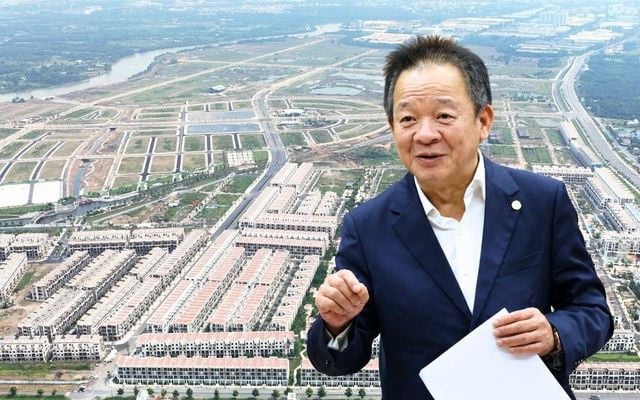
Bầu Hiển’s urban developments in the Mekong Delta are drawing attention because they follow a long-term execution strategy. In T&T Group’s approach, the company does not rush to ride short-term market cycles; instead, it accumulates land, completes legal groundwork, invests in design, and then launches projects in parallel when conditions are ready. Observers say this reflects the business style of Đỗ Quang Hiển and the Bầu Hiển group—prioritizing solid preparation and a willingness to nurture projects over a long horizon, so that once completed, they can be put into operation and exploited immediately rather than relying on price appreciation expectations.
Research reports cited in the article note that the Mekong Delta (ĐBSCL) accounts for about 20% of Vietnam’s population and contributes roughly 12% of GDP. The region plays a central role in agriculture, fisheries and exports, and has a large production base and clear demand for urbanization. However, the real estate market structure has not developed in line with that potential, with land abundant but a shortage of large-scale, well-planned urban areas that can function as a complete ecosystem.
The article attributes the bottlenecks to three main factors:
In recent years, the region has entered a new development cycle as infrastructure investment has expanded. The East–North expressway axis through Trung Lương – Mỹ Thuận – Cần Thơ – Cà Mau is gradually forming a backbone, while cross routes such as Châu Đốc – Cần Thơ – Sóc Trăng help open an East–West corridor. Key projects including Mỹ Thuận 2 Bridge, Rạch Miễu 2, Đại Ngãi, and the planned Trần Đề deep-water port are also described as gradually removing long-standing constraints.
Rather than entering only after a clear market trend emerges, T&T is described as acting earlier—anticipating infrastructure upgrades and urbanization, accumulating land in areas with remaining room, and then moving projects into operation when connectivity and economic convergence conditions align.
In Vĩnh Long, the Phước Thọ Residential Area covers more than 11.5 hectares in the province’s new development center. The article highlights that the project’s notable feature is its spatial organization: it is surrounded on three sides by the Cổ Chiên river, a rare structure in the canal-rich Mekong Delta. The design leverages the natural setting rather than relying on extensive artificial landscaping.
Architecturally, the project is oriented toward a Florida-inspired style combined with Art Deco and Mediterranean touches. A Hilton Garden Inn hotel is integrated as a highlight, drawing inspiration from the Mang Thít pottery village, including a three-arch ancient-column facade to connect international elements with local identity.
Phase 1 of Phước Thọ, with nearly 500 villa and shophouse products, is described as having completed infrastructure and the issuance of pink books (legal ownership documents) long-term, reflecting a completion-focused development approach aimed at practical operation.
In Long Xuyên (An Giang), the Residential and Commercial-Services Complex is presented as following a design language based on topographical symbolism. The project spans 3.5 hectares with total investment near 2,400 billion VND. It is intended to become the “Prosperous European-style street on the Hau Giang” river, combining European-square inspiration with river culture and the floating market.
The DoubleTree by Hilton Long Xuyên hotel, a 20-story building, is developed from the symbol of Núi Cấm—“the roof of the West”—paired with the image of local waterfalls. Functionally, the complex is organized as a complete urban center integrating housing, retail, services, and large-scale conference spaces, targeting tourism and events.
In Đồng Tháp, the T&T Sa Đéc Center project is described as approaching urban development around landscape and experience. Total investment is stated as over 1,170 billion VND, with the goal of becoming the most modern, synchronized urban complex in Sa Đéc—“The Mekong’s Pearl.”
Inspired by the Mekong and Sa Đéc’s century-old flower village, the space is organized using a “flow” structure where streets, commercial zones and parks are linked via waterways and green spaces. The project includes two main functional zones with distinct architectural forms: a commercial townhouse area along internal streets and a modern service-commercial complex planned along a public walking axis.
A highlight is a 25-story hotel at about 100 meters tall—the tallest building in the city—alongside a flower-walking street designed to showcase local seasonal flowers. The article frames the Sa Đéc project as creating a destination that can stimulate tourism and services, not only housing.
Near Ho Chi Minh City, the article notes that T&T Group has completed “Millennium City” (T&T City Millennia) in Tay Ninh, spanning 267 hectares. It is described as a new symbol for the southern region and an international-grade cultural and entertainment hub, not only a housing solution.
In October 2025, the project recorded 100% absorption in its sales basket after only a few hours of opening. Observers cited in the article interpret this as reflecting a market trend in which capital favors projects with real value—existing infrastructure, complete legal status, and genuine community-building potential—rather than relying on price expectations alone.
Across these projects, the article says a common thread is the design of integrated urban ecosystems. Instead of focusing solely on housing, each project integrates international-standard hotels, retail space, public amenities and service infrastructure, while incorporating local cultural identity into architecture and urban spaces. The intended outcome is an urban rhythm where residents can live, work, use services and form communities—described as the core value supporting long-term project value.
The article also points to the group’s earlier execution model. In 2016, with the T&T Riverview project at 440 Vĩnh Hưng, Hanoi, T&T Group used a construction approach that extended until nearly finished before official handover to the market. After Riverview, the model continued with T&T DC Complex at 120 Định Công, Hanoi. That project began operating in early 2022, and soon after, the developer handed pink books to residents.
In Nghệ An, T&T Victoria is cited for the “garden in the street” model, described as an ecosystem of synchronized utilities and an existing resident community. The project was named “Livable Project” in 2022, illustrating that T&T’s direction extends beyond product handover to shaping living environments and long-term value for residents.
The article concludes that projects in Hanoi, Nghệ An and ĐBSCL are part of a broader rollout, with T&T continuing to implement projects in Hanoi, Hưng Yên, Đắk Nông, Cà Mau and more. It emphasizes Bầu Hiển’s distinctive trait in pacing—accumulation, completion, then market entry—arguing that in a market increasingly focused on tangible value, urban developments that can operate immediately, offer service ecosystems, and carry strong local identity narratives may set a regional standard.




Premium gym chains are entering a “golden era” that is ending or already in decline, as rising operating costs collide with shifting consumer preferences toward more flexible, community-based ways to exercise. Long-term memberships are shrinking, margins are pressured by higher rents and facility expenses, and competition from smaller, more personalized…



