•
•
•
•
•
•
•
•
•
•
•
•
•
•
•
•
•
•
•
•
•
•
•
•
•
•
•
•
•
•
•
•
•



During this morning’s trading session, the 9999 gold ring price at Ngọc Thẩm was about 10–11 million đồng per tael lower than the SJC bullion price (on both buy and sell sides). By contrast, at Bao Tin Minh Chau (999.9 round plain rings) and Mi Hong (999 gold), SJC bullion and ring prices were nearly unchanged. Meanwhile, at DOJI, PNJ and Phú Quý, the SJC bullion price was about 400–500 thousand đồng per tael higher than the ring price.
A market survey of the gold market on the morning of 29/4 showed that both SJC bullion and ring prices fell by about 1.5 million đồng per tael compared with the previous session.
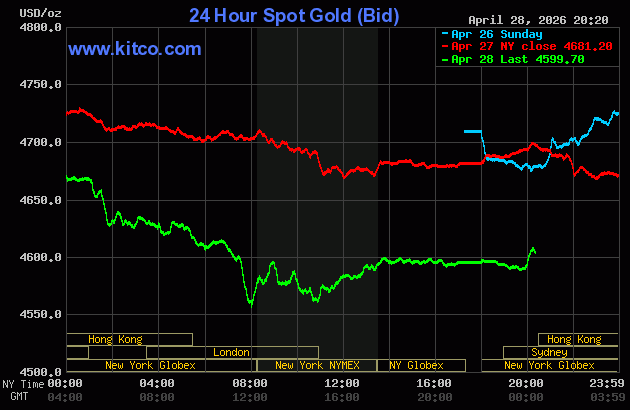
In April, domestic gold prices decreased by about 6.2%, falling from 176.8 million đồng per tael to around 166 million đồng per tael. Compared with the peak of 190.8 million đồng per tael set on January 29, 2026, prices have dropped by 24.8 million đồng per tael (about 13%).
As of 29/4/2026, SJC bullion showed slight differentiation among brands. The highest buying price was recorded at Mi Hong at 164.3 million đồng per tael, while the lowest selling price was at Ngọc Thẩm at 165.5 million đồng per tael.
Most companies—DOJI, PNJ, Phú Quý, Bao Tin Minh Chau and Ngọc Thẩm—kept a buy–sell spread around 3 million đồng per tael. Mi Hong had the lowest spread, at about 1.5 million đồng per tael.
At Bao Tin Minh Chau, SJC bullion was quoted at 163–166 million đồng per tael, with a buy–sell spread of 3 million đồng per tael. The 9999 round ring Hung Thinh Vuong was quoted at 162.5–165.5 million đồng per tael, with a similar margin. Compared with rings, SJC bullion was higher by about 500 thousand đồng per tael on the buy side and about 400–500 thousand đồng per tael on the sell side.
At Phú Quý, SJC bullion was at 163–166 million đồng per tael. 999.9 round rings (Phú Quý 999.9 and Phú Quý 1 tael 999.9) traded at 162.5–165.5 million đồng per tael, with a buy–sell margin of about 3 million đồng per tael. Compared with bullion, ring prices were about 0.5 million đồng lower per tael. The 999.9 jewelry line was quoted at 161–165 million đồng per tael, lower by about 2 million đồng per tael.
As of the morning of 29/4, the world price converted to local currency (including taxes and fees) stood at 148.5 million đồng per tael. Domestic SJC bullion (approximately 163–166 million đồng per tael) traded about 14.5–17.5 million đồng per tael higher than the world price on both buy and sell sides.
9999 rings showed wider dispersion. At some firms, rings were only about 14–17 million đồng per tael higher than the world price (buy and sell). At Ngọc Thẩm, however, the 9999 ring was quoted at 151.5–155.5 million đồng per tael, only about 3–7 million đồng per tael above the world price—far lower than the spreads seen for other brands.
At Mi Hong, SJC bullion was quoted at 164.3–165.8 million đồng per tael, with a buy–sell spread of about 1.5 million đồng per tael. The 999 ring traded at the same price range, with no difference relative to bullion.
At PNJ, SJC bullion was at 163–166 million đồng per tael. Rings such as PNJ 999.9, PNJ King Bao 999.9, Phúc Lộc Tài 999.9 and PNJ–Phoenix were quoted at 162.6–165.6 million đồng per tael, with a buy–sell spread of about 3 million đồng per tael. Compared with bullion, ring prices were about 400 thousand đồng per tael lower on average.
At Ngọc Thẩm, SJC bullion (10 tael) was quoted at 162.5–165.5 million đồng per tael, with a buy–sell spread around 3 million đồng per tael. The 999.9 ring was quoted at 151.5–155.5 million đồng per tael, with a width of about 4 million đồng per tael. Compared with SJC bullion, the ring was lower by about 10–11 million đồng per tael.
Ngọc Thẩm recorded the widest gap between SJC bullion and 9999 rings. Conversely, at Bao Tin Minh Chau and Mi Hong, the two forms showed almost no difference. Other firms such as DOJI, PNJ and Phú Quý reported typical differences of about 400–500 thousand đồng per tael between bullion and rings. For rings, the buy–sell margin was highest at Ngọc Thẩm at around 4 million đồng per tael, while other brands maintained around 3 million đồng per tael.




Premium gym chains are entering a “golden era” that is ending or already in decline, as rising operating costs collide with shifting consumer preferences toward more flexible, community-based ways to exercise. Long-term memberships are shrinking, margins are pressured by higher rents and facility expenses, and competition from smaller, more personalized…




