•
•
•
•
•
•
•
•
•
•
•
•
•
•
•
•
•
•
•
•
•
•
•
•
•
•
•
•
•
•
•
•
•


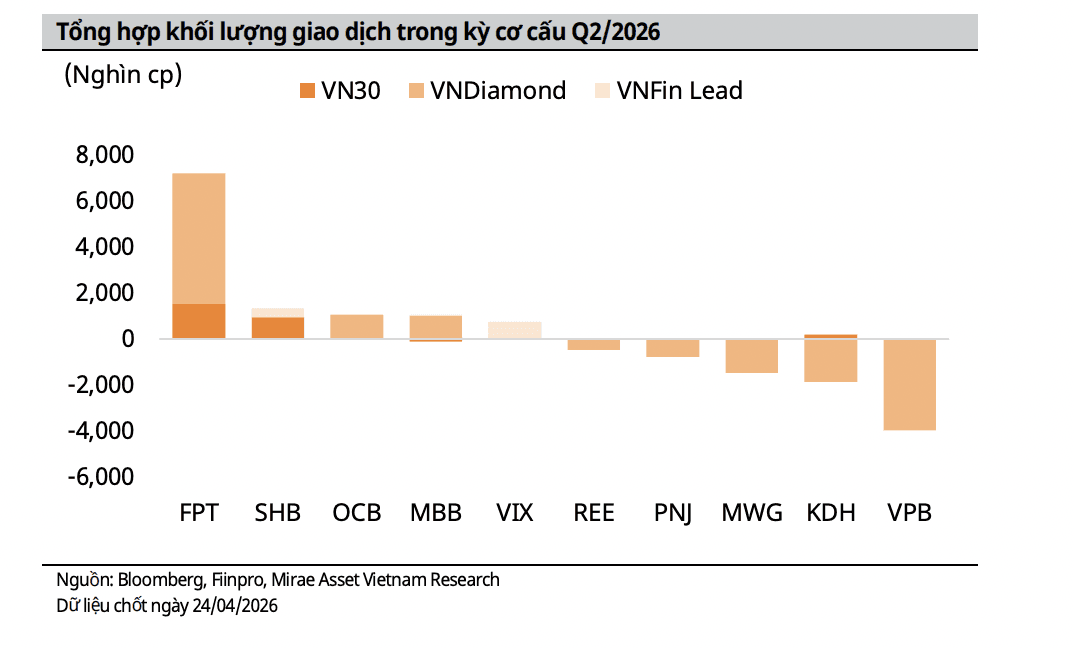
ETFs bought the most FPT, at 7.2 million shares, followed by SHB and OCB with more than 1 million shares each. Other stocks were also added to holdings such as MBB, VIX, HPG, ACB, TCB, BID, MSN, VNM. The Ho Chi Minh City Stock Exchange (HSX) published the new component list for the VN Diamond indices in the semiannual review for Q2 2026, as well as the new weights for the VN30 and VNFinlead baskets. As a result, the tracking funds following these indices will restructure mainly on 29 April before the official effective date on 04 May 2026. KDH has officially been added to the VN Diamond index watchlist for not meeting the minimum Free Float (FOL) requirement. Being placed on the watchlist means KDH’s weight contribution will be reduced by 50% compared with before — equivalent to a reduction to a modest 0.8% contribution, with the corresponding FUEVFVND fund liquidating nearly 4 million KDH shares. Meanwhile, FPT again saw a strong increase in weight due to a technical adjustment in how capitalization weighting is calculated, with the cap on FPT’s capitalization-contribution coefficient raised to 80.5% (+42.7%). In the VN30 group, weight adjustments mainly reduced exposure to the banking sector as this group experienced a slight reduction in maximum capitalization weight thanks to relatively stable performance since the start of the year. Conversely, a similar pattern continued with FPT, viewed as a stock that remains net-bought in the VN30 basket due to relaxed criteria on capitalization-weight limits. Total ETF trading shows FPT bought the most at 7.2 million shares, followed by SHB and OCB with over 1 million shares each. Other stocks were also added such as MBB, VIX, HPG, ACB, TCB, BID, MSN, VNM. On the downside, VPB was sold 4.1 million shares, KDH 3.9 million shares, MWG 1.7 million shares, PNJ 1.4 million shares. Other stocks also saw selling such as REE, NVL, VIC, MSB, VHM...





Premium gym chains are entering a “golden era” that is ending or already in decline, as rising operating costs collide with shifting consumer preferences toward more flexible, community-based ways to exercise. Long-term memberships are shrinking, margins are pressured by higher rents and facility expenses, and competition from smaller, more personalized…