•
•
•
•
•
•
•
•
•
•
•
•
•
•
•
•
•
•
•
•
•
•
•
•
•
•
•
•
•
•
•
•
•


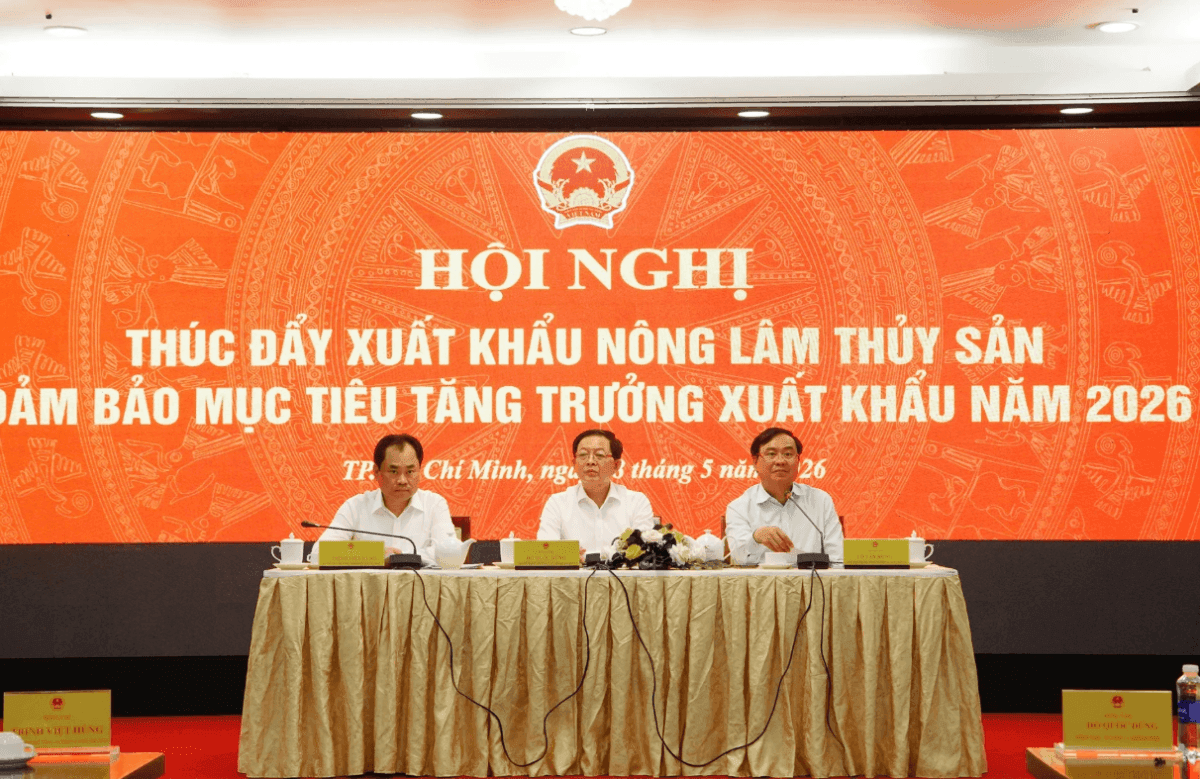
On May 8, 2026, in Ho Chi Minh City, Deputy Prime Minister Hồ Quốc Dũng, together with leaders of the Ministry of Agriculture and Environment, presided over a conference to promote exports of agricultural, forestry and fishery products. The meeting sought solutions to remove difficulties, sustain growth momentum, and strive to achieve the sector’s export value target of over 74.2 billion USD in 2026. The conference was organized by the Ministry of Agriculture and Environment in coordination with the Ministry of Industry and Trade, the Ministry of Finance, the State Bank of Vietnam, the Vietnam Chamber of Commerce and Industry (VCCI), and relevant local authorities and sector associations.
Deputy Minister Võ Văn Hưng said exports of agriculture, forestry and fishery products in Q1 and the first four months of 2026 continued to grow favorably across several key segments. Fruits and vegetables reached nearly 2.06 billion USD, seafood about 3.7 billion USD, and pepper and spices about 760 million USD. Many items recorded growth in both production volume and export value.
The Ministry of Agriculture and Environment highlighted near-term tasks including strengthening market forecasts; closely monitoring fluctuations in international trade, natural disasters and climate change to provide timely policy advice; and reducing risks of supply chain disruptions and agricultural product bottlenecks.
“The agriculture sector will continue to be oriented toward green, circular and sustainable restructuring; developing centralized raw material zones, advancing deep processing, traceability, and raising product quality to meet the requirements of importing markets,” Võ Văn Hưng said.
Delegates focused on analyzing difficulties across production, processing, logistics and exports, and discussed measures to boost competitiveness and expand markets.
Nguyen Hoai Nam, Secretary General of the Vietnam Association of Seafood Exporters and Producers (VASEP), said seafood exports in the first four months of 2026 reached about 3.7 billion USD, up nearly 15% year-on-year. He said the seafood sector is recovering after a difficult period in the world market and could target over 12 billion USD in 2026 if supported through credit, logistics and market expansion.
Nguyen Dinh Tung, Vice Chairman of the Vietnam Fruit and Vegetables Association (Vinafruit), noted positive signals as exports reached nearly 2.06 billion USD in the first four months. To sustain growth, he said it is necessary to expand standardized cultivation areas, improve post-harvest storage capacity, and enhance origin tracing.
A representative of the Vietnam Pepper and Spice Association said pepper and spice exports reached about 760 million USD, with pepper alone around 625 million USD. Exports rose strongly to the United States and China.
A representative of the Vietnam Coffee - Cocoa Association (VICOFA) said global coffee prices are highly volatile, creating pressure on both enterprises and farmers. The association recommended solutions to support credit, stabilize raw material supplies and expand export markets.
The wood and forestry sector continues to face pressures from high input costs, stricter origin tracing requirements, and green transition demands from major importing markets. A representative of the Vietnam Wood and Forestry Association urged preferential credit mechanisms, support for green transformation of enterprises, and development of domestic raw material regions.
Bach Khanh Nhut, Acting President of VINACAS (Vietnam Cashew Association), said the cashew industry maintained growth in Q1 2026, with nearly 140 thousand tonnes of cashew kernels exported, earning over 953 million USD. However, the sector faces strong impacts from geopolitics, particularly the Middle East conflict, which has reduced exports to that region.
Nhut said cashew exporters are also dealing with rising logistics costs, risks of transport through the Red Sea and the Suez Canal, credit pressures, and tightening environmental and origin-tracing requirements. VINACAS called on the government to support enterprises through credit, logistics, trade promotion, digital transformation in quarantine processes, and the sustainable development of domestic raw material regions.
Do Ha Nam, President of the Vietnam Food Association (VFA), said Vietnam became the world’s second-largest rice exporter with more than 8 million tonnes in 2025, but farmers’ incomes remain low. In the first four months of 2026, rice exports reached about 3.33 million tonnes, while export prices fell sharply due to market sentiment and aggressive selling after news that the Philippines would reduce imports.
Nam said a key weakness is that farmers lack the ability to regulate the market and control the timing of sales, adding that a mechanism is needed to help farmers store rice through cooperatives or enterprise warehouses and to provide credit to strengthen farmers’ role in the value chain.
The Vietnam Rice Association also warned of an impending risk of a “super” El Niño that could seriously affect rice production in the Mekong Delta in the near future. It said implementing the 1 million hectare high-quality rice project to reduce emissions is viewed as a strategic solution to enhance resilience and maintain the competitiveness of Vietnamese rice.
Delegates urged review and improvement of policies supporting enterprises, simplification of administrative procedures, and promotion of digital transformation in the management and trade of agricultural products.
On credit policy, the conference called on the State Bank of Vietnam and other financial institutions to effectively implement loan programs to support agricultural development. The aim is to enable people, cooperatives and enterprises to access capital for production, procurement, processing and exports, and to study measures to reduce interest rates—prioritizing credit for production, processing and export of agricultural, forestry and fishery products during peak harvest periods or when markets face difficulties.
Delegates also emphasized strengthening trade promotion, leveraging FTAs effectively, expanding markets for key products, and promoting the role of trade offices, commercial counselors and agricultural attachés in market connections, information flow and early risk warnings.

Premium gym chains are entering a “golden era” that is ending or already in decline, as rising operating costs collide with shifting consumer preferences toward more flexible, community-based ways to exercise. Long-term memberships are shrinking, margins are pressured by higher rents and facility expenses, and competition from smaller, more personalized…