•
•
•
•
•
•
•
•
•
•
•
•
•
•
•
•
•
•
•
•
•
•
•
•
•
•
•
•
•
•
•
•
•


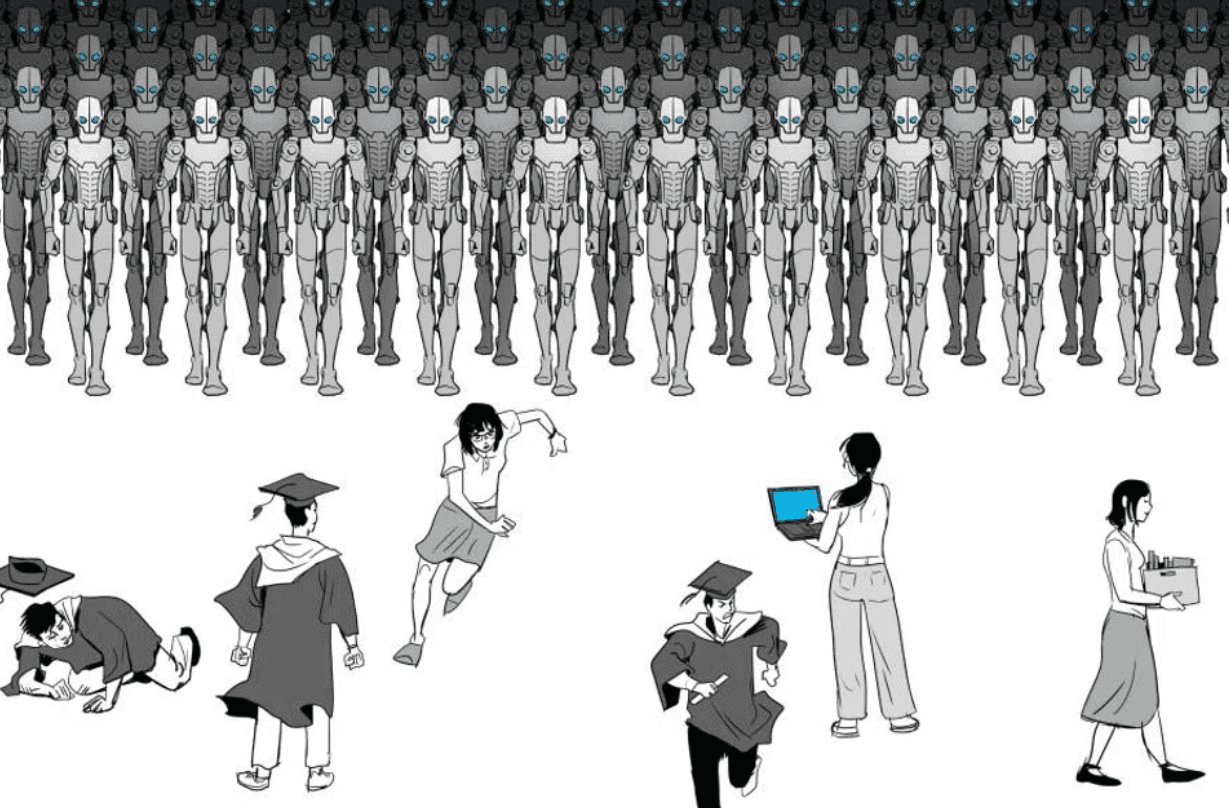
Two months ago, Dario Amodei, founder of Anthropic, warned that many professions could face rapid obsolescence: programmers could be replaced within six to twelve months, and half of entry-level office roles could disappear within one to five years. In China, that shift is increasingly visible in day-to-day work, where AI is affecting income, working hours, and career prospects for younger workers.
In Shandong, Qin, a freelance programmer with more than ten years of experience, said the market has tightened sharply. He told Lianhe Zaobao that a project that paid 10,000 yuan in 2021 now brings about 5,000 yuan. Clients have also questioned his pricing, arguing that AI can produce code for free. Qin said AI is not only cutting the value of projects by half, but also changing the nature of development work: clients now use AI to draft rough content, and he edits the output.
“Feels like I’m working for AI,” Qin said.
Even in large technology firms in Beijing, programmers report growing pressure. Shi Wenyu, a senior programmer, said more than 30% of the code in his company is generated by AI. He added that large language models have improved at understanding natural language for software development and can support nearly every stage of the process. While he said software architectures still require human input, Shi predicted that about 90% of programmers could be eliminated within the next three years.
In an Anthropic report released earlier this month, the labor-market impact of AI was described as extending beyond programming and mathematics. The report identified business and finance, office administration, management, law, arts and media as areas where AI could perform up to 80% of tasks.
In China, AI’s impact is moving beyond technical jobs into a wider range of office roles. Low-level office workers—particularly computer-using production staff—are seeing rapid restructuring of work models and career paths.
In Guangdong, Zhu, a 25-year-old administrative assistant, said 60% of his work now receives AI assistance. However, he said he must conceal how much AI he uses from his supervisor because “if AI does too much, the boss will think I’m idle and unworthy of that salary.”
In Anhui, Li Li, 24, said AI has taken over much of content writing and video editing, reducing her office schedule from five days a week to three. Her salary fell from 5,000 yuan to just over 3,000 yuan. To make ends meet, she moved to the outskirts of Hefei and began applying for more jobs, describing the process as anxiety-inducing.
This summer, 12.7 million university graduates are entering a labor market that has narrowed. Lu, a humanities major, said many roles she applies for now require graphic design skills or AI-assisted programming. She added that as AI replaces low-level roles, the number of openings has declined while the skill requirements for remaining positions have risen.
“If you don’t know how to use AI, you won’t even get an interview,” Lu said.
To respond to student concerns, training centers have launched “AI crash courses” on campus, with tuition starting at 10,000 yuan. Lu said she has seen the advertisements repeatedly but is hesitant to enroll: “That’s a lot of money I can’t spend. But if I don’t study, I fear I won’t find a job.”
While media coverage has cited World Economic Forum data suggesting AI could create 170 million new jobs globally by 2030, near-term outcomes remain difficult. A Citrini Research report from February 2026 described a more pessimistic scenario: each new AI-created job could render dozens of older roles obsolete, and wages for the new roles could be only a fraction of prior levels.
Zhu Xufeng, a researcher in tech governance and dean at the School of Public Policy and Management at Tsinghua University, said the personal takeaway is “short-term pain.” He argued that technology substitution is a recurring feature of human progress because technology’s purpose is to raise efficiency and reduce labor demand. Displaced workers, he said, typically transition into new industries and jobs.
Zhu added that China’s aging population and falling birth rates mean labor costs continue to rise, making corporate adoption of AI a rational choice. He said restricting technological development to protect jobs would undermine national competitiveness.
Shan Wei, a senior researcher at the East Asia Institute (EAI) at the National University of Singapore, said scholars are still debating whether this AI wave will follow the pattern of previous industrial revolutions or instead fundamentally replace human labor and disrupt the economic system. He said the key question is whether AI can extend the range of human activity. If it cannot, many current roles could be replaced; if it can open new fields and expand knowledge, then humanity may find new ways to “anchor its existence.” He added that it remains unclear what those new jobs and tasks will be.
When Li Li sought new work in Anhui, she said she did not try to avoid roles that AI can replace. Instead, she said there are very few jobs and she is focusing on the present: “I can only focus on the present and try to earn a little more for now.” She said she is competing not only with other displaced job seekers, but also with fresh graduates entering the market, and that until employment stabilizes, AI-driven volatility will continue.
To reduce exposure to algorithmic substitution, some young workers are building “moats.” For Zhu, this means becoming a “technology expert” in the company by deepening AI knowledge to act as a coordinator rather than someone replaced. For Shi Wenyu, it means maintaining highly crafted, human-driven coding skills that AI with broad logic cannot replicate.
Lawyer Wang Jun in Guangdong said AI can provide basic legal advice but cannot replace humans in ethical and emotional aspects. Shan Wei also emphasized that aesthetics, empathy and creativity remain areas AI will struggle to touch in the near future. He said AI can help with “treating” diseases and “healing,” but the emotional support people seek still requires human presence.
Google DeepMind CEO Demis Hassabis has predicted that AGI could arrive in five to ten years, after which workers may have less time to deliberate about how to adapt.
In China, AI adoption surged last year. Official reports cited in the article say that by the end of 2025 there were 602 million AGI users.






Premium gym chains are entering a “golden era” that is ending or already in decline, as rising operating costs collide with shifting consumer preferences toward more flexible, community-based ways to exercise. Long-term memberships are shrinking, margins are pressured by higher rents and facility expenses, and competition from smaller, more personalized…