•
•
•
•
•
•
•
•
•
•
•
•
•
•
•
•
•
•
•
•
•
•
•
•
•
•
•
•
•
•
•
•
•


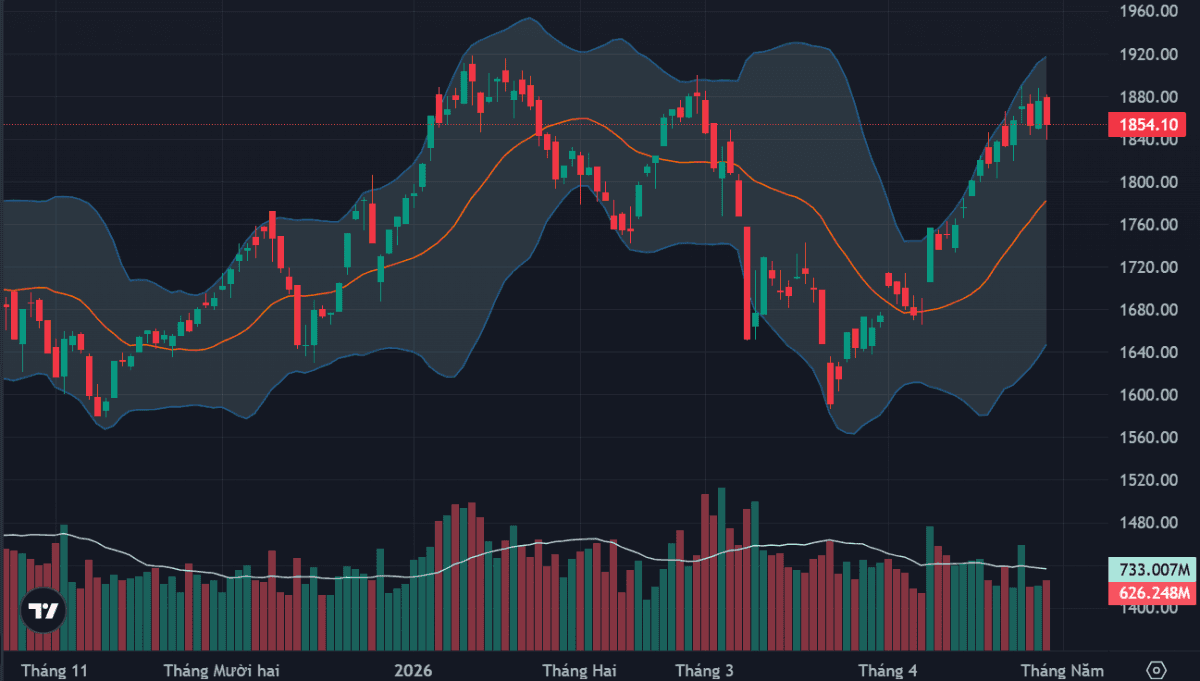
Although the VN-Index fell sharply today, bottom-fishing demand proved unexpectedly more active than in the morning session. Breadth improved as stocks recovered in unison, with the mid-cap segment helping to support market liquidity.
The index faced heavy pressure from blue chips, particularly VIC and VHM, which saw intense selling and rapid price declines.
Both VIC and VHM posted liquidity exceeding 1 trillion dong today, accounting for 12.7% of HoSE’s total matched value and 23.1% of the VN30 basket. VIC reversed after hitting a new all-time high yesterday; in April it rose 58.5%. VHM also performed strongly in April, up 41.8%, but reversed at a time when it could not break its all-time high set in early January 2026.
With both stocks closing at the day’s low, the scale of liquidity suggested sellers were in control. Foreign investors were major sellers, accounting for 51% of VIC’s liquidity and 45.7% of VHM’s liquidity. VIC was net sold by 402.9 billion dong and VHM by 147.6 billion dong.
Outside VIC and VHM, most VN30 blue chips were relatively stable. Only a few closed lower: TCB -2.17%, VPB -1.85%, SAB -2.06%, and MWG -1.87%. However, these names had already fallen sharply earlier in the day, and the afternoon decline was not substantial.
Statistics show that in the VN30 basket this afternoon, 15 stocks rose and 12 fell. Despite the number of changes, price swings were not wide. Declines were led by VIC and VHM, while gains were led by FPT, GAS, LPB, and VPL.
GAS rose sharply in the second half of the session, finishing up 1.21% from the morning close, for an overall gain of 2.31% from the morning. FPT rebounded at the ATC (after-hours), jumping above the reference by 1.48%, equivalent to a 2.44% gain versus the morning session. LPB rose about 1.94% today, closing up 3.73% from the reference. DGC and GVR also closed strongly, though with limited additional upside in the afternoon.
In the mid- and small-cap group, bottom-fishing demand was more active in the afternoon than in the morning and helped prices improve. HoSE’s breadth at the close was 161 advancers to 136 decliners, compared with 119 advancers to 160 decliners at the morning close.
The VN30 basket contributed only 13 gainers, indicating the rebound was driven mainly by mid- and small-cap stocks. The VN-Index closed down 1.16%, or 21.74 points.
Mid-cap stocks that attracted notable money remained strong from the morning, and fund flows intensified in the afternoon, lifting liquidity. Reported afternoon performers included: CII +1.58%, DXG +3.02%, VIX +2.14%, TCH +1.4%, DIG +4.26%, PDR +1.54%, and DCM +5.82%, all trading with liquidity in the hundreds of billions of dong.
The smaller-cap segment also saw multiple gains of 2–6%, including HDC, BFC, NTL, AAA, DXS, and HHP.
Total market turnover on HoSE today rose 1% to about 172 billion dong. The VN30 basket fell 5% (down 451 billion dong), while the mid-cap basket rose more than 17% (about 1,196 billion dong). This indicates the mid-cap group contributed most of the liquidity during the session.
The strong afternoon money improved the trading atmosphere, helping not only prices but also reducing the weakness in many stocks. Only about 20 HoSE stocks declined more than 1% with liquidity above 10 billion dong.
Besides the blue chips, PC1 and VSC were among the midcaps under clear selling pressure, down 6.46% and 1.39% respectively. PC1 had hit the daily lower limit in the morning, so the close still showed some improvement.
Foreign investors recorded strong net selling ahead of the long holiday. In the afternoon, they sold more than 775 billion dong, bringing total net sale for the day on HoSE to 1,328 billion dong.
Heavily sold stocks included: VIC -402.9 billion, PC1 -232.9 billion, VHM -147.6 billion, VCB -142.3 billion, FPT -119.9 billion, ACB -109.2 billion, NVL -105.2 billion, and BID -97.8 billion. On the buy side, purchases included VRE +139.2 billion and DCM +47.9 billion.
ETF net buying of Vietnamese stocks surprised after more than a month of withdrawals.
Premium gym chains are entering a “golden era” that is ending or already in decline, as rising operating costs collide with shifting consumer preferences toward more flexible, community-based ways to exercise. Long-term memberships are shrinking, margins are pressured by higher rents and facility expenses, and competition from smaller, more personalized…