•
•
•
•
•
•
•
•
•
•
•
•
•
•
•
•
•
•
•
•
•
•
•
•
•
•
•
•
•
•
•
•
•


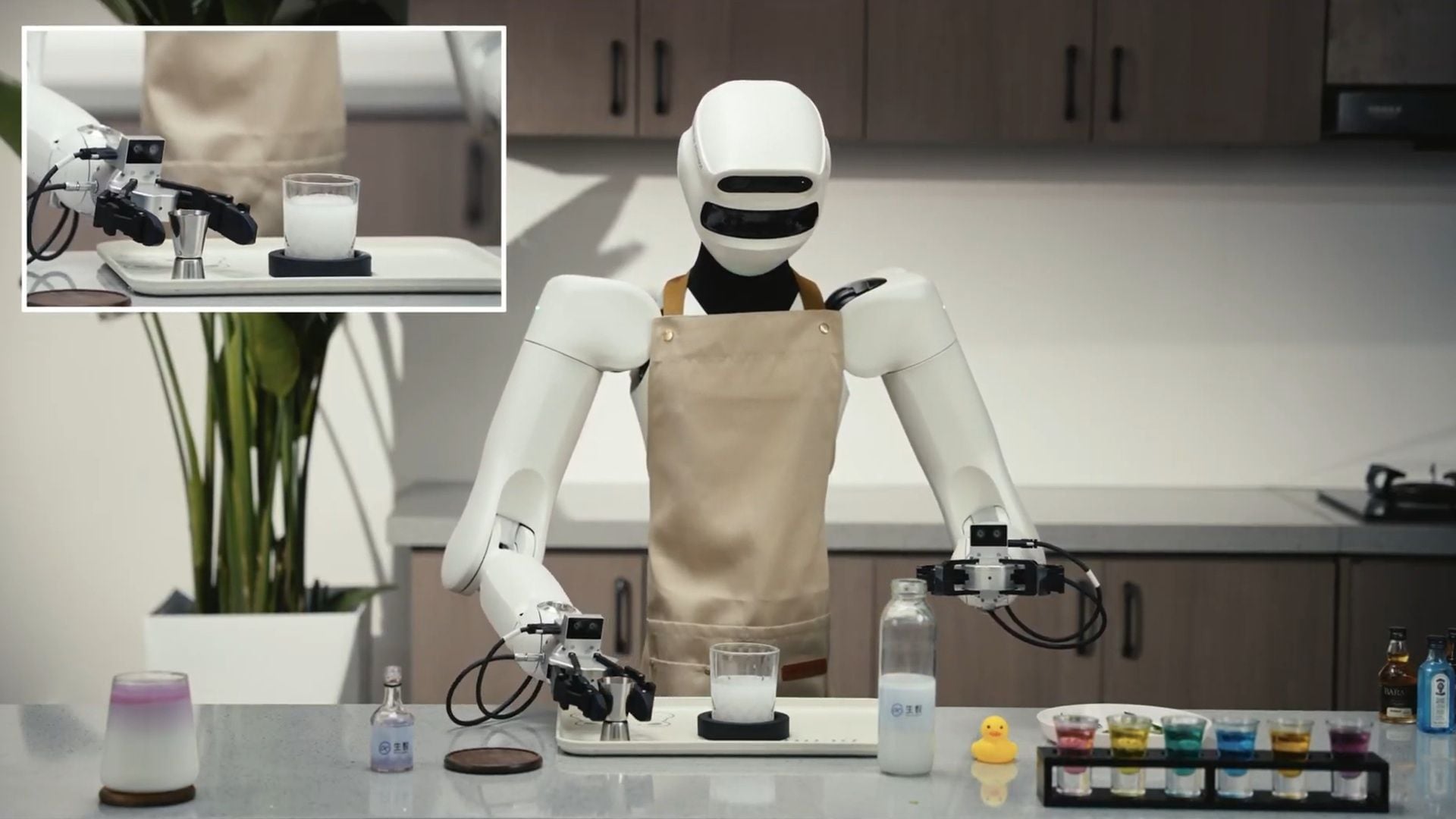
The embodied AI race is moving into a new phase as technology companies shift from chatbot-style systems and text generation toward building a “digital brain” that can control versatile robots. In that context, ShengShu Technology of China announced Motubrain, a unified AI model intended to help robots perform a range of complex real-world tasks through a single system.
ShengShu positions Motubrain as more than a conventional robot-control model. The company describes it as a “common brain” that combines perception, reasoning, prediction, and action within one AI framework.
The goal is to replace the fragmented approach that currently dominates robotics, where sensing, planning, and action control typically rely on separate modules.
ShengShu says Motubrain is built using large-scale video data from its generative Vidu platform, which previously supported the company’s growth in AI video. Rather than learning only from text or still images, the model processes video, language, and actions together to form an understanding of the real world more closely aligned with human cognition.
Jun Zhu, founder of ShengShu Technology, said a true “world model” should build a unified representation of the environment and predict how it will evolve over time. He added that future AI systems should be a unified architecture in which components—from perception to action—are tightly integrated rather than loosely connected.
Motubrain uses a three-stream Mixture-of-Transformers architecture designed to process different input data types concurrently. ShengShu says this enables robots to interpret natural-language instructions, observe their surroundings, and predict the outcomes of subsequent actions in real time.
The company also highlights a training approach that aims to reduce reliance on manually labeled data. Motubrain leverages large amounts of unlabeled video data, simulated data, and task logs from multiple robots. ShengShu says the system uses a “latent action framework” to automatically extract motion and behavior patterns, reducing training costs and time.
In task execution, ShengShu says Motubrain can carry out complex tasks with up to 10 atomic actions and can automatically identify and correct errors if a step fails.
ShengShu reports strong evaluation outcomes for Motubrain. The model scored 63.77 points on WorldArena and averaged 96.0 points across 50 tasks in the RoboTwin 2.0 benchmark.
The company also claims Motubrain is the only model to surpass 95.0 in a randomized environment, where robots must handle continually changing situations rather than fixed scenarios.
ShengShu further states that the model scales more efficiently as data volume grows, and that internal tests showed a high success rate even as task complexity increased.
Beyond benchmarks, ShengShu says Motubrain is designed for substantially more complex real-world tasks than many existing robotics systems. The company states robots using Motubrain can perform sequences of up to 10 atomic actions, while many platforms handle only about 2–3 steps.
The company describes potential applications in factories, stores, and homes, where a robot could identify an object’s location, move to the area, pick it up, handle errors, and continue the task without bespoke programming for each scenario.
In real-world trials, ShengShu says robots trained with Motubrain demonstrated self-adaptation. For example, if a pick operation fails mid-way, the system can detect the fault, adjust actions, and retry without prior training for that specific scenario.
Motubrain is currently deployed in robot training programs across multiple fields, including industry and commerce as well as household environments. ShengShu says it is collaborating with companies such as Astribot, SimpleAI, and Anyverse Dynamics to expand the technology’s applications.
ShengShu Technology also reported substantial funding for the project, securing a Series B investment of $293 million led by Alibaba Cloud. The company says the capital is expected to accelerate embodied AI research and scale Motubrain deployment in the near term.






Premium gym chains are entering a “golden era” that is ending or already in decline, as rising operating costs collide with shifting consumer preferences toward more flexible, community-based ways to exercise. Long-term memberships are shrinking, margins are pressured by higher rents and facility expenses, and competition from smaller, more personalized…




