•
•
•
•
•
•
•
•
•
•
•
•
•
•
•
•
•
•
•
•
•
•
•
•
•
•
•
•
•
•
•
•
•


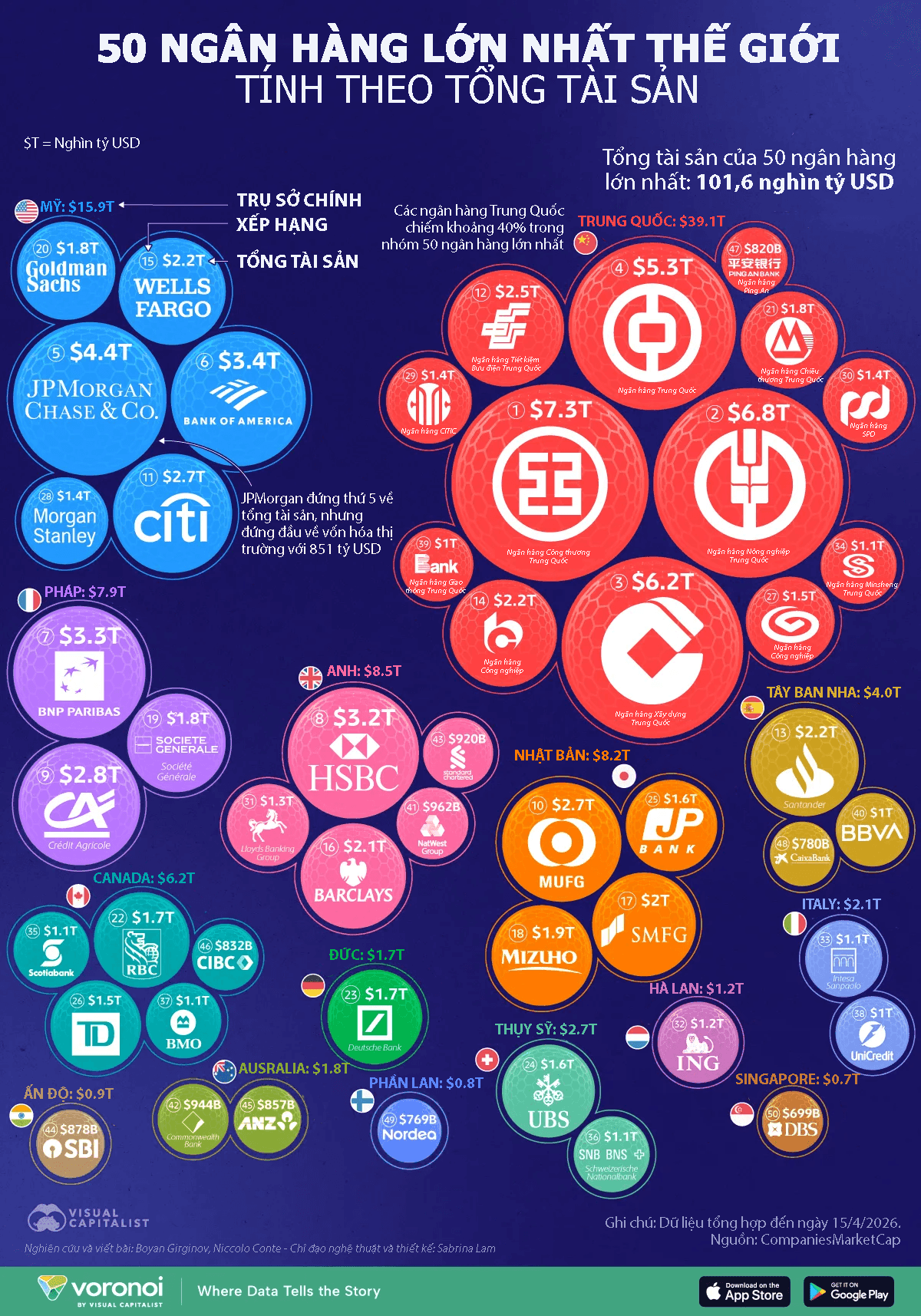
Based on data from CompaniesMarketCap as of April 15, 2026, the infographic below ranks the world’s 50 largest banks by total assets. The figures reflect each bank’s total assets in the most recent reporting period, including cash and cash equivalents, loans, investments, real estate and equipment.
Chinese banks dominate the leading group. The four largest banks in the world are all state-owned Chinese lenders: the Industrial and Commercial Bank of China (ICBC), the Agricultural Bank of China (ABC), the China Construction Bank (CCB) and Bank of China (BOC). Combined assets of these four institutions reach USD 25.5 trillion, about one-quarter of the total assets of the 50 largest banks globally.
The United States ranks second to China. JPMorgan Chase leads the U.S. contingent with assets valued at USD 4.4 trillion, followed by Bank of America with USD 3.4 trillion.
The remainder of the top 10 includes three European banks—BNP Paribas, HSBC and Crédit Agricole—along with Japan’s Mitsubishi UFJ Financial Group (MUFG).
Most bank assets are held in cash or highly liquid assets. This structure partly reflects regulatory requirements designed to ensure banks have sufficient resources to respond to sharp market movements or funding pressures.
Regionally, Asia leads the ranking, accounting for nearly half of the total assets of the world’s 50 largest banks. This position largely reflects contributions from 13 Chinese banks, which alone account for about 39% of total assets on the list.
Europe ranks second, but its lead is mainly by quantity rather than size. The region has about as many banks on the list as Asia, with 18 banks compared to 19 banks in Asia. However, European institutions are generally smaller, with an average of about USD 1.6 trillion in assets per bank, below Asia’s USD 2.6 trillion.
North America has 11 banks on the list, including six U.S. banks and five Canadian banks. Although the number is smaller than Europe, banks in this region have a larger average asset size.







Premium gym chains are entering a “golden era” that is ending or already in decline, as rising operating costs collide with shifting consumer preferences toward more flexible, community-based ways to exercise. Long-term memberships are shrinking, margins are pressured by higher rents and facility expenses, and competition from smaller, more personalized…