•
•
•
•
•
•
•
•
•
•
•
•
•
•
•
•
•
•
•
•
•
•
•
•
•
•
•
•
•
•
•
•
•


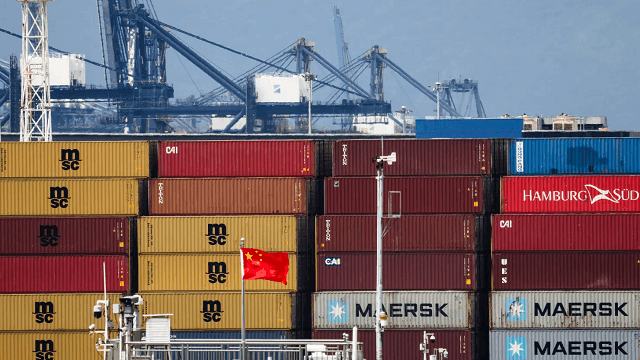
Over the past year, Chinese exporters accelerated efforts to diversify away from the U.S. market, relocating parts of their supply chains abroad and expanding into new regions, including the Middle East, after high U.S. tariffs disrupted their business model. Ahead of a planned meeting between U.S. President Donald Trump and Chinese President Xi Jinping later this weekend, exporters appear to be focusing less on tariffs and more on the growing uncertainty from the Iran conflict.
Wang Dan, head of China at Eurasia Group, said that after speaking with numerous exporters across China, many firms have “almost stopped mentioning tariffs” when asked about expectations for the summit. She said the dominant concern is how long the Iran conflict will last, because firms fear delays and reduced orders from foreign markets.
Wang added that some companies have begun contingency planning to reduce scale in the second half of the year if the conflict persists.
Yue Su, chief China economist at the Economist Intelligence Unit, said Beijing and Washington are likely to reaffirm a shared desire to reopen the Hormuz Strait and restore stability. However, she cautioned that naval confrontations and rounds of talks that pause and resume could continue to weigh on trade.
The disruption to supply chains from the Iran conflict is currently creating more pressure than the irregular U.S. tariffs exporters have faced over the past year, according to the article.
Bryan Zheng, founder and CEO of Livall Tech, a Shenzhen-based helmet manufacturer, said he has relied on air freight at very high costs to ship goods to Europe after maritime delays at the Hormuz Strait. He said delivery times to Europe have stretched to around 50 days, compared with the usual 30–40 days.
Port congestion across Asia is also pushing freight rates higher. The article cites severe congestion at ports including Shanghai and Ningbo, alongside labor shortages and capacity constraints that slow container movements on Asia–Europe and Mediterranean trade routes.
Rail transport has been affected as well. Zheng said his smart helmet samples were classified as dual-use sensitive goods due to routes through conflict zones, limiting the ability to shift logistics away from sea freight.
“A peace agreement that reopens the strait would be an extremely positive signal for everyone,” Zheng said, adding that any ceasefire reached at the Trump–Xi meeting might be short-lived.
Zheng noted that higher tariffs could still show up in consumer costs, but logistics disruption is harder to control.
Rising input costs are affecting multiple industries. The China index measuring the cost of raw materials, fuel, and electricity rose 3.5% year over year in April, after increasing by 0.8% in March, according to the article.
Cameron Johnson, a senior partner at Tidalwave Solutions in Shanghai, said companies are particularly concerned because the war is disrupting supply chains and affecting petroleum-derived products and fertilizers sourced from the Middle East. He described it as a global issue “much bigger than tariffs.”
The article notes that the last U.S.–China trade war, when tariffs at times rose into triple digits, prompted many firms to restructure supply chains and expand production to Southeast Asia, the Middle East, and other regions. It said the tariff truce reached between the two countries last year was not enough to reverse that shift.
It also cites Wind Information data showing that China’s exports to the U.S. fell 20% last year, while exports to other regions rose. Exports increased to Africa by 25.8%, Southeast Asia by 13.4%, the European Union by 8.4%, and Latin America by 7.4%.
Exports to five Gulf states—Iran, Saudi Arabia, UAE, Qatar, and Kuwait—rose 9% last year to $144.9 billion, nearly double the 2019 level, according to the article.
For exporters that are now less dependent on the U.S. market, and with most tariff costs passed on to consumers, expectations for tariff changes after the Trump–Xi summit have eased. The article emphasizes that the Iran conflict’s impact on shipping, logistics, and input costs is proving more immediate and difficult to offset.
Premium gym chains are entering a “golden era” that is ending or already in decline, as rising operating costs collide with shifting consumer preferences toward more flexible, community-based ways to exercise. Long-term memberships are shrinking, margins are pressured by higher rents and facility expenses, and competition from smaller, more personalized…