•
•
•
•
•
•
•
•
•
•
•
•
•
•
•
•
•
•
•
•
•
•
•
•
•
•
•
•
•
•
•
•
•


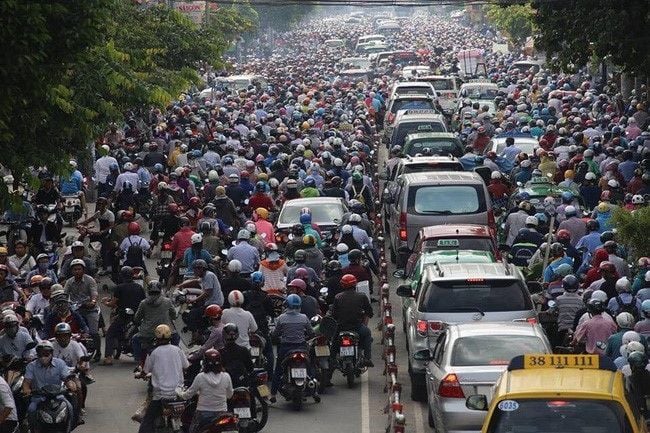
A new era of mobility is gradually taking shape in major cities, as smoky air and gasoline-powered vehicles give way to greener, cleaner solutions. In this landscape, technology—especially domestic technology—has become a key factor, opening up the possibility to redefine the user mobility experience comprehensively.
In Vietnam, motorcycles are like the “legs” of the economy. Vietnam is among the world’s five largest consumption markets by volume as of last year, according to Motorcycles Data. The dense infrastructure, with many narrow lanes, helps two-wheelers maintain advantages in flexibility, operating costs, and carrying capacity. For many households, motorcycles are not only a means of transport but also assets and tools of work.
Against this backdrop, the electrification of two-wheelers in Vietnam is viewed as a structural transition. According to Mordor Intelligence, electric motorcycles are a promising market with a projected size of over USD 3.7 billion this year and more than USD 8.8 billion by 2031. The momentum is driven by net-zero emissions commitments by 2050, government policy support, and a growing green consumer trend.
Tax relief proposals and financial support from the government and businesses are also helping boost demand for electric vehicles. However, the pace of transformation depends on addressing core barriers.
Even as awareness improves, hesitation persists, largely due to experiences with older-generation electric two-wheelers that use batteries.
According to a Mibrand Vietnam survey, the three main factors causing hesitation are charging infrastructure, battery durability, and battery technology. The lack of charging stations is cited as the biggest barrier in suburban areas. Limits on battery life, charging time, and driving range also directly affect purchase decisions.
Some manufacturers have developed charging stations or battery-swapping, but these solutions require high costs and complex operation, which are not yet well suited to flexible usage patterns.
From a technical standpoint, the challenge is optimizing the overall balance among the battery, motor, and the Battery Management System (BMS). The battery determines range but also affects weight and cost; the motor must deliver performance; and the control system coordinates the user experience. Integrating these elements into a seamless whole remains difficult, and many electric models have not yet matched the smoothness of gasoline-powered vehicles.
In response, some domestic companies are focusing on tackling bottlenecks at the technology level rather than relying primarily on infrastructure expansion. Experts say the core issue is not only expanding charging stations, but also improving battery performance, shortening charging times, and increasing usage flexibility.
From a market perspective, a consumer research representative said the biggest barrier for Vietnamese considering a switch to electric vehicles remains the “fear of running out of battery mid-journey,” along with the inconvenience of depending on charging stations that are not yet widespread. As a result, solutions that enable users to charge and use their vehicles more proactively are viewed as practical and aligned with current infrastructure conditions.
Dat Bike is cited as an example of a core-technology-driven development strategy. Instead of expanding a costly charging-station ecosystem that requires significant time to build infrastructure, the company focuses on improving battery performance and optimizing charging capability to deliver a better user experience, with local content exceeding 90%.
Dat Bike Vietnam’s CEO Nguyễn Bá Cảnh Sơn said the firm pursues a vertically integrated model, developing core technologies—from motor and battery to BMS, control electronics, and smart charging—internally. This approach is intended to allow the company to control every step from R&D to production, continuously improve and refine solutions, and deliver maximum value to users, with a domestic content share of over 90%.
Vietnam’s electric motorcycle market is still in the early stage of a long cycle of growth. Demand for mobility between urban and rural areas continues to sustain two-wheeler usage, while also creating opportunities for new infrastructure and service models.
In this context, the long-term advantage is expected to belong to companies that can master core technologies and understand Vietnamese mobility habits. The transition is not only a product competition issue, but also an opportunity for domestic industry to participate more deeply in the production value chain.
If leveraged effectively, Vietnam can accelerate green transportation and position itself as a Southeast Asia regional hub for two-wheel electric vehicle manufacturing.








Premium gym chains are entering a “golden era” that is ending or already in decline, as rising operating costs collide with shifting consumer preferences toward more flexible, community-based ways to exercise. Long-term memberships are shrinking, margins are pressured by higher rents and facility expenses, and competition from smaller, more personalized…



