•
•
•
•
•
•
•
•
•
•
•
•
•
•
•
•
•
•
•
•
•
•
•
•
•
•
•
•
•
•
•
•
•



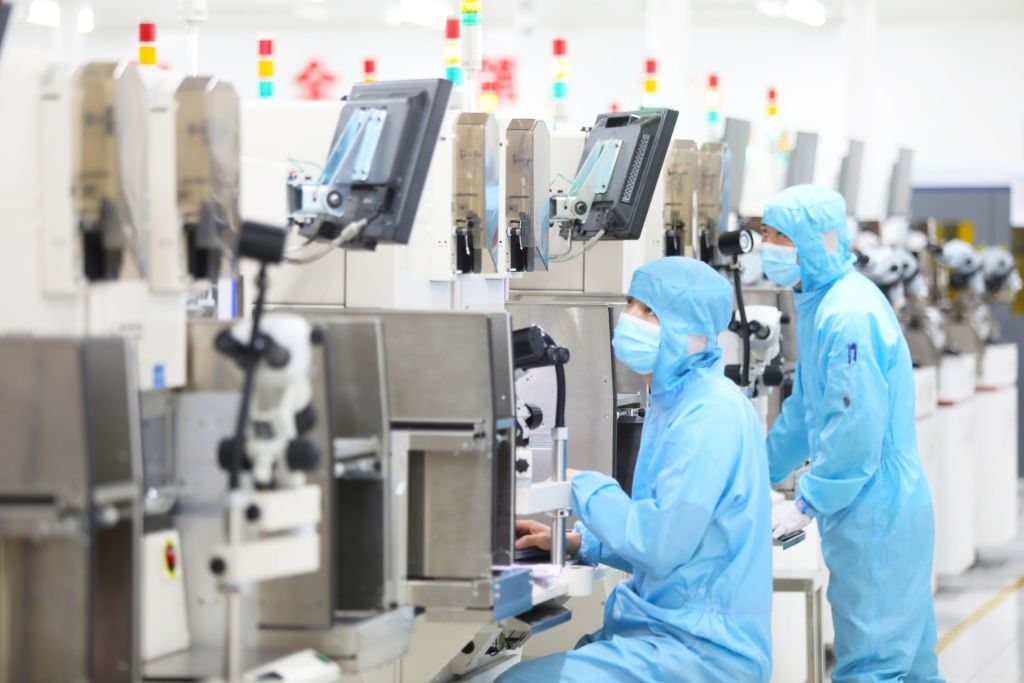
Deputy Prime Minister Hồ Quốc Dũng requested that in April 2026, ministries present and publish the list of strategic technologies, after which they must immediately implement the tasks and propose funding. On 20 April, Deputy Prime Minister Hồ Quốc Dũng chaired a meeting on the status of implementing the list of strategic technologies and strategic technology products. At the meeting, Minister of Science and Technology Vũ Hải Quân said that the list of strategic technologies is oriented based on three factors: development needs and competitiveness of the economy; advantages and potential of sectors; the ability to form value chains and markets. Guidance for approaching the strategic technology list is to be in two groups: the group of strategic technologies that already have a market, with significant direct impact (such as agriculture, processing industries, textiles & footwear, construction, steel, energy, etc.); and the group of technologies that create new growth drivers, foundational technologies for the future, technologies ensuring self-reliance in national security and defense (such as quantum technology, missile technology, small modular reactors, technologies serving near-space high-altitude economy, small satellites, UAVs). Deputy Prime Minister Hồ Quốc Dũng presided over the meeting on the status of implementing the strategic technology list (CNCL) and the strategic technology products – Photo: VGP. According to the Ministry of Science and Technology, initial results include a relatively clear legal framework and direction for strategic technology development. Ministries and localities have proactively issued action plans, built roadmaps for technology renewal through 2030 and 2035, and gradually translated the strategic technology list into programs. Resources for science and technology have been increased, with tens of trillions of dong allocated. In terms of technological mastery, the higher education system and research institutes have initially formed several nuclear research centers in key areas such as artificial intelligence (AI), semiconductors, and new energy. Localization rates in some strategic technology products are positive; for example, manufacturing sector achieving about 50% localization for industrial robots and nearly 80% for machine vision and artificial intelligence systems. Some domestic enterprises have begun to master core technologies and develop strategic technology products. For example, R&D of several foundational technologies in the quantum field; localization above 50% in AI Camera and intelligent surveillance; Viettel has mastered about 85% of core technology in 5G networks; research, development and deployment of autonomous robotic systems for logistics and manufacturing; mastery of around 70% of core technology for unmanned aerial vehicles (UAV); gradual mastery of core technologies for natural language processing, digital infrastructure… However, these results are still in the early stages; ecosystem components remain fragmented, and a unified national-scale model for strategic technology development has not yet formed. Implementation still faces legal and guidance-related hurdles; financial and investment mechanisms, human resources and research infrastructure; business capabilities… Concluding the meeting, Deputy Prime Minister Hồ Quốc Dũng emphasized that strategic technology and strategic technology products are crucial in the new development phase, acting as a driver for socio-economic growth, especially since double-digit growth targets rely heavily on science, technology and innovation. Without breakthroughs and decisive actions, the tasks will not be completed. According to the Deputy Prime Minister, developing strategic technology linked to the country’s development is a matter of great importance; therefore ministries and agencies must engage, invest boldly, accept risks, and leverage the advantage of being “late” to accelerate and lead. There remain several obstacles such as unclear responsibilities, lack of criteria for identifying strategic products, financial mechanisms still facing issues, and a shortage of high-quality human resources; thus the Deputy Prime Minister called for revising the strategic technology list to be feasible and effective, avoiding waste, based on three criteria: market demand, leveraging national advantages, and forming value chains. The Deputy Prime Minister requested in April 2026: establish an inter-ministerial task force; ministries present and publish the strategic technology list. Afterward, ministries must immediately implement the tasks and propose funding. At the same time, the ministries of Science and Technology, Finance, and Education and Training should intensify human resource development and improve financial mechanisms. The Ministry of Education and Training should have special policies to encourage training for strategic technology human resources. The Ministry of Industry and Trade should study integrating into amendments to the Law on Key Industries.
Premium gym chains are entering a “golden era” that is ending or already in decline, as rising operating costs collide with shifting consumer preferences toward more flexible, community-based ways to exercise. Long-term memberships are shrinking, margins are pressured by higher rents and facility expenses, and competition from smaller, more personalized…