•
•
•
•
•
•
•
•
•
•
•
•
•
•
•
•
•
•
•
•
•
•
•
•
•
•
•
•
•
•
•
•
•


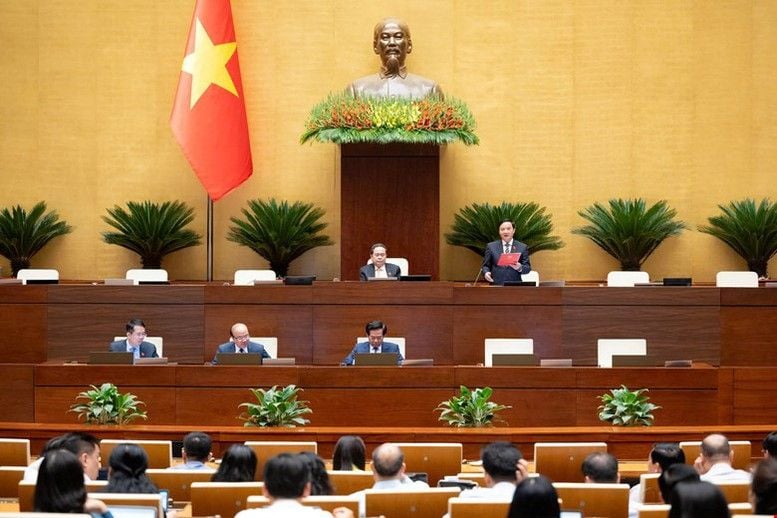
On the morning of April 22, the National Assembly discussed in the chamber a draft resolution on establishing Dong Nai City as a centrally administered city. Many deputies expressed broad support, saying the move is an important step to expand development space and create new momentum for the Southeast region and the country.
Most delegates supported the policy of upgrading Dong Nai to a centrally administered city. They said the change not only meets development requirements but also creates additional room and momentum for the locality to break through in the coming period.
After National Assembly approval, Dong Nai would become the seventh centrally administered city, joining Hanoi, Ho Chi Minh City, Hai Phong, Da Nang, Can Tho, and Hue. Deputies described it as a politically and economically meaningful milestone aimed at reorganizing national development space toward modern, efficient, and sustainable directions.
Deputies noted that Dong Nai is a dynamic development locality, particularly after the merger with Binh Phuoc Province. They said Dong Nai’s economic scale ranks fourth nationwide, behind Ho Chi Minh City, Hanoi, and Hai Phong. The merger and the formation of a centrally administered city are expected to bring additional resources and new development space.
Deputies also said Dong Nai has met the standards defined for the upgrade. They said that if approved, the establishment of Dong Nai City would take effect on April 30, 2026.
Deputy Nguyen Minh Tam (Quang Tri Province) said the move is a strategic step to implement the Politburo’s policy. He noted that after merging with Binh Phuoc, Dong Nai has a population of over 4.4 million people and an area of more than 12,700 square kilometers, exceeding current regulations. He added that the locality has 95 commune-level units, a high urbanization rate, a positive shift in the economic structure, and strong budget autonomy.
Deputy Nguyen Thi Thuy (Thai Nguyen Province) said Dong Nai is the industrial capital with rapid development, and that Binh Phuoc before merging also belonged to fast-growing localities nationwide. She said that after the merger, the former Binh Phuoc area would become a new engine, supplementing Dong Nai’s development space.
Deputy Nguyen Thi Thuy also said that when Dong Nai becomes a centrally administered city, it will have favorable conditions to promote its role as the gateway and the economic-cultural center of the region, and to work with Ho Chi Minh City to form a major growth pole driving national socio-economic development.
Alongside broad consensus, deputies said Dong Nai needs strong special mechanisms and policies issued as soon as possible. Deputy Trinh Thi Tu Anh (Lam Dong Province) urged the Government to promptly study and submit to the National Assembly special mechanisms for Dong Nai, particularly in financial-budget management, investment attraction, and land management. She said that without superior mechanisms, the locality would struggle to unlock its full potential.
Deputies also called for strengthening regional development cooperation between Dong Nai and Ho Chi Minh City and the Tây Nguyên provinces through feasible coordinated mechanisms. They said accelerating key infrastructure projects such as the Dau Giay–Lien Khuong expressway would help realize Dong Nai’s gateway role.
Deputies further emphasized policies for residents affected by urbanization, including worker retraining, sustainable employment creation, and social welfare. They said the goal of development is not only economic growth but also improving people’s quality of life.
Deputies also proposed that Dong Nai coordinate with relevant ministries to quickly implement the Nuclear Science and Technology Research Center to enhance scientific and technological capacity and provide a long-term foundation for development.
Concluding the session, Vice President of the National Assembly Nguyen Khac Dinh said the Standing Committee and the Government would thoroughly absorb deputies’ opinions and coordinate to implement related contents. He said the Government would direct ministries and localities to promptly carry out tasks within their authority and simultaneously develop necessary proposals for submission to competent authorities for consideration and decision.
Regarding special breakthrough mechanisms for Dong Nai, the Vice President said the Government would continue studying, refining, and presenting them to the National Assembly at an appropriate time to create the most favorable conditions for Dong Nai’s rapid and sustainable development.


Premium gym chains are entering a “golden era” that is ending or already in decline, as rising operating costs collide with shifting consumer preferences toward more flexible, community-based ways to exercise. Long-term memberships are shrinking, margins are pressured by higher rents and facility expenses, and competition from smaller, more personalized…