In the latest World Economic Outlook report released this month, the International Monetary Fund (IMF) projects
Europe’s nominal GDP to reach $32.3 trillion in 2026. However, this economy size is not evenly distributed, but concentrated mainly in a few countries.
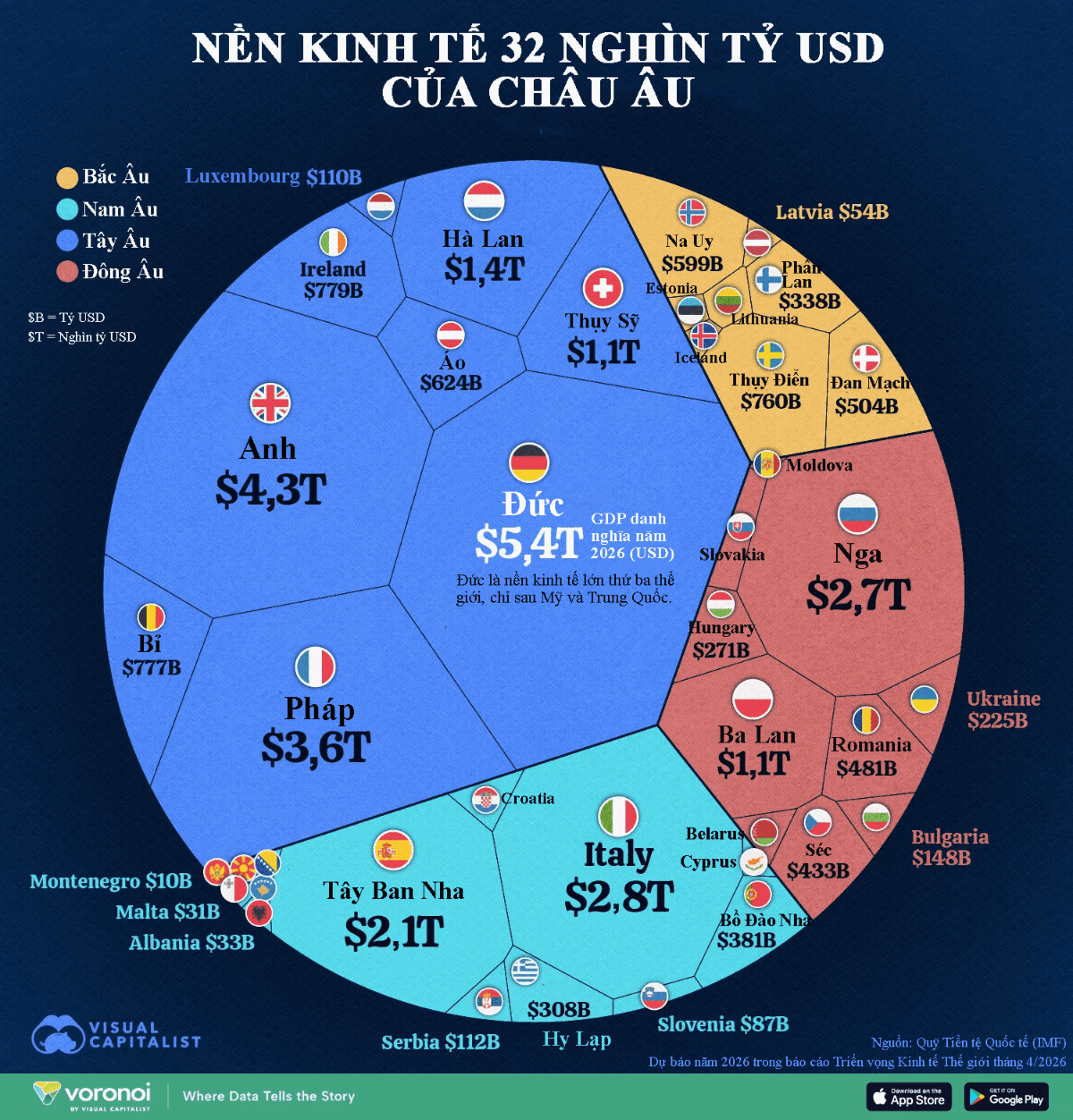
The infographic below shows the projected nominal GDP of each European economy in 2026.
The following paragraphs describe the leading economies and regional dynamics. Germany is the largest economy in Europe, followed by the United Kingdom and France. Italy, Russia, and Spain rank next, forming the group of the six biggest economies in the region.
The economic focus of Europe remains centered in the western part of the continent. The trio of Germany, the UK, and France has a combined GDP of more than $13 trillion, accounting for more than half of the region’s total economy. The strength of these three economies stems from early industrialization, followed by expansion and diversification into manufacturing, finance, and services.
From the UK, the economic transition spread to neighboring Western European countries, helping many economies in the region become major industrial centers. The three Western European countries—Belgium, the Netherlands, and Luxembourg—are forecast to have a combined GDP of more than $2.2 trillion this year.
Unlike the UK and Germany, where industry plays a crucial role, or France with strong agriculture, the large scale of Russia’s economy is mainly driven by the energy sector. Russia’s GDP is forecast to reach about $2.7 trillion in 2026.
Russia is one of the world’s largest energy producers. Commodities such as oil and natural gas account for more than half of its export earnings. Although not a member of OPEC—an organization that has a large influence on the oil market—Russia still regularly participates in discussions shaping global oil prices.
In North Europe, Norway also has an economy closely tied to oil and gas. Although the population is only about 5 million, the country’s GDP is forecast to reach nearly $600 billion this year, thanks to abundant energy resources.
While Western and Northern Europe still dominate in economic size, growth momentum in Europe is shifting southward. Economies such as Spain and Portugal are now growing faster than many developed economies in the region.
Spain is forecast to reach a GDP of about $2.1 trillion, and Portugal about $381 billion. Both economies are projected to grow around 2% in 2026, more than twice the growth rate of France and Germany. This growth is supported by a rebound in the tourism sector after the Covid-19 pandemic, higher energy autonomy, and increased public investment.