•
•
•
•
•
•
•
•
•
•
•
•
•
•
•
•
•
•
•
•
•
•
•
•
•
•
•
•
•
•
•
•
•


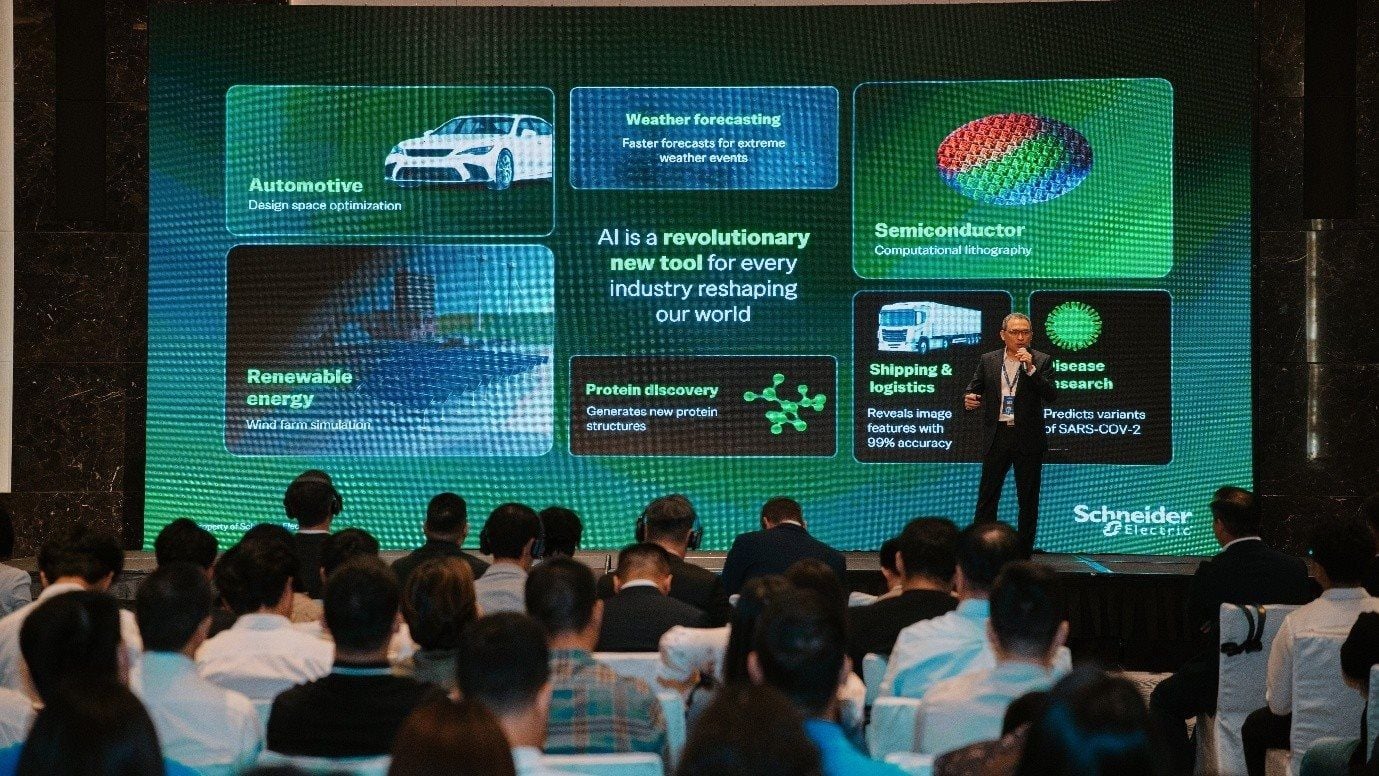
Artificial intelligence (AI) is reshaping the digital economy and creating new requirements for data center infrastructure. Experts say the shift presents an opportunity for Vietnam to design data centers in an “AI-ready” direction from the outset, while also introducing major challenges—especially in energy management and cooling—as data centers evolve into high-density “AI factories.”
As demand for data processing grows rapidly with the AI boom, data centers—described as the “heart” of the digital economy—are increasingly being built and operated with fundamentally different design, construction, and operating requirements. In earlier models, a data center typically needed hundreds of racks to reach capacities ranging from a few megawatts (MW) to tens of MW.
In “AI factories,” the same capacity can be deployed with fewer racks but much higher density—potentially five, ten, or twenty times higher. This changes operational priorities: instead of focusing primarily on storing data, data centers increasingly operate continuously at high intensity.
The transition also brings distinct technical challenges, including ultra-high power density, fluctuating load profiles, diverse system architectures, and rapid technological advancement. Together, these factors increase pressure on both the power system and cooling systems, where traditional approaches are described as reaching their limits, driving the need for liquid cooling solutions.
Schneider Electric Vietnam’s Nguyen Tuan Anh, Solution Manager for the Energy Management Segment, said that the speed of AI development can outpace technical standards. He warned that if businesses wait for standards before deploying, they could miss opportunities.
He also noted that in some cases, technology lifecycles may shorten to the point where data centers risk becoming obsolete within 1–2 years, even before commissioning.
With AI-driven growth in energy demand, the challenge is to ensure operational efficiency while pursuing sustainable development. When assessing a data center’s environmental impact, experts say it is necessary to consider the full lifecycle—from design and production through operation.
Embodied carbon is highlighted as a key factor, reflecting emissions associated with equipment manufacturing and transport. The article states that about 80% of a product’s environmental impact is determined at the design stage.
Accordingly, sustainability should be addressed in two parallel directions: reducing emissions during operation and reducing embodied carbon in equipment and materials.
Schneider Electric’s solutions described in the article apply EcoDesign criteria, including optimizing efficiency, using sustainable materials, extending product life, and increasing recyclability.
Energy efficiency is presented as a central lever for emissions reduction. For a three-phase UPS, the article states that up to 93% of lifecycle CO2 emissions come from electricity usage. It adds that improvements in high-efficiency UPS can reduce CO2 emissions by up to 34%, and by up to 79% in an optimized operation mode.
At the electrical distribution level, optimizing equipment is said to reduce losses from 11.91% to 4.91% and improve PUE from 1.5 to 1.45. When combined with smart cooling solutions, PUE can further improve to 1.29.
The article also points to IT-side optimization. By optimizing IT equipment through virtualization and load balancing, server utilization is described as increasing from 5–10% to 60–80%, while reducing the number of devices required. It further states that adjusting operating temperatures by 1°C can save 4–7% of energy across the data center.
Globally, Vietnam is described as emerging as a promising data center market. Unlike many mature markets, Vietnam can design data centers in an “AI-ready” direction from the start rather than upgrading from existing systems.
To capture this opportunity, the article says businesses should first identify specific AI application needs to design infrastructure accordingly, rather than using a one-size-fits-all approach. Selecting the right architecture early can help avoid large upgrade costs and limit obsolescence risk.
It also notes that updating operational recommendations—such as adjusting system temperatures or optimizing load distribution—can deliver significant gains without major infrastructure changes.
Schneider Electric’s approach described in the article emphasizes end-to-end solution ecosystems spanning power supply, cooling, and rack solutions, alongside software platforms such as EcoStruxure. The article states that DCIM systems help unify data and support capacity management, load balancing, and overall operations.
In this view, the integrated approach improves operational efficiency at the data center level and provides a foundation for building digital infrastructure in a coherent and sustainable way.
In the long term, the article says data centers will become more than supporting infrastructure; they will function as an operating platform for the digital economy and AI. For developing nations such as Vietnam, it frames this as both a technology trend and an opportunity to shape digital infrastructure—including data centers and energy—toward flexibility, efficiency, and readiness for future innovation cycles.

Premium gym chains are entering a “golden era” that is ending or already in decline, as rising operating costs collide with shifting consumer preferences toward more flexible, community-based ways to exercise. Long-term memberships are shrinking, margins are pressured by higher rents and facility expenses, and competition from smaller, more personalized…