•
•
•
•
•
•
•
•
•
•
•
•
•
•
•
•
•
•
•
•
•
•
•
•
•
•
•
•
•
•
•
•
•


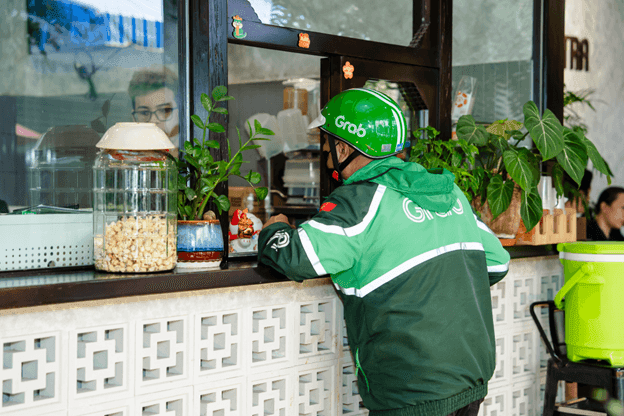
Vietnam’s food and beverage (F&B) sector is increasingly tied to how well businesses understand and optimize consumer behavior—particularly how to reach customers and sustain purchase frequency to increase the value of each order. In this context, online food delivery platforms are playing a larger role, not only connecting supply and demand but also contributing directly to revenue formation.
A key example is GrabFood. According to the Vietnam Merchant Study conducted by Cardas Research & Consulting in November 2025, GrabFood was recorded as the leading food-delivery brand in driving and generating sales for restaurant partners. Platform-based solutions are designed to influence multiple elements of consumer behavior directly.
Beyond generating orders, online food delivery platforms also support restaurants in optimizing revenue. On GrabFood, platform tools have expanded beyond basic buyer-seller connectivity, including demand stimulation for price-sensitive customers and mechanisms to encourage repeat purchasing.
For price-sensitive customers, promotions such as the “Save Every Day” collection—featuring discounts of up to 50%—help restaurants attract new demand and increase orders during off-peak hours. At the same time, maintaining return frequency is important for stable revenue. Membership packages like GrabUnlimited encourage users to order more regularly.
Restaurants can also raise average order value through features such as “Group Order.” GrabXu rewards for group leaders provide additional incentives for users to invite friends to place combined orders, increasing revenue per transaction without a corresponding rise in customer-acquisition costs.
Taken together, these solutions indicate that restaurant performance is increasingly driven by a combination of consumer-behavior factors, with technology and data becoming competitive advantages.
Another determinant of revenue quality is the ability to improve operations and make data-driven decisions. With ongoing fluctuations in material costs and labor, stronger operational practices can improve profitability and support sustained growth.
However, many restaurants face challenges in selecting promotions, timing, or adjusting menus to match real demand. Without data, these choices can become subjective and lead to ineffective discounting.
To address this, technology tools are playing a growing role in the ecosystem. On GrabFood, an AI Assistant helps restaurants make decisions based on real business data—from selecting suitable programs to managing the content displayed. Grab’s statistics show that over 42% of platform partners have used this tool in their operations.
In addition, the reporting system on the GrabMerchant app enables restaurants to monitor consumer behavior in real time, including ordering trends, peak hours, and the performance of each dish. This data supports more flexible adjustments to menus, pricing, and operational strategies.
Applying data to operations has produced measurable changes for some restaurants. Mr. Nguyen Thuan Toan, owner of Chóp Chép — Bánh tráng trộn tóp mỡ, said that GrabMerchant’s business and consumer-behavior data are updated almost in real time, simplifying monitoring and decision-making. He noted that previously he had to compile data from multiple sources, while the system now returns results almost instantly. He also highlighted that metrics such as cart-to-checkout rate and conversion rate are provided comprehensively and in an easy-to-use format.
Using these insights, he identified a bottleneck in consumer behavior: high traffic but conversion rates that were not proportionate. He said that adjusting portions toward smaller sizes with more accessible pricing improved conversion in a short period. “When you have data, you see the problem more clearly, and decisions come faster,” he emphasized.
As a result, operations can become more proactive. Waste reduction, inventory control, and cost management contribute to revenue quality—particularly as profit margins in F&B face pressure.
With consumer behavior continuing to evolve and competition in the F&B market intensifying, increasing sales volume alone may not be sufficient. Long-term competitiveness will depend on selling more efficiently—supported by a clearer understanding of customers and more optimized operations.







Premium gym chains are entering a “golden era” that is ending or already in decline, as rising operating costs collide with shifting consumer preferences toward more flexible, community-based ways to exercise. Long-term memberships are shrinking, margins are pressured by higher rents and facility expenses, and competition from smaller, more personalized…