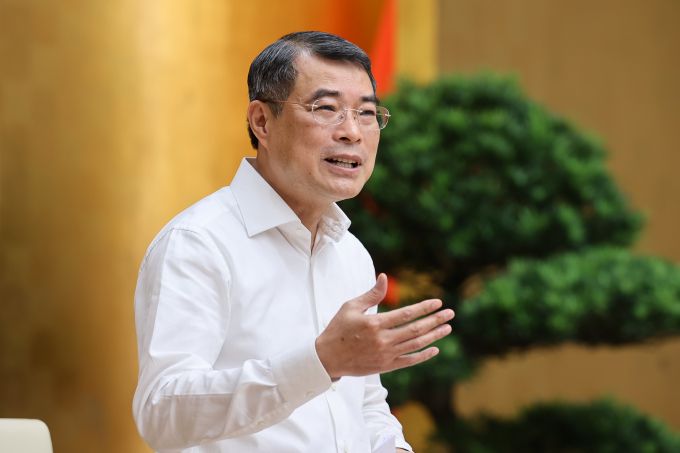
The Prime Minister said citizens have the right to hold gold as an asset, but the State does not encourage this approach because it does not create added value for the economy. Speaking at a meeting with the State Bank on April 29, Prime Minister Le Minh Hung asked the banking sector to build an effective mechanism to manage the gold market, supported by a realistic and practical roadmap.
The Prime Minister said people may hold gold as a commodity and an asset. However, he noted that the State does not encourage gold hoarding because it can shift behavior away from productive activities. “We must limit as much as possible the mindset of hoarding and speculation in gold,” he said.
He added that when macroeconomic foundations are stable and the legal framework is transparent and easy to forecast, people and businesses are expected to reduce storing gold, shift toward production and business, or deposit money in banks. This, in turn, would allow the operator to mobilize resources for growth.
Earlier, at the end of January, the Government requested the State Bank to promptly finalize the dossier and consider proposals to establish a national gold exchange.
The Prime Minister referenced the National Assembly’s growth target for the period up to 2030: 10% or higher per year, aiming to bring Vietnam into the group of 30 economies with the world’s leading GDP.
He said total capital mobilization for the economy is expected to be about 1.7–2 times the previous term, while the state budget is expected to meet only about 20–22%.
Prime Minister Le Minh Hung said global and regional conditions in the near future are expected to be complex and could rapidly affect macroeconomic management. He directed that monetary policy management (exchange rates, interest rates, and credit) should be based on maintaining macroeconomic stability, controlling inflation, and ensuring the safety of the banking system.
“Macroeconomic stability is the foundation of the house; it must be reinforced before adding floors, renovating, or building anew,” he said.
Regarding upcoming tasks, the Prime Minister requested the State Bank and relevant ministries and agencies to develop action plans for the year, quarter by quarter. He urged banks to manage credit growth flexibly, directing capital toward productive production and business sectors and prioritizing growth drivers.
The State Bank was tasked with studying and revising regulations to allow credit beyond limits for strategic, national-priority projects, while linking this to credit quality control and project evaluation. The Prime Minister also called for careful calculation, monitoring, and supervision of lending in risk-prone sectors.
He specifically mentioned studying the classification of real estate to set appropriate limits and to encourage the development of social housing and industrial zones.
The Prime Minister said the State Bank, together with the Ministry of Finance, should revise regulations to develop the capital market and the International Financial Center, with the goal of reducing the load on the banking system.
As an example, he cited Decree 153 on corporate bonds, saying it should clearly specify criteria, standards, and conditions so that all credit institutions meeting the standards can manage assets securing corporate bonds issued individually.