•
•
•
•
•
•
•
•
•
•
•
•
•
•
•
•
•
•
•
•
•
•
•
•
•
•
•
•
•
•
•
•
•


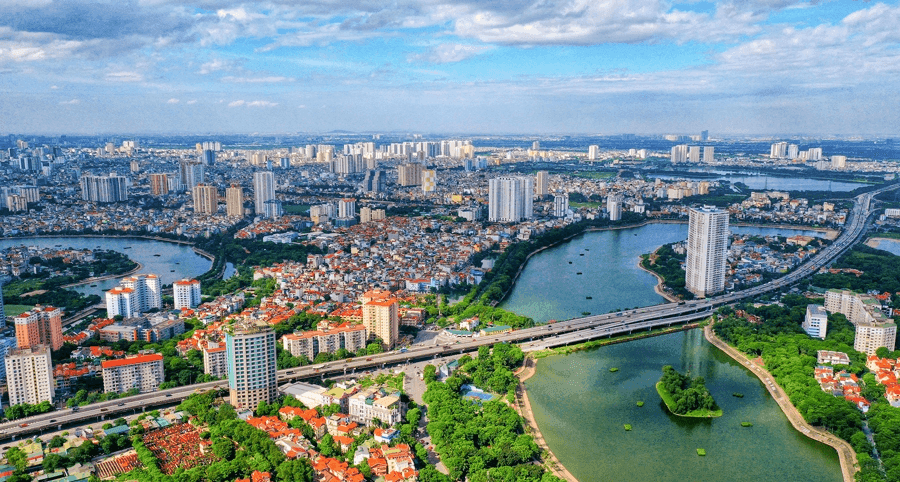
Hanoi plans to roll out several large-scale projects that will affect city planning, transport infrastructure development and the reshaping of the capital’s urban landscape. At the Second Session of the Hanoi City People’s Council (XVII term) on May 11, representatives voted to approve a resolution adjusting the investment policy for six major projects.
The approved project covers the wastewater collection system for the S3 basin across Cau Giay, Nghia Do, Yen Hoa, Phu Dien, Tu Liem and Dai Mo, including the Phu Do wastewater treatment plant. It also includes compensation, support and resettlement to clear the site.
The scope includes construction of the S3 catchment collection system with a total sewer line length of about 24.09 km, with pipe diameters ranging from D300 to D1500, along with manholes, inspection pits and five pumping stations. The Phu Do wastewater treatment plant will have a design capacity of 91,500 m3/day and is designed to operate up to a maximum daily capacity of 113,000 m3/day during heavy rainfall.
The project is expected to be completed 12 months after handover of a cleared site. Total investment is about 4,037.8 billion VND.
The National Highway 1A space-axis project will be implemented using a PPP, BT-type contract, linking Ring Road 1 to the Cau Giay junction. The project aims to build a modern road to meet future transport needs between the city center and major metropolitan areas, while connecting Hanoi with southern provinces and the coastal region.
Key parameters include a project length of about 36.3 km and a cross-section of 90 m, designed to provide 10 lanes on the main route and 6 lanes on the two belt roads. Land use is about 337.3 ha. Preliminary total investment is 161,994 billion VND, with expected completion in 2027.
The Ring Road 3 project will run through Dong Anh district, including Dong Anh, Thu Lam, Quang Minh and Phuc Thinh. It includes two components: compensation, support and resettlement for land clearance in the communes, and construction of the Ring Road 3 section through these areas.
Total preliminary investment is about 11,731 billion VND, with expected completion in Q3 2027.
The Ring Road 3.5 segment will cover the route from Phuc La–Van Phu to Phap Van–Cau Giay expressway. It includes compensation, support and resettlement for land clearance in Kien Hung and Phu Luong (Component 1.1), and in Dai Thanh, Ngoc Hoi, Thanh Tri and Nam Phu (Component 1.2).
Total preliminary investment is about 13,017 billion VND.
The Hanoi project along the Red River scenic axis (sông Hồng) will develop and complete the transport infrastructure system and promote urban space development along the river. It is aligned with sustainable development and aims to enhance the quality of the central urban area, consistent with Resolution 15-NQ/TW (May 5, 2022) and Resolution 02-NQ/TW (Mar 17, 2026) on Hanoi’s development in the new era, in line with the city’s 100-year plan.
The project will be implemented across 16 wards/communes: Hong Ha, O Diên, Thu Cat, Dong Ngac, Phu Thuong, Linh Nam, Thanh Tri, Nam Phu, Hong Van, Me Linh, Thien Loc, Vinh Thanh, Dong Anh, Bo De, Long Bien and Bat Trang. Estimated land use is about 11,418 ha.
Main components include a scenic boulevard axis, landscape parks and entertainment areas, urban development plots, water surface areas, technical infrastructure land and other land. Preliminary total investment is about 736,963 billion VND, with an implementation period from 2026 to 2038.
The approved A-class project will build Hanoi Oncology Hospital, Campus 2, in Thuong Cat ward. The project aims to upgrade Campus 2 into a regional hospital providing specialized services across the Red River Delta, offering comprehensive care from prevention and screening to advanced technical treatment, and expanding oncology networks in the region.
The hospital will have a scale of 650 beds, comprising 5–7 story blocks, two basements and complete technical infrastructure with equipment. Implementation is planned for 2026–2030, with total investment of more than 4,767 billion VND.
Premium gym chains are entering a “golden era” that is ending or already in decline, as rising operating costs collide with shifting consumer preferences toward more flexible, community-based ways to exercise. Long-term memberships are shrinking, margins are pressured by higher rents and facility expenses, and competition from smaller, more personalized…